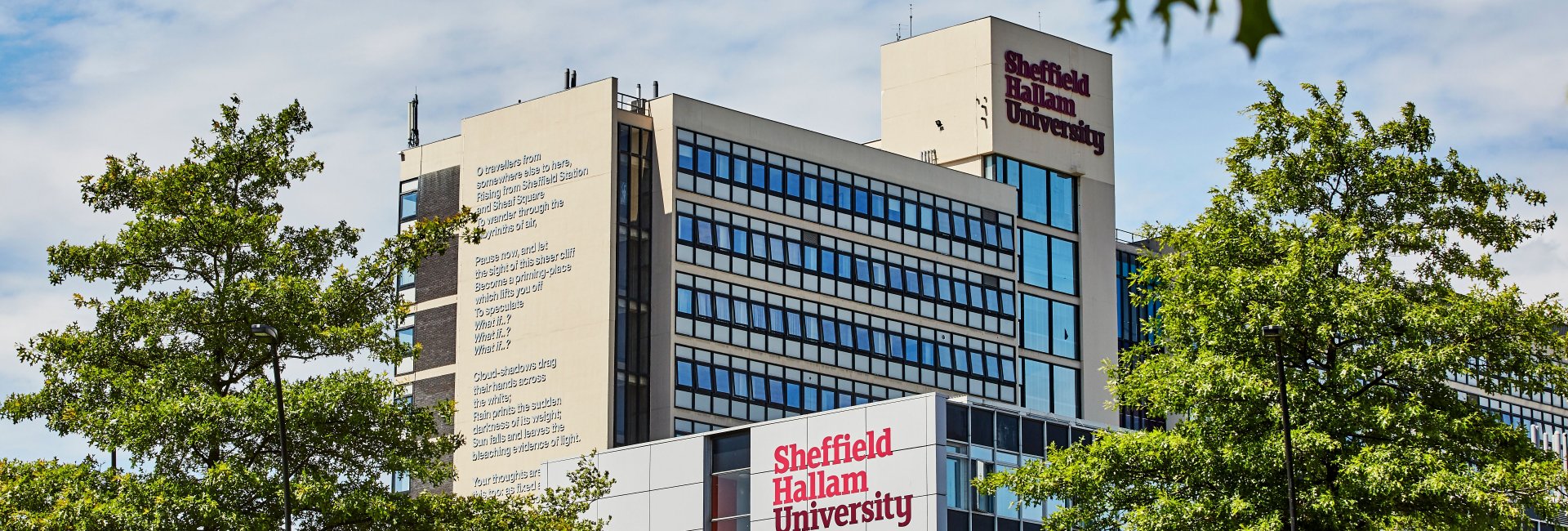
Sheffield Hallam University - undergraduate open day event
4 Jul 2026, 08:30
Sheffield

Please check the Sheffield Hallam University website for the latest information.
Home fee-paying students can access a non-repayable maintenance grant of at least £5,000 per year. You may also be eligible for additional financial support based on your circumstances. Learn more at www.shu.ac.uk/study-here/health-and-social-care/fees-and-funding
Course summary
Build on your undergraduate experience to fully qualify as a nurse.
Understand health sciences in the practice setting.
Gain the skills and values to enter highly skilled employment.
Learn to develop and deliver person-centred care.
Reflect on the evolution of the nursing role.
Home students can access a non-repayable maintenance grant of at least £5,000 per year.
This unique course is an exciting opportunity to transform the lives of individuals and communities by becoming a fully qualified mental health nurse. You’ll consider the changing nature of health, illness and recovery – as well as the relationship between healthcare professionals and service users. You’ll graduate as a reflective, competent and employable professional.
How you learn
On this course you’ll learn from enthusiastic academic staff who have a variety of clinical expertise and experience. You’ll apply your theoretical study directly to the practice of nursing on real-world healthcare challenges. You’ll develop a strong professional identity and confidence.
Nurses are an integral part of a multidisciplinary team. In some modules you’ll learn and collaborate with students from other health and social care courses. This approach will help you to deliver person-centred care – with an understanding of how other professionals contribute to the person's journey through health and social care services.
Applied learning
Work placements
You’ll apply the theory you study to practice-based learning experiences. Here you’ll develop critical and ethical approaches to your practice – preparing you to become a life-long, competent professional. The experiences you’re provided with are compulsory to achieve the course’s practice-based learning outcomes.
These experiences will help you build your skills, confidence, creativity, resilience, integrity, and curiosity. They’ll take place in different practice-based learning environments – reflecting the range of ways services are currently delivered. This might include simulated learning and virtual placements, alongside real-world experience of services delivered face to face to service users.
We’ll ensure the practice-based learning element of your course complies with the requirements of the Professional and Statutory Regulatory Body (PSRB) – which governs the mental health nursing profession. So by the end of your course, you’ll have the opportunity to show that you meet the requirements to register as a mental health nurse.
Important notice: The structure of this course is periodically reviewed and enhanced to provide the best possible learning experience for our students and ensure ongoing compliance with any professional, statutory and regulatory body standards. Module structure, content, delivery and assessment may change, but we expect the focus of the course and the learning outcomes to remain as described above. Following any changes, updated module information will be published on this page.
Year 1
Compulsory modules
Evaluating Research Methodologies | Coursework (100%)
Fundamentals of Nursing | Coursework (100%)
Nursing Sciences | Coursework (100%)
Placement Part 2
Final Year
Compulsory modules
Creating Original Practice | Coursework (100%)
Evaluating Complexity In Practice | Practical (100%)
Nursing Leadership | Coursework (100%)
Placement Part 3 | Exam (100%)
Psrb One Credit Module
Coursework | Exam | Practical
Professionally accredited courses provide industry-wide recognition of the quality of your qualification.
This is the equal consideration deadline. You can still apply after this date, but your application may not receive guaranteed consideration.

Sheffield Hallam University has participated in the Teaching Excellence Framework. These ratings were awarded in 2023, for four years.
See why these ratings were awarded
What does this TEF outcome mean?
The following entry points are available for this course:
English Language or Literature at grade C or 4 or equivalent, Maths at grade D or 4 or equivalent, and Science at grade C or 4 or equivalent. Information on equivalents if provided on the course page: https://www.shu.ac.uk/courses/nursing-and-midwifery/msc-nursing-mental-health/full-time
You need a first degree recognised in the UK at 2:2 or above.
Find out more about qualification requirements for this course.
| Test | Grade | Additional details |
|---|---|---|
| IELTS (Academic) | 7 | If English is not your first language you will need an IELTS score of 7.0 with a minimum of 7.0 in reading, listening and speaking and 6.5 in writing, or a recognised equivalent. |
Please click the following link to find out more about English language requirements for this course https://www.shu.ac.uk/Courses/Nursing-and-midwifery/MSc-Nursing-Mental-Health/Full-time/
When you apply to Hallam, we consider your personal circumstances as well as your grades, experience and personal statement. In some cases, we will make you a contextual offer. Contextual offers ensure that all applicants have a fair chance of getting a place, regardless of their background.
This section shows the range of grades that students who received offers were previously accepted on to this course with (learn more).
It is designed to support your research but does not guarantee whether you will or won't get a place.
Admissions teams consider various factors, including interviews, subject requirements, and entrance tests. Check all course entry requirements for eligibility.
We are unable to show previous accepted grades for this course. This could be because the course is new, it's a postgraduate course, there isn't enough historical data, or the provider has opted out of sharing their entry grades data for this course - learn more.
No fee information has been provided for this course
Tuition fee status depends on a number of criteria and varies according to where in the UK you will study. For further guidance on the criteria for home or overseas tuition fees, please refer to the UKCISA website.
Our postgraduate fees vary depending on course, level and mode of study. Each postgraduate course page tells you how much the tuition fees are, and what additional costs you might have to budget for during your studies. Please refer to our website for up-to-date information on costs and fees for both full-time and part-time postgraduate study options.
Scholarships, discounts and bursaries may be available to students who study this course.
Phone:(+44) 0114 225 5533
City Campus
Howard Street
Sheffield
S1 1WB
At Sheffield Hallam University