SOAS University of London
Thornhaugh Street
Russell Square
Camden
WC1H 0XG
Visit our website Visit our course page
Course contact details
Main Contact
Email:study@soas.ac.uk
Phone:020 7898 4700

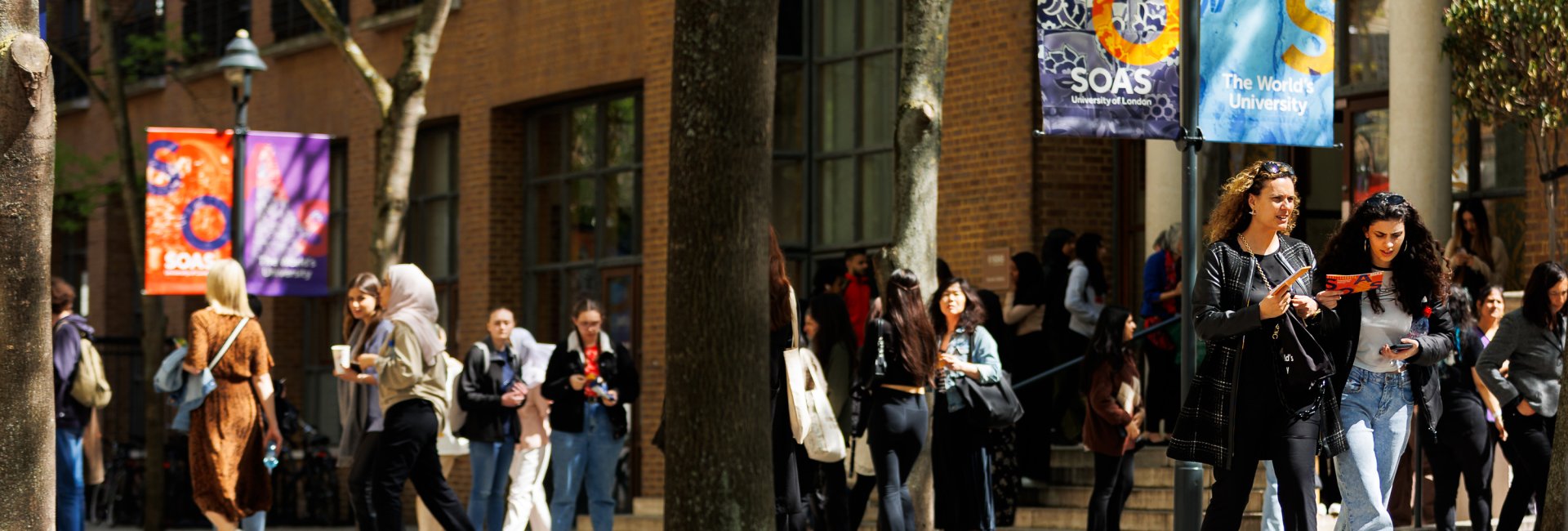
The Department has an unrivalled concentration of specialists in the laws of Asian and African countries, with additional areas of expertise in the areas of comparative law, human rights, transnational commercial law, environmental law, international law and socio-legal method. Lecturers in the Department maintain close links with professional practice and frequently have first-hand knowledge of the latest developments in business, government and international organisations.
If the course start date is before 31 December 2025 and you have already submitted an application, this course can be added. If you have not submitted an application, contact the university or college direct.
If the course start date is between 01 January and 31 July 2026 click the 'Apply' button to make an application.
This is the equal consideration deadline. You can still apply after this date, but your application may not receive guaranteed consideration.

SOAS University of London has participated in the Teaching Excellence Framework. These ratings were awarded in 2023, for four years.
See why these ratings were awarded
What does this TEF outcome mean?
The following entry points are available for this course:
Applicants without A-level Maths (or equivalent) must have a minimum of Grade B in GCSE Maths (grade 6 in the new structure)
Find out more about qualification requirements for this course.
SOAS is committed to making higher education more accessible. When considering an application, we will look at a combination of factors that may have impacted progression to university. This is contextual data and is collected from information provided on your UCAS application form.
This section shows the range of grades students (with UK A-Levels or Pearson BTEC Level 3 National Extended Diplomas) who received offers were previously accepted with (learn more). It is designed to support your research but does not guarantee whether you will or won't get a place. Admissions teams consider various factors, including interviews, subject requirements, and entrance tests. Check all course entry requirements for eligibility.
Students aged 17/18 who applied to this course were offered a place.
See how students with your grades have been accepted onto this course in the past.
Operated by the Office for Students
Employment after 15 months (Most common jobs)
Go onto work and study
The number of student respondents and response rates can be important in interpreting the data – it is important to note your experience may be different from theirs. This data will be based on the subject area rather than the specific course. Read more about this data on the Discover Uni website.
| Location | Fee | Year |
|---|---|---|
| England | £9535* | Year 1 |
| Northern Ireland | £9535* | Year 1 |
| Scotland | £9535* | Year 1 |
| Wales | £9535* | Year 1 |
| EU | £22870* | Year 1 |
| International | £22870* | Year 1 |
* This is a provisional fee and subject to change.
Tuition fee status depends on a number of criteria and varies according to where in the UK you will study. For further guidance on the criteria for home or overseas tuition fees, please refer to the UKCISA website.
Home fees are capped by the Government. The Government may raise the cap during the course of students’ studies. If the fee cap rises, SOAS may increase the fee in line with the cap.
Please contact the university for information about fees.
Thornhaugh Street
Russell Square
Camden
WC1H 0XG
Visit our website Visit our course page
Email:study@soas.ac.uk
Phone:020 7898 4700