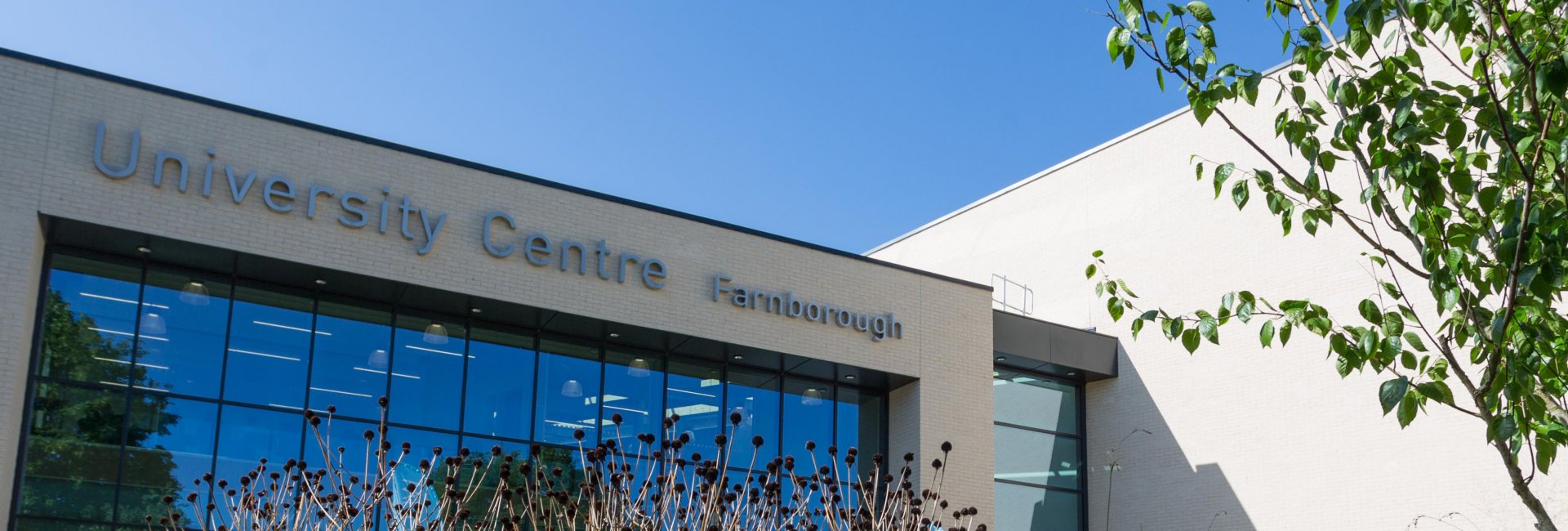
University Centre Farnborough
Boundary Road
Farnborough
GU14 6SB
Visit our website Visit our course page
Course contact details
Application Co-Ordinator
Email:admissions@farn-ct.ac.uk
Phone:01252 407028
Fax: 01252 407041

Studying psychology and sociology together will give you a fascinating insight into how humans behave, both as individuals and within groups. These two subjects complement each other and are ideal for anyone who wants to understand human behaviour using scientific reasoning and by analysing patterns of behaviour.
Our two-year fast-track degrees are awarded by the University of Surrey. They have been created so that you can:
Start your career or masters course a year sooner
Save money by paying for just two years’ tuition fees
Save money on the costs associated with being a student
Based at Farnborough College of Technology, we offer classroom-based lectures, a small campus experience and plenty of personalised support. This makes us a popular choice locally for those who want to study higher education in a down-to-earth setting – where you won’t get lost in the crowd.
Modules chosen at Level 5 and Level 6 will define the particular degree title awarded, of either BSc (Hons) Psychology with Sociology or BSc (Hons) Sociology with Psychology.
What will I study?
Psychology
For those interested in the mind and human behaviour, psychology is a fascinating subject to explore. Our degree introduces you to a number of insightful topics, designed to stimulate and challenge your way of thinking.
Biological, social, developmental and cognitive psychology are investigated to uncover the reasons for certain human behaviours. These topics are linked to real-life issues to encourage relevant thought about why people are the way they are.
You will dive into important topics such as research methods and data analysis to ensure your work is academically sound while feeling confident about your ability to create insightful work that unpicks the human mind.
Sociology
Sociology is an enlightening subject for those who like to think about social issues in the world, such as inequality, sexuality, class and mass media. Studying these fascinating topics with us will encourage you to think objectively about why people behave in certain ways. You will be considering questions such as:
What role does crime play in shaping society? How can society address inequality? Why doesn’t society do more to improve global issues?
During your degree, you will uncover the theories that seek to explain why some groups of people can flourish together, while others try to tear each other apart. You will delve into contemporary theories and discover how different cultures fit into our society.
As a sociology student, your critical-thinking skills will be honed as you begin to broaden your understanding of society and its relationship with our everyday lives.
Level 4 (Year 1: September – April)
The aim of the Level 4 programme is to give you a thorough grounding in both psychology and sociology. Typical topics studied include:
You will also benefit from a course in academic skills for degree students.
Level 5 (April in Year 1 – December in Year 2)
Level 5 of the programme offers you the opportunity to develop your skills in more depth in a range of topics. Options are chosen from the following:
Level 6 (January in Year 2 to July in Year 2)
In the final Level of study, you have an opportunity to specialise in your chosen area. For example:
In addition to taught modules, a dissertation will allow you to conduct research and investigate a topic in greater depth.
A wide range of assessment methods are used in this programme, which have been chosen to suit the subject material being taught. The range of assessment methods you will experience will give you the confidence and capability to complete an honours degree and progress further in your career. Your tutor will be on hand to provide support during the assessment process and discuss any queries you may have.
The range of assessment methods used in this programme includes:
This is the equal consideration deadline. You can still apply after this date, but your application may not receive guaranteed consideration.

University Centre Farnborough has participated in the Teaching Excellence Framework. These ratings were awarded in 2023, for four years.
See why these ratings were awarded
What does this TEF outcome mean?
The following entry points are available for this course:
This section shows the range of grades students (with UK A-Levels or Pearson BTEC Level 3 National Extended Diplomas) who received offers were previously accepted with (learn more). It is designed to support your research but does not guarantee whether you will or won't get a place. Admissions teams consider various factors, including interviews, subject requirements, and entrance tests. Check all course entry requirements for eligibility.
We are unable to show previous accepted grades for this course. This could be because the course is new, it's a postgraduate course, there isn't enough historical data, or the provider has opted out of sharing their entry grades data for this course - learn more.
| Location | Fee | Year |
|---|---|---|
| England | £9000 | Year 1 |
| Northern Ireland | £9000 | Year 1 |
| Scotland | £9000 | Year 1 |
| Wales | £9000 | Year 1 |
| Channel Islands | £9000 | Year 1 |
| EU | £9000 | Year 1 |
| International | £13000 | Year 1 |
Tuition fee status depends on a number of criteria and varies according to where in the UK you will study. For further guidance on the criteria for home or overseas tuition fees, please refer to the UKCISA website.
No additional fees or cost information has been supplied for this course, please contact the provider directly.
Boundary Road
Farnborough
GU14 6SB
Visit our website Visit our course page
Email:admissions@farn-ct.ac.uk
Phone:01252 407028
Fax: 01252 407041
At University Centre Farnborough