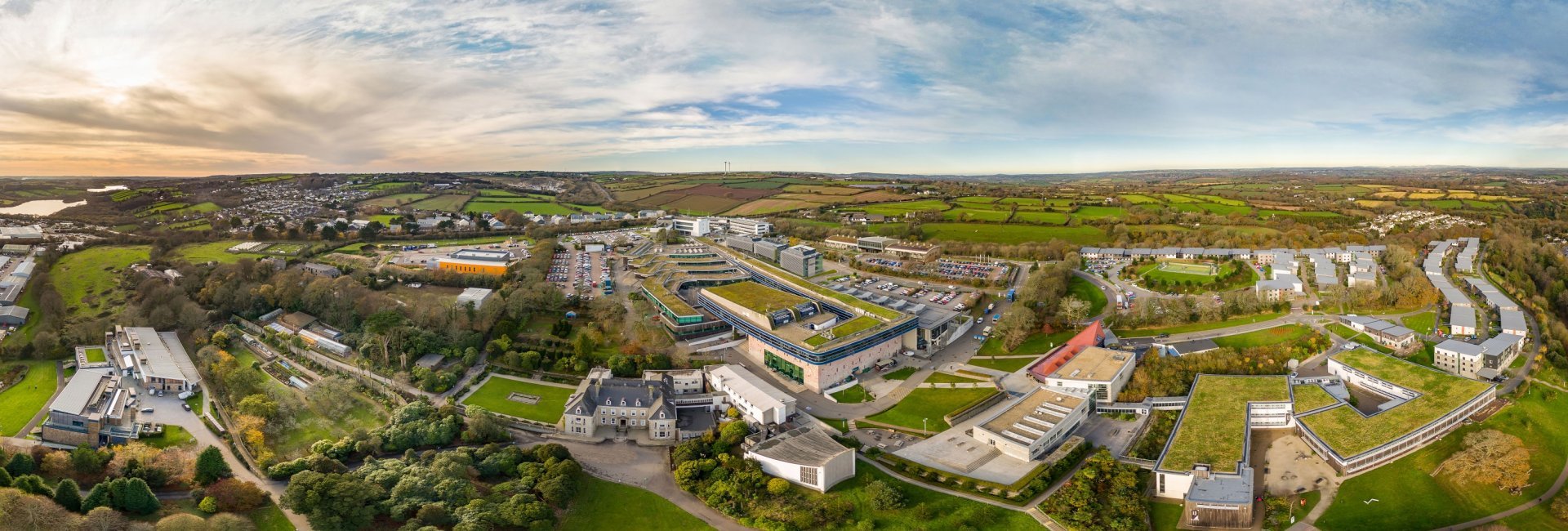
Falmouth University
Woodlane
Falmouth
TR11 4RH
Visit our website Visit our course page
Course contact details
Admissions
Email:applicantservices@falmouth.ac.uk
Phone:01326 213730

Develop your skills by entering the creative industries on an Integrated Foundation Year degree.
If you’re interested in taking on a new subject that you’ve not had the opportunity to study in depth before, or have been out of education for a while, then our Integrated Foundation Year courses might be for you. These four-year courses include an introductory year to help you build the core skills needed for specialist degree-level study.
This is a chance for you to let your imagination run wild and explore your creativity, expand your professional skills and develop enhanced subject knowledge in the domain you want to study. We’ll help nurture your expertise in problem solving, risk-taking, designing and making as you develop your abilities through five core modules.
After your foundation year, you’ll have a deeper knowledge of your subject, a clear understanding of your strengths, a developed practical and technical skill set and the confidence to excel in your chosen degree subject when you join other students for the rest of your course.
Influence the shape of fashion as you take on the world of fashion styling. In our vibrant studios, future art directors and stylists are busy curating imaginative fashion stories for catwalks, editorial shoots, window displays, fashion films and new immersive spaces. By joining them on this course, you’ll collaborate with fellow creative thinkers and makers from across the University to produce real work for real clients under the expert guidance of passionate lecturers. From garment fitting and editorial art direction to producing advertising campaigns, you’ll develop the skills you need to break into the global fashion industry.
You will:
Develop technical, design thinking and production skills in your chosen specialism.
Learn teamwork, leadership and project management skills through a variety of learning environments.
Develop critical thinking and creative problem-solving skills through the development of unique and innovative projects.
Complete your chosen degree over a four-year period.
Develop confidence as a future fashion visionary, committed to harnessing the power of storytelling through multimedia productions
Gain the key practical skills necessary to operate at a professional level in the global styling industry
Engage in debate around the practical and theoretical context of fashion communication
Work on industry-led briefs as part of a collaborative team of supportive, risk-taking global practitioners, in preparation for your future creative career
Create a powerful professional fashion styling portfolio to launch into industry
Have access to enviable facilities, including industrial sewing machines, specialist construction equipment, a dye lab and a contemporary dress and textile archive.
Throughout this degree, you'll learn how to construct powerful fashion stories in real-life visual merchandising environments and fashion shows, as well as immersive 3D digital spaces. You'll become proficient in styling and directing for magazine editorials and advertising campaigns, master garment fitting and construction for runway and celebrity client dressing, and consider the environmental and ethical considerations of the industry.
Foundation Year:
In your foundation year, you'll study five core modules: three short modules in the first study block and two in the second (one short, one long). These are all designed to help you explore the foundational elements of both creative practice and your chosen specialism. You'll gain relevant technical skills, learn to experiment and take risks, develop an understanding of professional practice, have opportunities to work across disciplines and collaborate with other students on live project briefs.
After your foundation year, you'll have a deeper knowledge of your subject, a clear understanding of your strengths, a developed practical and technical skillset and the confidence to excel in your chosen degree subject when you join other students for the rest of your course.
Modules:
Explore
Technique
Apply
Industry
Launch
Year One:
In year one of this degree, you'll take your first steps to becoming a progressive, conscious, professional and courageous practitioner within fashion styling and art direction. You'll start to develop your technical skills, gain an understanding of the varied specialisms within the disciplines and explore storytelling, sustainability, identity and body politics..
Modules:
Fashion Foundations
Fashion & Belonging
Thinking & Storytelling
Body Politics
Earth Action
Year Two:
In your second year of the Fashion Styling & Art Direction degree, you'll begin to acquire a tenacious, resilient and visionary set of skills for professional practice. You'll take on real-world briefs guided by icons of industry and embrace new technologies and advanced digital processes.
Modules:
The Fashion Space
The Fashion Show
The Fashion Client
Collaboration
Year Three:
The final year of the degree consolidates your ground-breaking creative critical thinking, advanced technical skills and professional practice know-how. Modules will give you the leverage to launch yourself into industry as a visionary fashion stylist and art director.
Modules:
The Fashion Consultant
Breaking Ground
Fashion Visionary
Future Skills
As part of our process of continuous improvement, we routinely review course content to ensure that all our students benefit from a high-quality and rewarding academic experience. As such, there may be some changes made to your course which are not immediately reflected in the content displayed on our website. Any students affected will be informed of any changes made directly.
Foundation Year assessments are 100% coursework based.
Assessment will take place at the end of each module, and you'll get feedback and evaluation throughout the year. You'll be assessed through visual, verbal and written assignments, including your portfolio and a reflective journal. In your foundation year all assessments are pass/fail to encourage students to take risks and engage with the feedback provided.
Progressing in your specialism
Students studying on courses with an Integrated Foundation Year must successfully complete and pass all foundation modules before they can progress to the next stage of their course.
Your specialism
You'll be assessed through coursework and practical submissions.
Assessment methods
Assessments can take many forms, including:
Practical projects
Presentations
Portfolios
Critical writing
This is the equal consideration deadline. You can still apply after this date, but your application may not receive guaranteed consideration.

Falmouth University has participated in the Teaching Excellence Framework. These ratings were awarded in 2023, for four years.
See why these ratings were awarded
What does this TEF outcome mean?
The following entry points are available for this course:
If English is not your first language, you will need to demonstrate English language skills that are sufficiently developed for successful completion of your studies. We accept a range of recognised English language qualifications that are equivalent to the International English Language Testing System (IELTS) Academic minimum score of 6.0 overall, with a minimum of 5.5 in Reading, Writing, Speaking and Listening. Through the award of international scholarships, we aim to support academic enrichment by encouraging diversity and excellence at Falmouth. For details of our international scholarships, and how to apply for them, please visit our website at www.falmouth.ac.uk.
If you are able to demonstrate relevant, current, equivalent experience instead of formal qualifications, we encourage you to apply. Please contact our Applicant Services team before applying, for advice regarding your individual experience and eligibility.
If you are an international applicant and require a Student visa to study in the UK, you must have a recognised English language test approved and vouched for by the University at the appropriate level. Our Applicant Services team can help you with any general questions you may have about study visas or suitable language tests. For more specific advice, we recommend you also consult UKCISA http://www.ukcisa.org.uk/
This section shows the range of grades students (with UK A-Levels or Pearson BTEC Level 3 National Extended Diplomas) who received offers were previously accepted with (learn more). It is designed to support your research but does not guarantee whether you will or won't get a place. Admissions teams consider various factors, including interviews, subject requirements, and entrance tests. Check all course entry requirements for eligibility.
We are unable to show previous accepted grades for this course. This could be because the course is new, it's a postgraduate course, there isn't enough historical data, or the provider has opted out of sharing their entry grades data for this course - learn more.
No fee information has been provided for this course
Tuition fee status depends on a number of criteria and varies according to where in the UK you will study. For further guidance on the criteria for home or overseas tuition fees, please refer to the UKCISA website.
No additional fees or cost information has been supplied for this course, please contact the provider directly.
Woodlane
Falmouth
TR11 4RH
Visit our website Visit our course page
Email:applicantservices@falmouth.ac.uk
Phone:01326 213730
At Falmouth University