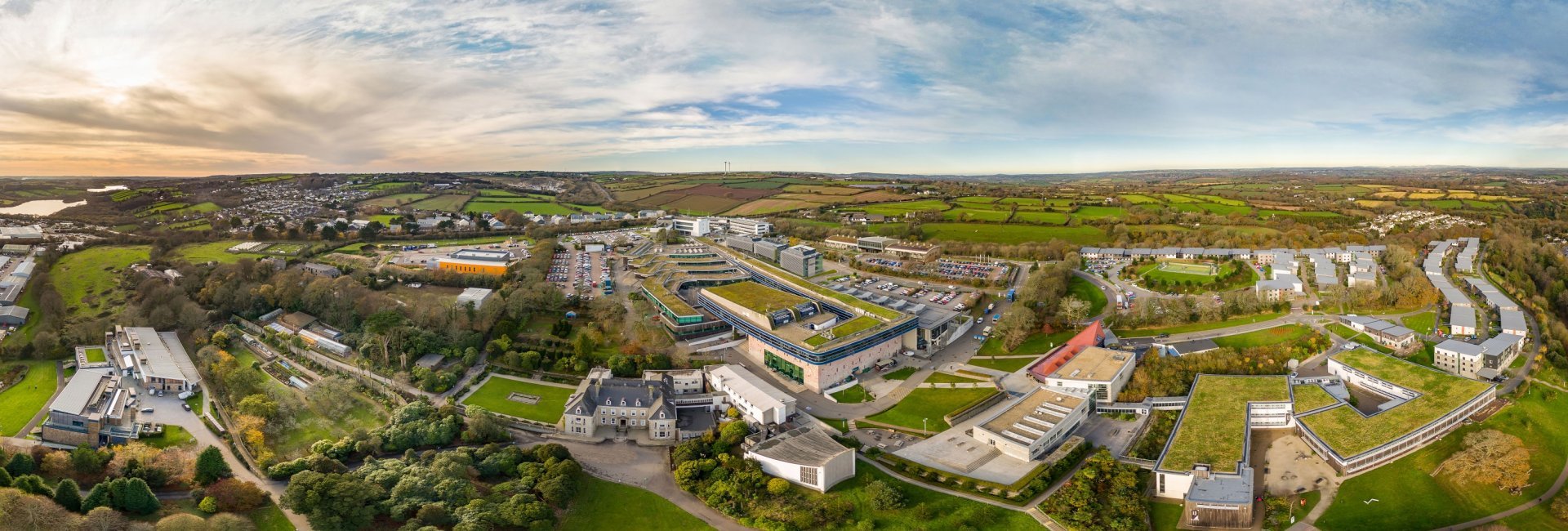
Falmouth University
Woodlane
Falmouth
TR11 4RH
Visit our website Visit our course page
Course contact details
Admissions
Email:applicantservices@falmouth.ac.uk
Phone:01326 213730

Become an industry-ready game artist.
On this Game Art degree, you'll master the creative and technical skills to succeed as a digital artist. Using industry-standard tools including Adobe Photoshop, Maya, ZBrush, Substance Painter and Unreal, you'll develop expertise in character, concept and environment art, 3D modelling, UV mapping, baking, composition and shading.
In the second and third year of the Game Art degree, you’ll showcase your skills as you contribute to a major game development project. You’ll graduate from the course as a confident, industry-ready game artist, equipped to join one of the fastest growing sectors of the games industry.
Why study this course at Falmouth?
We’re experts in our field – Achieving a top ranked status for Concept Art and Game Design and Development (Rookies Global Rankings 2024)
You’ll study in one of the largest and best-equipped dedicated game-making spaces of any UK university, with access to industry standard hardware and software
Our industry-focused approach means you’ll team up with creative talent to produce real games while you study, and you’ll keep the Intellectual Property (IP)
You’ll learn from professional artists, game art practitioners and developers who have worked on titles such as Grand Theft Auto, World of Warcraft, Project Gotham Racing and the Total War series
You’ll have opportunities to network with industry giants and games fans through our epic guest speaker programme and annual Games Academy Expo
Our graduates have worked at studios including Build A Rocket Boy, Fireproof, Free Radical Design, Frontier Developments, Splash Damage and 10:10 Games
You'll study the principles of game art in the context of traditional art practice, combining subjects like life drawing and composition with digital 2D and 3D modelling. We'll also build your expertise in concept, character and environment art, agile project management, and game development pipelines and processes.
Focused on industry practices, much of your learning will come from working in game development teams – devising and developing real games using real-world practices.
Year one
During the first year of your Game Art degree, you'll build the basic skills demanded by the industry, and learn about game artists' major roles and techniques. Working with industry-standard software, methods and processes, you'll develop your drawing skills, better understand anatomy, and apply these abilities to 3D modelling and related elements.
You'll learn traditional and digital art skills – both 2D and 3D – alongside concept, environment and character art to build digital worlds and characters.
Modules:
Concept Art 1
Character Art 1
Environment Art 1
Concept Art 2
Character Art 2
Environment Art 2
Year two
You'll grow your confidence in game art and your skills in using professional digital tools. You'll provide art assets to a collaborative project with game students of different disciplines, giving you valuable experience in an industry-style development pipeline.
An additional specialist practice project lets you hone your skills in a particular area of game art and create high quality work for your portfolio.
Modules
World Building: Pre-production
Developing Concept Art Vocabularies
Developing Character Art Vocabularies
Developing Environment Art Vocabularies
Art Research Practice
World Building: Production
Portfolio Development
Year three
With specialism, independence and professional practice at the front and centre of this year, you'll join a multi-skilled team on a game development project. Working in a studio, you'll contribute art assets using industry-standard methods and pipelines.
You'll also create distinctive and polished work for your growing portfolio by working on specialist game art. We'll then help you commercialise this work and prepare you for the transition to professional life.
Modules
Future Skills
Professional Portfolio
Technical Art Practice
Future of Games
Major Collaboration
As part of our process of continuous improvement, we routinely review course content to ensure that all our students benefit from a high-quality and rewarding academic experience. As such, there may be some changes made to your course which are not immediately reflected in the content displayed on our website. Any students affected will be informed of any changes made directly.
100% of your assessment will be coursework.
Assessment methods
Continuous assessment with no formal examinations
Visual, verbal and written assignments
A portfolio of personal and group project work is developed over the course of the degree to boost your employability
This is the equal consideration deadline. You can still apply after this date, but your application may not receive guaranteed consideration.

Falmouth University has participated in the Teaching Excellence Framework. These ratings were awarded in 2023, for four years.
See why these ratings were awarded
What does this TEF outcome mean?
The following entry points are available for this course:
If English is not your first language, you will need to demonstrate English language skills that are sufficiently developed for successful completion of your studies. We accept a range of recognised English language qualifications that are equivalent to the International English Language Testing System (IELTS) Academic minimum score of 6.0 overall, with a minimum of 5.5 in Reading, Writing, Speaking and Listening. Through the award of international scholarships, we aim to support academic enrichment by encouraging diversity and excellence at Falmouth. For details of our international scholarships, and how to apply for them, please visit our website at www.falmouth.ac.uk
If you are able to demonstrate relevant, current, equivalent experience instead of formal qualifications, we encourage you to apply. Please contact our Applicant Services team before applying, for advice regarding your individual experience and eligibility.
If you are an international applicant and require a Student visa to study in the UK, you must have a recognised English language test approved and vouched for by the University at the appropriate level. Our Applicant Services team can help you with any general questions you may have about study visas or suitable language tests. For more specific advice, we recommend you also consult UKCISA http://www.ukcisa.org.uk/
| Test | Grade | Additional details |
|---|---|---|
| IELTS (Academic) | 6 | An (IELTS) Academic minimum score of 6.0 overall is required, with a minimum of 5.5 in Reading, Writing, Speaking and Listening |
| Trinity ISE | A minimum of Trinity ISE II with Distinction in all four components is required. | |
| Cambridge English Advanced | Level B2 | A minimum on the Cambridge English scale of 169 is required |
| PTE Academic | 55 | A minimum score in the Pearson Academic Test of English of 55 overall is required, with a minimum of 51 in all four components. |
English language support at Falmouth https://www.falmouth.ac.uk/international/english-language-support
This section shows the range of grades students (with UK A-Levels or Pearson BTEC Level 3 National Extended Diplomas) who received offers were previously accepted with (learn more). It is designed to support your research but does not guarantee whether you will or won't get a place. Admissions teams consider various factors, including interviews, subject requirements, and entrance tests. Check all course entry requirements for eligibility.
We are unable to show previous accepted grades for this course. This could be because the course is new, it's a postgraduate course, there isn't enough historical data, or the provider has opted out of sharing their entry grades data for this course - learn more.
No fee information has been provided for this course
Tuition fee status depends on a number of criteria and varies according to where in the UK you will study. For further guidance on the criteria for home or overseas tuition fees, please refer to the UKCISA website.
No additional fees or cost information has been supplied for this course, please contact the provider directly.
Woodlane
Falmouth
TR11 4RH
Visit our website Visit our course page
Email:applicantservices@falmouth.ac.uk
Phone:01326 213730
At Falmouth University