
Sheffield Hallam University - applicant open day event
28 Feb 2026, 09:30
Sheffield
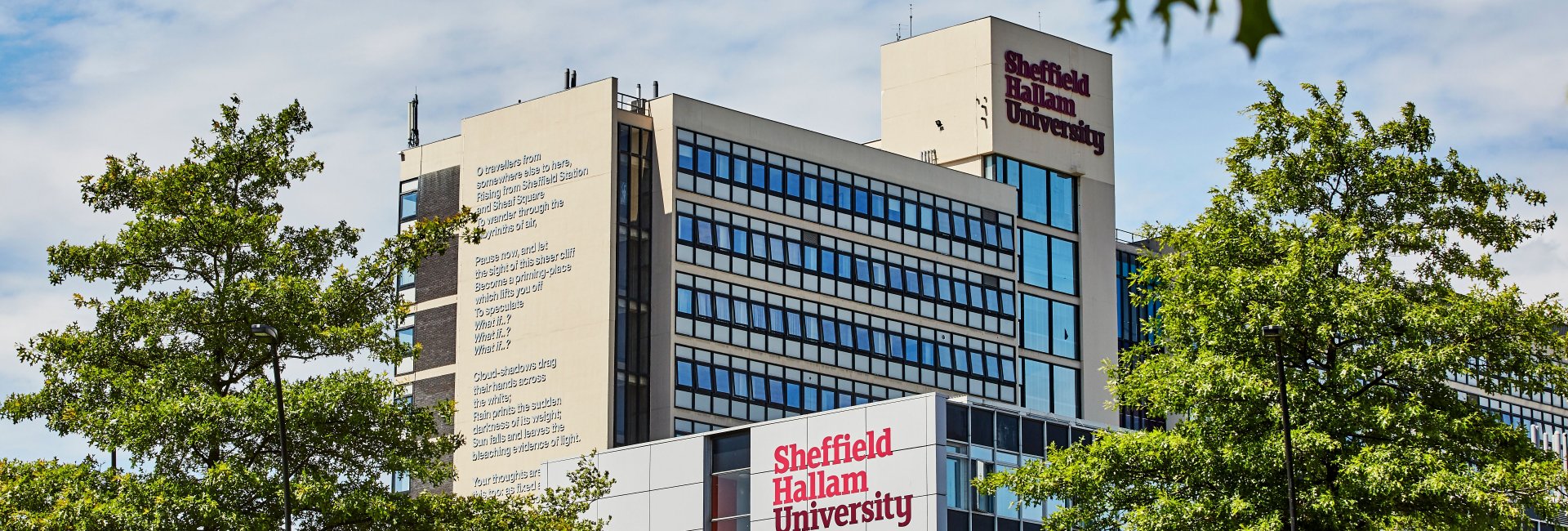
Please check the Sheffield Hallam University website for the latest information
Course summary
Research, plan and produce journalistic content in audio, video and written formats.
Use the latest recording and editing technologies to create online content.
Develop and manage successful PR campaigns and events.
Gain insights through connections like This Morning, Rise at Seven and Disney.
Debate the relationship between journalism, PR, media and wider society.
Learn from industry experts in top class facilities, gaining a wide range of knowledge to help you succeed in these dynamic professions. You’ll examine key theories and issues relating to journalism and PR while working with communications professionals, journalists and influencers. You’ll learn essential practical skills relevant to these industries, the media in general and the workplace beyond.
How you learn
At Sheffield Hallam, all our courses are designed to engage you with the world and challenge you to think in new ways. You’ll get to collaborate with others, and you’ll be taught in a supportive environment where you can thrive.
On this course your studies are led by a team that includes award-winning journalism, PR and media practitioners, alongside internationally recognised theorists with experience across a range of industries. These include TV, radio, newspapers, magazines and digital expertise across a range of sectors, from health and charity to finance and politics.
We’ll draw on the creative industries in Sheffield as well as broader national and international connections. Throughout the course you’ll respond to live PR briefs and/or engage with real-life journalistic stories. The course is outward looking and engages with real-life scenarios, with a special focus on underrepresented communities.
We’ll introduce key topics and concepts through a mix of tutor-directed learning and discussions, as well as student-led exercises and tasks. You’ll engage in collaborative activities both in person and online, supported by digitally enhanced teaching.
You learn through:
lectures
workshops
seminars
essays
practical work
case studies
reports
group work
research projects
presentations and pitches
portfolios
Key themes
Your course begins with the basics of journalism and PR. You’ll learn how to manage a PR campaign and how to write and broadcast as a journalist, gaining vital recording and editing skills along the way.
During your second year, you’ll build on these skills with a firm grounding in the legal and regulatory requirements of industry, while also improving your research and investigation skills. The ‘content creation’ module gives you the cutting-edge industry-based skills to create PR or journalistic-based audio, video and written material.
Your final year is about preparing you for the workplace, whether that’s a traditional office, freelancing or being your own boss. You’ll also create a final piece of detailed work in your research project, with the support of a personal tutor. Previous students have researched the health impacts of social media, the representation of women’s cricket in the media, and investigations into whether young people are still interested in politics and voting.
Applied learning
Work Placement
You’ll be encouraged and supported to undertake a full-time work placement between your second and third year of the course. This valuable experience can have a transformative impact on your personal and professional development, which you can enhance further by completing Sheffield Hallam’s Applied Professional Diploma.
Important notice: The structure of this course is periodically reviewed and enhanced to provide the best possible learning experience for our students and ensure ongoing compliance with any professional, statutory and regulatory body standards. Module structure, content, delivery and assessment may change, but we expect the focus of the course and the learning outcomes to remain as described above. Following any changes, updated module information will be published on this page.
You will be able to complete a placement year as part of this course. See the modules table below for further information.
Year 1
Compulsory modules
Broadcast Journalism
Campaign Management
News Writing
Pr Essentials
Year 2
Compulsory modules
Content Creation
Crisis And Reputation Management
Media Law, Regulation And Government
Research And Investigation Skills
Elective modules
Study Abroad - Creative Industries
Year 3
Optional modules
Placement Year
Final year
Compulsory modules
Entrepreneurship And Freelancing
Journalism, Pr With Media Research Project
Long Form Journalism
Workplace Practice And Ethics
Coursework
If the course start date is before 31 December 2025 and you have already submitted an application, this course can be added. If you have not submitted an application, contact the university or college direct.
If the course start date is between 01 January and 31 July 2026 click the 'Apply' button to make an application.
This is the equal consideration deadline. You can still apply after this date, but your application may not receive guaranteed consideration.

Sheffield Hallam University has participated in the Teaching Excellence Framework. These ratings were awarded in 2023, for four years.
See why these ratings were awarded
What does this TEF outcome mean?
The following entry points are available for this course:
This course may be available at alternative locations, please check if other course options are available.
Course optionsFind out more about qualification requirements for this course.
| Test | Grade | Additional details |
|---|---|---|
| IELTS (Academic) | 6 | If English is not your first language you must have an IELTS score of 6.0 with a minimum of 5.5 in all skills or equivalent. |
Please click the following link to find out more about English language requirements for this course https://www.shu.ac.uk/Courses/Media-PR-and-journalism/BA-Honours-Journalism-Public-Relations-with-Media/Full-time/
When you apply to Hallam, we consider your personal circumstances as well as your grades, experience and personal statement. In some cases, we will make you a contextual offer. Contextual offers ensure that all applicants have a fair chance of getting a place, regardless of their background.
This section shows the range of grades students (with UK A-Levels or Pearson BTEC Level 3 National Extended Diplomas) who received offers were previously accepted with (learn more). It is designed to support your research but does not guarantee whether you will or won't get a place. Admissions teams consider various factors, including interviews, subject requirements, and entrance tests. Check all course entry requirements for eligibility.
Students aged 17/18 who applied to this course were offered a place.
See how students with your grades have been accepted onto this course in the past.
| Location | Fee | Year |
|---|---|---|
| England | £9535 | Year 1 |
| Northern Ireland | £9535 | Year 1 |
| Scotland | £9535 | Year 1 |
| Wales | £9535 | Year 1 |
| Channel Islands | £9535 | Year 1 |
| Republic of Ireland | £9535 | Year 1 |
| EU | £17155 | Year 1 |
| International | £17155 | Year 1 |
Tuition fee status depends on a number of criteria and varies according to where in the UK you will study. For further guidance on the criteria for home or overseas tuition fees, please refer to the UKCISA website.
Our tuition fee for UK students on full-time undergraduate degree courses in 2025/26 is £9,535 per year (capped at a maximum of 20% of this during your placement year). These fees are regulated by the UK government and therefore subject to change in future years.
If you are studying an undergraduate course, postgraduate pre-registration course or postgraduate research course over more than one academic year then your tuition fees may increase in subsequent years in line with Government regulations or UK Research and Innovation (UKRI) published fees. More information can be found at https://www.shu.ac.uk/study-here/terms-and-conditions-and-student-regulations under student fees regulations.
Our tuition fee for International/EU students starting full-time study in 2025/26 is £17,155 per year (capped at a maximum of 20% of this during your placement year).
Please refer to our website for up-to-date information on costs and fees:
https://www.shu.ac.uk/study-here/undergraduate/fees
Scholarships, discounts and bursaries may be available to students who study this course.
City Campus
Howard Street
Sheffield
S1 1WB
Visit our website Visit our course page
Phone:(+44) 0114 225 5533