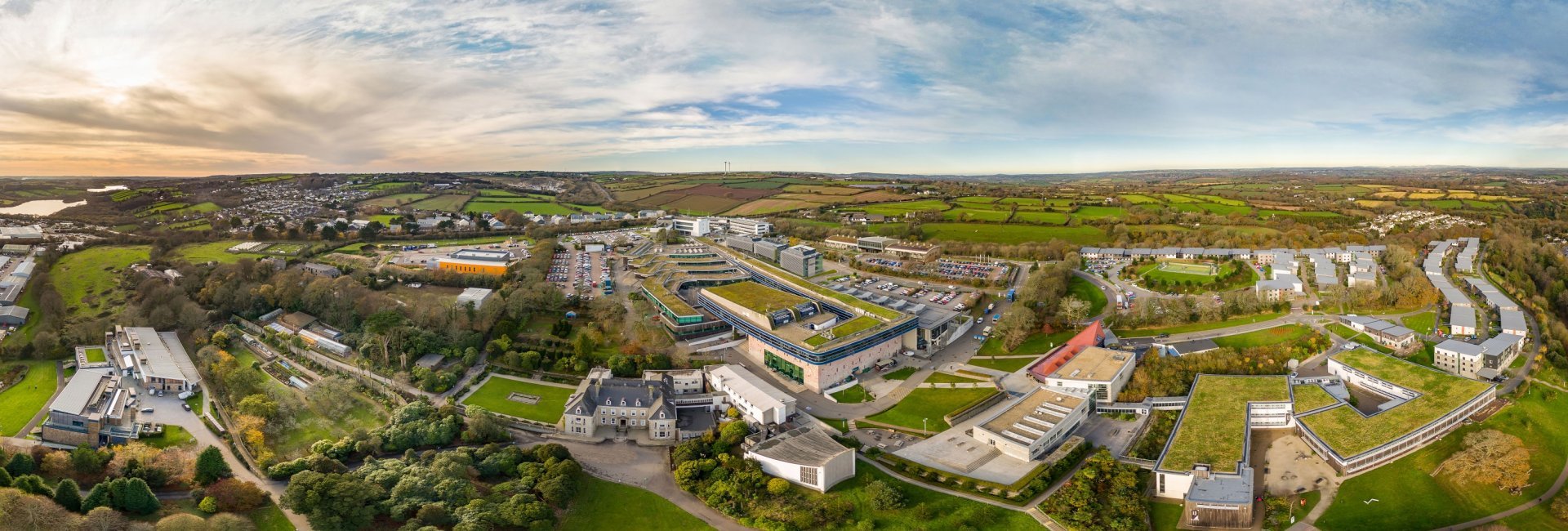
Falmouth University
Woodlane
Falmouth
TR11 4RH
Visit our website Visit our course page
Course contact details
Admissions
Email:applicantservices@falmouth.ac.uk
Phone:01326 213730

Join a celebration of literature and writing and experiment in all forms.
This course is a celebration of literature, where you’ll develop the ability and confidence to write for specific genres, forms and audiences. You’ll read critically and widely, analyse and create in equal measure and build the technical and imaginative thinking skills valued by employers across any number of careers. Follow a literary journey that culminates in the most vivid contemporary writing before specialising in chosen areas such as poetry, drama, fiction or non-fiction – making your own contribution through University publications or projects with our industry partners.
You will:
Learn, debate and create under the guidance of academics, industry professionals and diverse guest speakers
Design and run a collaborative project such as a sitcom, podcast or illustrated anthology, working with business, education and community partners
Attend our guest lecture series, where you’ll build relationships and contacts within all facets of the literary world
Participate in literary events, such as Falmouth Book Festival and the North Cornwall Book Festival
Take inspiration from The Lighthouse – the workspace at the heart of our community
Gain industry-ready skills by writing, editing or promoting FalWriting, our student-led online magazine
Use our state-of-the-art Soundhouse and edit suites to record audience ready productions
This english and creative writing degree seeks to capture and analyse the most vital contemporary writing (across all formats and media) within the context of a rich literary, historical and theoretical past, developing your critical and creative eye.
Learn, debate and create under the guidance of leading academics, industry professionals and diverse guest speakers, whether in The Lighthouse, our state-of-the-art campus facilities, or any of our immediate and beautiful natural spaces.
By making your own choices, you'll build skills in areas like poetry, fiction, non-fiction, screenwriting, and digital games. Be the voice of your community by writing, editing or promoting Falwriting – our student-led online magazine – gaining vital (and CV-boosting), industry-ready skills.
Live collaborative projects will allow you to make priceless personal connections. Work directly with industry, educational, and community partners, creating a clear path to your desired industry or area of further academic study.
Year one:
During the first year of BA English & Creative Writing, you'll explore the basics of creative writing, english literature and publishing – all key areas for aspiring writers to be familiar with. While providing an introduction to the subject, this course also breaks the mould of most English degrees with modules like Exploding the Canon: Writing Then and Now and Breaking the Rules: Remix and Writing Back. Each week, you'll learn through a mix of lectures, workshops and tutorials.
Modules
Writing: Craft & Contexts
Exploding the Canon: Writing Then & Now
Publishing Cultures
Breaking the Rules: Remix and Writing Back
Literatures of Revolution
Publishing Studio: Technologizing the Word
Year two:
Your second year is all about narrowing down to your specialisation, building on two core modules addressing contemporary literature and a collaborative project. You’ll then be able to branch out into different creative writing types to hone your skills in your optional modules.
Your core modules will explore key issues such as race, gender, sexuality and identity politics in contemporary literature, alongside delivering a dynamic collaborative project with your peers.
The optional modules in year two will give you the opportunity to grow your writing abilities in different specialisms including: writing for games, screenwriting, poetry, creative non-fiction and writing for radio or theatre. You’ll then hone your creative, analytical, critiquing and writing skills and learn how to research, plan, pitch and build a professional profile.
Modules
Society & the Self
Collaborative Project
Optional modules
Satire and Scandal
Poetry
Screenwriting
Magic and the Impossible
Fiction
Creative Non-Fiction
Games
Radio & Theatre
Year three:
Harnessing the knowledge and skills you’ve honed throughout your degree, in your final year you’ll work on a dissertation and portfolio, allowing you to create a critical and sustained piece of work. For these projects, you’ll have weekly tutorials with your supervisor, giving you a close focus on your own writing.
You’ll examine contemporary literature, focusing only on prize winners, bestsellers and controversial content published in the last five years. You’ll also choose from optional modules during the year, and you’ll study a module in experimentation and adaptation.
Modules
Dissertation and Portfolio
Experiment and Adaptation
Writing Now: Prize Winners, Bestsellers & Controversial Content
Optional modules
We Have Never Been Human
Crime and Dark Fiction
Children and Young Adult
Innovations
As part of our process of continuous improvement, we routinely review course content to ensure that all our students benefit from a high-quality and rewarding academic experience. As such, there may be some changes made to your course which are not immediately reflected in the content displayed on our website. Any students affected will be informed of any changes made directly.
100% of your assessment will be coursework.
Assessment methods:
Coursework and e-learning exercises
Live creative industry briefs
Final year creative writing portfolio
This is the equal consideration deadline. You can still apply after this date, but your application may not receive guaranteed consideration.

Falmouth University has participated in the Teaching Excellence Framework. These ratings were awarded in 2023, for four years.
See why these ratings were awarded
What does this TEF outcome mean?
The following entry points are available for this course:
If English is not your first language, you will need to demonstrate English language skills that are sufficiently developed for successful completion of your studies. We accept a range of recognised English language qualifications that are equivalent to the International English Language Testing System (IELTS) Academic minimum score of 6.0 overall, with a minimum of 5.5 in Reading, Writing, Speaking and Listening. Through the award of international scholarships, we aim to support academic enrichment by encouraging diversity and excellence at Falmouth. For details of our international scholarships, and how to apply for them, please visit our website at www.falmouth.ac.uk
If you are able to demonstrate relevant, current, equivalent experience instead of formal qualifications, we encourage you to apply. Please contact our Applicant Services team before applying, for advice regarding your individual experience and eligibility.
If you are an international applicant and require a Student visa to study in the UK, you must have a recognised English language test approved and vouched for by the University at the appropriate level. Our Applicant Services team can help you with any general questions you may have about study visas or suitable language tests. For more specific advice, we recommend you also consult UKCISA http://www.ukcisa.org.uk/
| Test | Grade | Additional details |
|---|---|---|
| IELTS (Academic) | 6 | An (IELTS) Academic minimum score of 6.0 overall is required, with a minimum of 5.5 in Reading, Writing, Speaking and Listening |
| Trinity ISE | A minimum of Trinity ISE II with Distinction in all four components is required. | |
| Cambridge English Advanced | Level B2 | A minimum on the Cambridge English scale of 169 is required |
| PTE Academic | 55 | A minimum score in the Pearson Academic Test of English of 55 overall is required, with a minimum of 51 in all four components. |
English language support at Falmouth https://www.falmouth.ac.uk/international/english-language-support
This section shows the range of grades students (with UK A-Levels or Pearson BTEC Level 3 National Extended Diplomas) who received offers were previously accepted with (learn more). It is designed to support your research but does not guarantee whether you will or won't get a place. Admissions teams consider various factors, including interviews, subject requirements, and entrance tests. Check all course entry requirements for eligibility.
We are unable to show previous accepted grades for this course. This could be because the course is new, it's a postgraduate course, there isn't enough historical data, or the provider has opted out of sharing their entry grades data for this course - learn more.
No fee information has been provided for this course
Tuition fee status depends on a number of criteria and varies according to where in the UK you will study. For further guidance on the criteria for home or overseas tuition fees, please refer to the UKCISA website.
No additional fees or cost information has been supplied for this course, please contact the provider directly.
Woodlane
Falmouth
TR11 4RH
Visit our website Visit our course page
Email:applicantservices@falmouth.ac.uk
Phone:01326 213730
At Falmouth University