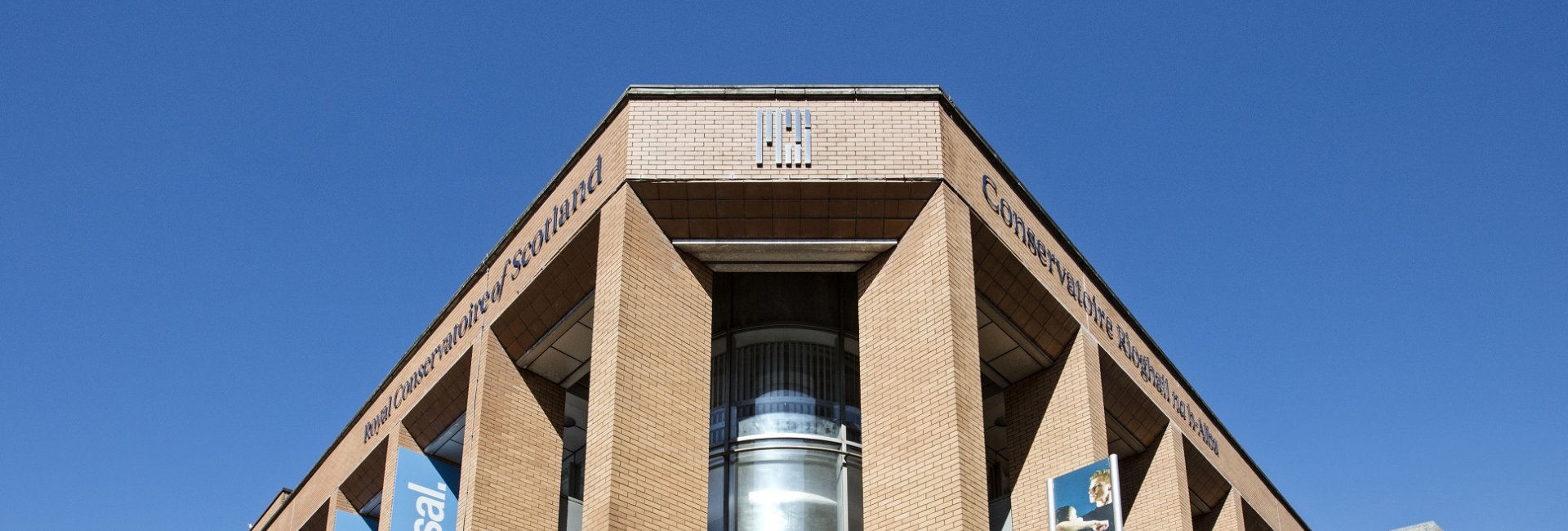
Production consists of both the BA Production Technology and Management and the BA Production Arts and Design programmes. Production students work closely with each other in the classroom and on RCS productions.
This is the only conservatoire-based technical theatre degree in Scotland. Through the programme we aim to produce production technicians, stage managers and lighting designers who can turn their hands to any related role. This makes our students employable in a range of contexts, whilst also being specialists in their chosen career pathways.
We’ll help you create your own pathway through the programme, focusing on your main area of interest. You will learn to work creatively, as an individual, as part of a production team and in collaboration with other students of all disciplines.
RCS is a major public performance venue with world-class facilities. The combination of professional venues, extensive workshops, construction spaces, design studios, and the latest stage and workshop technologies provide a fantastic learning environment.
We work closely with industry partners to ensure the programme is current, competitive, and aligned to the highest professional standards so you can build the relevant skills, knowledge and experience to fully engage in your future career. We have close working relationships with the Scottish national performance companies, as well as many other performing arts and live events organisations across Scotland, the UK and internationally.
Our graduates will aim to become the creative leaders and innovators of the future and are encouraged to push boundaries and create new standards of practice in the wider industry.
Course details
Principal study options
During the application and audition process, you must select which instrument(s) you wish to specialise in for the duration of your course. On this course, you can choose from the following options:
Main specialism
Only one specialism is studied. It may be possible to study a further instrument, but this will not contribute towards the qualification.
Instrument/specialisms
For all courses, you must select at least one specialism from the 'primary' list. For those studying primary/secondary pathways, two instruments may be selected – one from the 'primary' list and one from the 'secondary' list. Joint pathway students may select any two instruments from either list.
Primary instrument/specialism
Lighting
Sound
Stage Management
Stage Technology & Automation
Modules
Please see our course webpage for more information on what is covered.
Assessment method
Most work is assessed through staff observations of your practice but reflection underpins the approach to assessment. Reflective blogs and summary statements form a key component of assessment in all modules. There is a strong emphasis on the assessment of process and so all paperwork generated in each practical role is also assessed as evidence of your widening understanding of the production process and your role within it.
This course is closed for the 2025 academic cycle. Please contact the provider or view the 2026 courses.
Apply by 29 January
This is the equal consideration deadline. You can still apply after this date, but your application may not receive guaranteed consideration.
Application codes
Course code:
204F
Institution code:
R68
Campus name:
Main Site
Campus Code:
-
Points of Entry:
Year 1, 2
How to apply
This course is closed for the 2025 academic cycle. Please contact the provider or view the 2026 courses.
If you are an international applicant, or you are applying for a postgraduate course, or are choosing certain assessment locations, the 'on time' deadline may be later in the year - please contact the conservatoire directly.
Apply by 29 January
This is the deadline for applications to be completed and sent for this course. If the university or college still has places available you can apply after this date, but your application is not guaranteed to be considered.
Application codes
Course code:
204F
Institution code:
R68
Campus name:
Main Site
Campus Code:
-
Points of entry
The following entry points are available for this course:
Year 1
Year 2
Entry requirements for advanced entry (i.e. into Year 2 and beyond)
Applications for direct entry beyond Year 1 will be considered on a case-by-case basis and in accordance with the Royal Conservatoire’s Recognition of Prior (Experiential) Learning policy. If you wish to apply for direct entry, please mark the point of entry on UCAS Conservatoires application as 2 or 3.
We do not offer deferred entry.
International applicants
Currently around 20% of our students come from outside the UK. Between them, they represent over 60 different nationalities and add a rich diversity to the Conservatoire. International applications are welcome to this programme and online interviews can be arranged.
Entry requirements
Qualification requirements
UCAS Tariff - Not accepted
A level - A* - E
Passes in two subjects at GCSE Advanced level
Scottish Higher - A - C
Passes in three subjects at Higher level
International Baccalaureate Diploma Programme - 45 - 24 points
minimum score of 24 with 3 subjects at Higher Level
Please see the link for further information on the entry requirements we accept.
You will be required to identify your chosen specialist subject pathway at the point of application and your interview will be tailored to this choice.
The four specialisms are:
* Stage Management
* Lighting
* Sound
* Stage Technology & Automation
Your interview will involve an in-person conversation with two staff members from the Programme. (approx. 30 minutes). You will also be offered a short tour of the Production Technology and Management facilities with a current student (15/20 mins)
At your interview, the panel will ask you about your academic record, previous experiences, your interests and hobbies as well as your response to the set task(s).
Portfolio
Your portfolio of work may take any form you feel is appropriate and could include:
* Prompt books, setting lists, props lists, scene breakdowns, running lists
* Cue sheets, colour calls, lighting plans, patch sheets
* Photographs of previous work
* Technical drawings and ground plans
* Short audio and/or video clips
* Testimonials/Certificates
* Other relevant production documentation
At your interview, the panel will also ask you about a production you have seen (see brief one below), but they will focus primarily on your portfolio so if you feel you currently do not have much evidence, we strongly recommend that you undertake the creative response task (see brief two below). You may wish to do this anyway to supplement other work in your portfolio.
There will also be an opportunity for you to ask questions about the programme and discuss any other interests you have that may be relevant.
Candidates should bring all relevant work to the interview including their portfolio.
Prior to attending the interview (in-person or online), you are required to set up an Acceptd account and complete the tasks below:
It is important that you show us your previous work (portfolio) as well as your response to these tasks. Without this, we will not be able to proceed with the interview.
If you have not already done so, please set up an Acceptd account: https://app.getacceptd.com/rcs
The tasks below must be completed A MINIMUM OF THREE WORKING DAYS before your interview:
* Complete the “About You” questionnaire (completed online via Acceptd)
* Upload a digitised version of your portfolio to Acceptd
* Complete the Production / Performance Visit (See below) and upload any supplementary material to Acceptd
Optional
* Complete the Supplementary Creative Response Task and upload supplementary material to Acceptd
Other
Brief One: Production / Performance Visit (Compulsory):
Please attend a stage performance of your choice and be able to discuss your observations of this event with the panel. Ideally this should be a live performance but, if this is not possible, a recorded or streamed stage production can be used.
This should be a recent professional production if possible but not one you have worked on. This may be an opportunity to challenge yourself by choosing a type of performance or venue that you have not experienced before. The panel will want to hear your opinion of the production during the interview so prepare some notes to help you but don’t write an essay to read out.
You should try to give a clear account of the production elements such as the overall set & costume design, staging, costume, props, lighting, sound and stage technology to the interview panel. Whilst an overview of the directing or performances is sometimes useful, this is not what we want you to focus on.
You may also be asked to comment on how you would have approached certain elements differently, given the chance.
It is often helpful to provide supplementary evidence of your visit such as publicity material or personal notes and sketches to illustrate a point.
Brief Two: Supplementary Creative Response Task (Optional)
* Source a copy of the play, Macbeth by William Shakespeare. This can be found online here Macbeth – Entire Play, Read for Free (thecompleteworksofshakespeare.com)
* Having read the play, have a particular look at Act 1 Scene i – iii and come to the interview ready to discuss your solutions to any production challenges you see in the script or stage directions relating to your chosen specialism.
* Create a portfolio of work including relevant subject specific paperwork and other evidence of creative solutions (See portfolio of work above)
English language requirements
Test
Grade
Additional details
IELTS (Academic)
6.5
Applicants who first language is not English will be required to provide evidence of proficiency in English. An IELTS score of 6.5 in each component (with no component below 5.5) is required.
TOEFL (iBT)
88
Overall score of 88, with minimum scores of: Reading – 18, Listening – 17, Speaking – 20, Writing – 17
PTE Academic
62
Overall score of 62 with a minimum of 59 in all components (reading, listening, speaking, writing)
* This is a provisional fee and subject to change.
Tuition fee status depends on a number of criteria and varies according to where in the UK you will study. For further guidance on the criteria for home or overseas tuition fees, please refer to the UKCISA website.
Additional fee information
Please note, fees are subject to change for AY25 entry
Please note, all new students are required to pay associated programme cost related fees at the start of their studies. For more information on this please see our website - https://www.rcs.ac.uk/study/fees-funding/fees/
Sponsorship information
The School of Drama, Dance, Production and Film scholarships are awarded for a mixture of financial need and merit. Scholarships within the School of DDPF are applied for and awarded on an annual basis. If you are offered a place at the Conservatoire for drama, dance, production or film (DDPF), you will be forwarded the link to Apply for a DDPF Scholarship. - https://www.rcs.ac.uk/study/fees-funding/scholarships/.