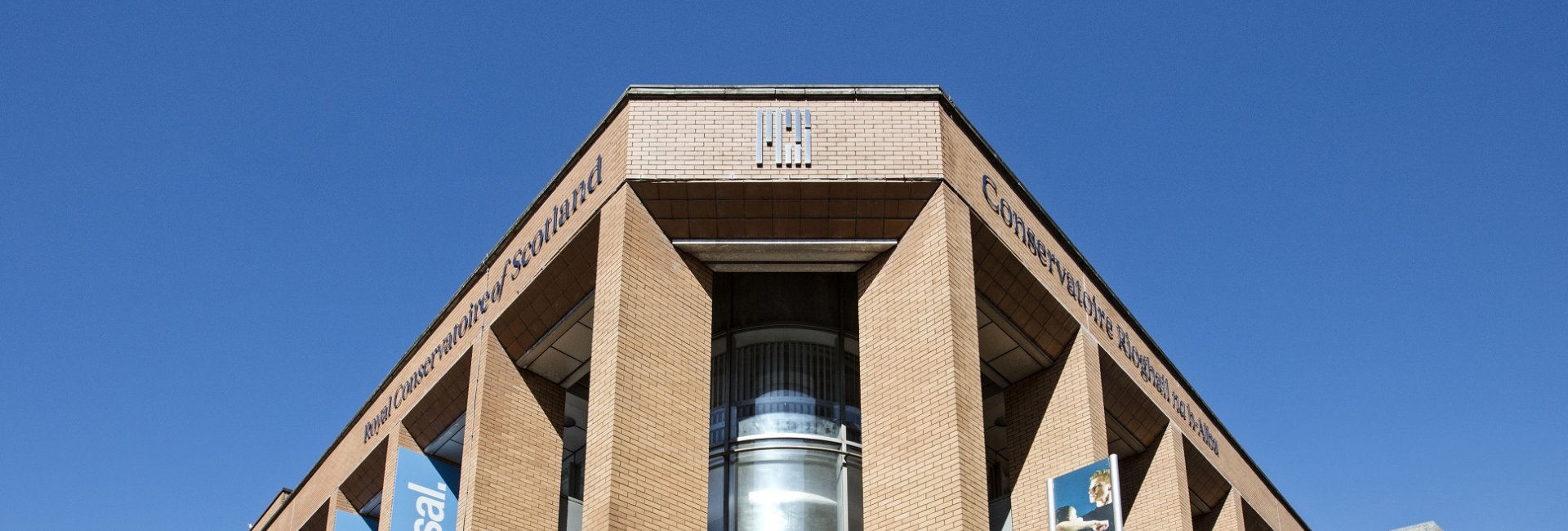
Royal Conservatoire of Scotland
100 Renfrew Street
Glasgow
G2 3DB
Visit our website Visit our course page
Course contact details
Main Contact
Email:admissions@rcs.ac.uk
Phone:0141 332 4101
Fax: 0141 332 8901

The MMus Performance programme is designed for students who aim to make music their life’s work.
Perhaps you aspire to become an opera singer, a concert artist or orchestral musician; to accompany, compose or arrange; to work as a freelance instrumentalist or to be a conductor, music leader or animateur. You may be planning to coach or teach, either as the sole focus of your professional life or, more likely, as part of a portfolio career. You might have your sights set on doctoral study, on making a contribution to Scotland’s vibrant traditional music culture or may perhaps wish to fulfil one of the vital specialist music roles in related art forms such as ballet.
Whatever your rationale for joining the Conservatoire’s MMus programme, you are here to refine and extend your musicianship in preparation for your next steps.
Our MMus Performance pathway places a main emphasis on performance instead of academic work, with 80 of 120 credits for first year MMus students dedicated to your principal study, this rises to 90 credits in second year. The programme is designed to be flexible and in both stages you will be able to choose your other credits from a range of options including performance classes, ensembles, rehearsals and masterclasses, and/or other courses from across the many disciplines we offer here at the Conservatoire. next steps.
Overseas Auditions
If you want to audition live at one of our overseas locations, you must submit your application by the 2nd October 2025. We do not operate a pre-screening round of auditions. We may not be able to audition certain instruments at our overseas auditions, please see our website for more information. Where required, all applicants will need to provide their own instruments (except piano) and accompanist for some locations. Further details of audition dates and locations can be found on our departmental webpage, under the 'How to apply' section. Please note, our locations are subject to change at short notice. If you choose a location that becomes unavailable we will be in touch to offer an alternative, this will likely be a recorded submission.
Please note, the international deadline for recorded submissions for this programme is the 1st December 2025 (except for keyboard who's deadline is 2nd October 2025), but we would encourage applicants to apply by the 2nd October 2025 to be guaranteed consideration for the first round of scholarship
Curriculum Review
We are currently in the review cycle for our postgraduate music programmes starting in 2026, these courses are currently designated 'subject to validation'. This is standard practice during curriculum review periods. The outcome of this process, may mean there are some changes to how your programme is delivered.
During the application and audition process, you must select which instrument(s) you wish to specialise in for the duration of your course. On this course, you can choose from the following options:
Only one specialism is studied. It may be possible to study a further instrument, but this will not contribute towards the qualification.
For all courses, you must select at least one specialism from the 'primary' list. For those studying primary/secondary pathways, two instruments may be selected – one from the 'primary' list and one from the 'secondary' list. Joint pathway students may select any two instruments from either list.
Please see our webpage for more information about this course.
Please see our webpage for more information about this course.
This course is not accepting applications at this time. Please contact the provider to find out more.
The following entry points are available for this course:
Currently around 20% of our students come from outside the UK. Between them, they represent over 55 different nationalities and add a rich diversity to the Conservatoire. To find out more please visit: https://www.rcs.ac.uk/study/international-students/
Candidates for both the MMus and MA are normally expected to hold a good honours (at least 2:2) degree, or its overseas equivalent, in a subject area relevant to the demands of the programme.
| Test | Grade | Additional details |
|---|---|---|
| IELTS (Academic) | 6 | 6.0 with no component below 5.5 |
| TOEFL (iBT) | 80 | Overall score of 80, with minimum scores of: Reading – 18, Listening – 17, Speaking – 20, Writing – 17 |
| PTE Academic | 59 | Overall score of 59 with a minimum of 59 in all components (reading, listening, speaking, writing) |
| Cambridge English Advanced | Overall score of 169 with a minimum of 162 in all components | |
| Cambridge English Proficiency | Overall score of 169 with a minimum of 162 in all components |
More information about our language requirements can be found at the weblink. https://www.rcs.ac.uk/study/international-students/english-requirements/
No fee information has been provided for this course
Tuition fee status depends on a number of criteria and varies according to where in the UK you will study. For further guidance on the criteria for home or overseas tuition fees, please refer to the UKCISA website.
Fees are variable depending on the mode of study. Please consult the Conservatoire's website for more information: https://www.rcs.ac.uk/study/fees-funding/fees/
All new students are required to pay associated programme cost related fees at the start of their studies.
Please note, all tuition fees per year are subject to an annual review.
Within the School of Music, the majority of scholarship awards are made in January following an audition and offer of a place at the RCS. Scholarships are made based on ability and potential with some for financial need. Many School of Music scholarships are made for the duration of the programme. There is no separate scholarship application for the School of Music as everyone is automatically considered.
More information can be found at: www.rcs.ac.uk/study/fees-funding/scholarships/
100 Renfrew Street
Glasgow
G2 3DB
Visit our website Visit our course page
Email:admissions@rcs.ac.uk
Phone:0141 332 4101
Fax: 0141 332 8901