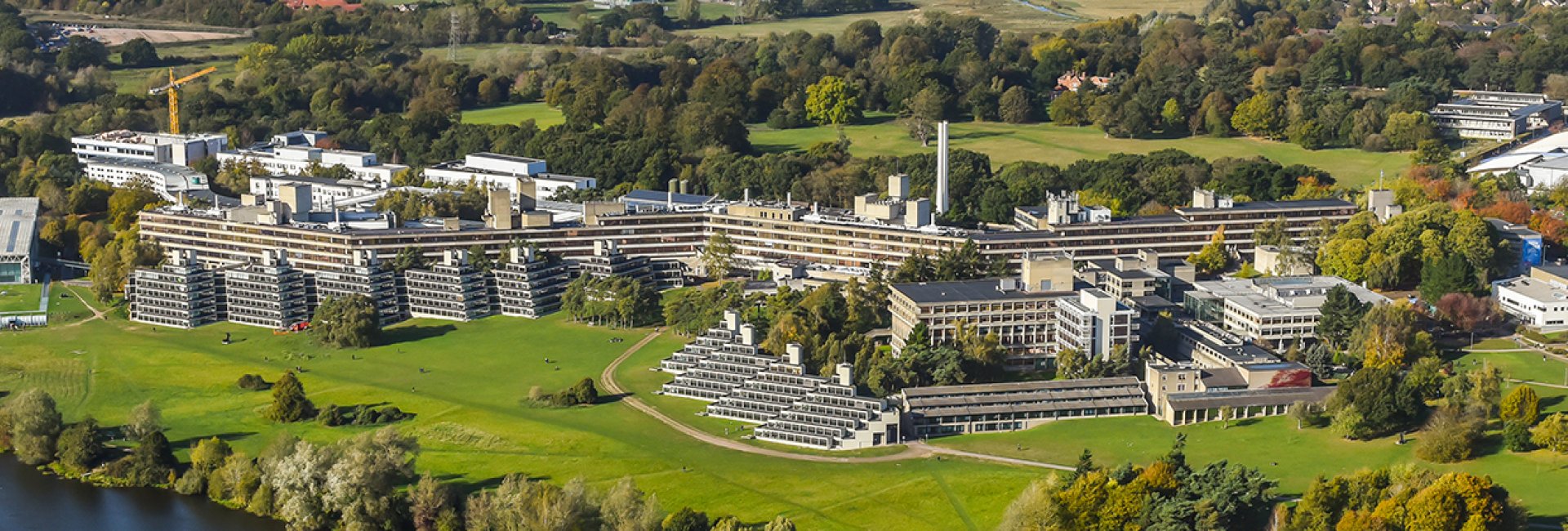
University of East Anglia UEA - Open Day
4 Jul 2026, 08:00
Norwich

Overview
This Computing Science with a Foundation Year course is specifically designed to help you build your academic confidence. After the Foundation year, the School of Computing Sciences has several Year in Industry study and integrated Master options that you can choose from. Learn to programme the future and gain a solid foundation in a range of computing fields, including managing and storing data for banks and businesses; creating and designing action-packed games; improving web usability and user experience, or developing next- generation apps, AI, robotics, cloud computing, big data and lots, lots more. This flexible course is ideal if you’re a digital native who already lives and breathes computing. You might like solving real-world problems, or coding your next-generation apps and websites, designing your own games, or building your own hardware.
You’ll acquire a strong grounding in the theory of computing science, as well as gaining experience and skills in software engineering and problem solving. You’ll become a competent programmer in a range of modern general-purpose languages such as Java, Python, JavaScript, C and C++. You’ll explore the underlying principles of the subject and learn to adopt a logical, systematic approach to developing solutions to real-world problems. You’ll have the opportunity to enhance your studies by spending a year in industry – putting what you’ve learnt into practice and transforming theory into reality.
All our computer science courses follow an identical structure in the first two years. This means that you can easily transfer between them if you decide you want to incorporate a year abroad, a year in industry or continue to Master’s level learning. Jobs in computer sciences have one of the highest starting salaries. In core modules, you’ll cultivate the essential skills of a computing professional. And in optional modules you’ll be able to sample some of the wide range of problems that arise in both research and industry. You’ll also gain transferable skills that will help your long-term development, such as working in teams, project management and presenting ideas.
You’ll also benefit from our expertise in artificial intelligence (AI), machine learning, computer vision, graphics, computational biology, data science and speech processing, and software engineering and systems engineering. You’ll also learn from the latest research done at UEA.
IT industries are growing fast and provide various job opportunities each year. You can work as a software and computer games developer, data scientist, website designer or specialist in user experience (UX). You’ll also have huge career possibilities in cybersecurity, network and systems engineering.
Disclaimer
Course details are subject to change. You should always confirm the details on the provider's website: www.uea.ac.uk
Our foundation year consists of six modules including Introduction of Computing for Business, Foundations of Computing and Mathematics. Upon successful completion of the foundation year, you will progress onto one of our Computing Sciences degree programmes. The subjects you study on the foundation year help to prepare you for the modules on our degree programmes, where you will have the opportunity to take a range of optional modules to tailor your studies to your interests.
This is the equal consideration deadline. You can still apply after this date, but your application may not receive guaranteed consideration.

University of East Anglia UEA has participated in the Teaching Excellence Framework. These ratings were awarded in 2023, for four years.
See why these ratings were awarded
What does this TEF outcome mean?
The following entry points are available for this course:
Discover what it's like to study Computing Science with a Foundation Year at University of East Anglia UEA: insights on the course, making friends, personal statement tips, uni prep, and recommended books, podcasts, and videos.

Contextual offer: CDD
Critical Thinking and General Studies are not accepted.
Contextual offer: MMP
Please see UEA website for further information on accepted combinations.
Principal subjects and A-level combinations are considered - please contact us.
Obtain an overall Pass including a C in the core of the T Level and a Pass in the Occupational Specialism. Any subject is acceptable.
GCSE Requirements: GCSE English Language grade 4 or C and GCSE Mathematics grade 4 or C.
UEA are committed to ensuring that Higher Education is accessible to all, regardless of their background or experiences. One of the ways we do this is through our contextual admissions schemes – please see our website www.uea.ac.uk/apply/undergraduate/contextual-admissions for further information.
We welcome a wide range of qualifications - for further information please visit our website www.uea.ac.uk
| Test | Grade | Additional details |
|---|---|---|
| IELTS (Academic) | 6.5 | 6.5 overall (minimum 5.5 in each component). |
This course may make contextual offers. This means that we use additional information to understand and recognise your potential to succeed at UEA. Using this insight, we could provide you with an offer with reduced entry requirements to study at UEA. You don’t need to do anything to be considered – if eligible we will process your contextual offer automatically, based on the data we hold in your application. We do not make contextual offers during clearing. Check our website for eligibility.
This section shows the range of grades that students who received offers were previously accepted on to this course with (learn more).
It is designed to support your research but does not guarantee whether you will or won't get a place.
Admissions teams consider various factors, including interviews, subject requirements, and entrance tests. Check all course entry requirements for eligibility.
We are unable to show previous accepted grades for this course. This could be because the course is new, it's a postgraduate course, there isn't enough historical data, or the provider has opted out of sharing their entry grades data for this course - learn more.
| Location | Fee | Year |
|---|
Tuition fee status depends on a number of criteria and varies according to where in the UK you will study. For further guidance on the criteria for home or overseas tuition fees, please refer to the UKCISA website.
Tuition fees increase annually for all students in subsequent years of study. Any fee increase is based on the fee for the year that you register. Home undergraduate fees, whose rates are regulated by the UK Government, will be amended in line with any alteration advised by the UK Government. Fees not regulated by the UK Government will increase by a maximum of 4% or RPI-X whichever is the higher. RPI-X is the Retail Prices Index excluding mortgage interest.
For further information about additional costs for your course and information on fee status please see our website.
Email:admissions@uea.ac.uk
Phone:01603 591515
Norwich Research Park
Norwich
NR4 7TJ
At University of East Anglia UEA