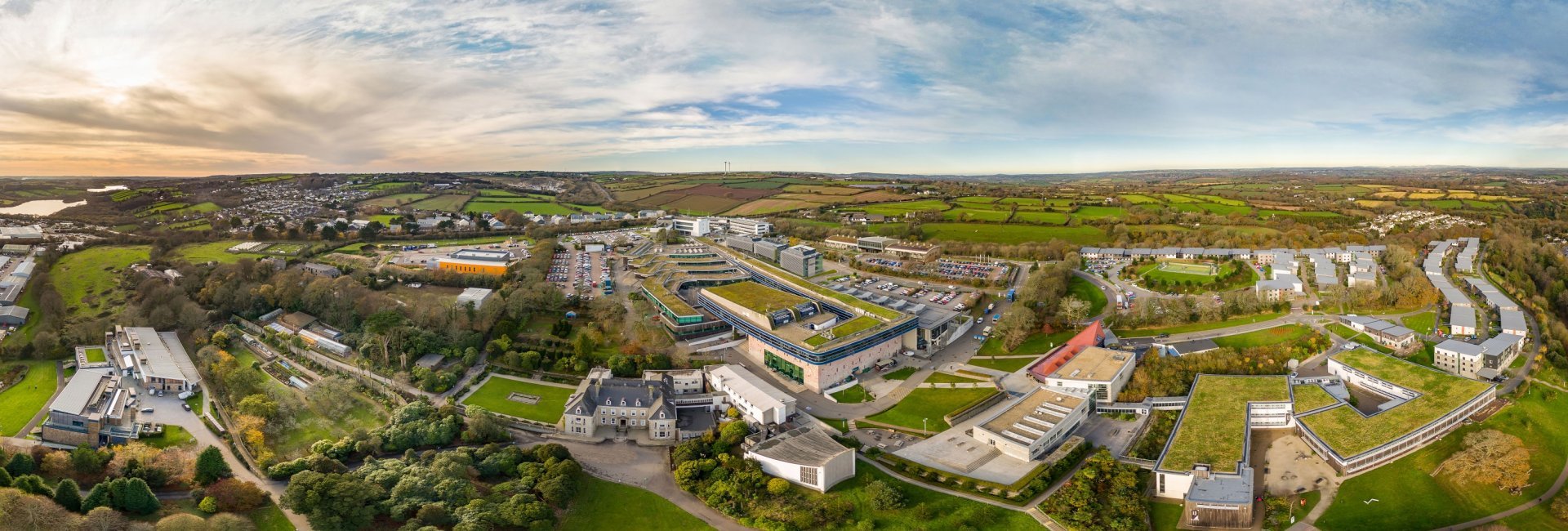
Falmouth University
Woodlane
Falmouth
TR11 4RH
Visit our website Visit our course page
Course contact details
Admissions
Email:applicantservices@falmouth.ac.uk
Phone:01326 213730

Create sustainable textiles using innovative and traditional techniques.
Join a new era in textile design, where the thread of sustainability runs through the creation of contemporary fabrics for fashion, interiors and art. You’ll master traditional and digital processes as you innovate with weave, print and mixed media techniques, from 3D construction and natural dyeing to exquisite hand-embellishment with beading and embroidery.
Based in lively, industry-linked studios and supported by professional designers and makers, you’ll develop confidence, technical expertise and critical judgment evidenced through your original and environmentally conscious designs.
You will:
Learn essential skills for woven, printed and mixed-media textiles, with sustainability embedded throughout
Work in fantastic facilities, using industry-standard kit such as industrial sewing machines, screen printing workshops, digital embroidery machines and weaving looms
Have opportunities to collaborate with degree students in areas such as fashion design, fashion marketing and interior design, across a range of projects
Take on live briefs set by companies such as The Natural Fibre Company, to boost your professional portfolio
Embrace artisanal, traditional craft methods – such as hand-dyeing using plants from our Dye Garden – alongside the latest mechanical and digital production techniques mirroring industry practice
Study at one of only six universities supported by the Worshipful Company of Weavers, which offers individual scholarships and educational grants
Have the chance to travel to events such as Première Vision, the international textile and trend forecasting show in Paris
Through this career-focused Textile Design degree, you’ll learn about technical process and production alongside environmental and sustainability issues surrounding the textile industry. You’ll learn how to design and make woven, printed and mixed media textiles for a broad range of outcomes, including fashion, interiors and one-off artefacts. Preparing for your career, you’ll also learn how to innovate and take creative risks, communicate professionally, network and approach potential employers.
Year one:
The first year supports you to develop individual creative skills and a voice within textile design. The modules are designed to help you to become adept at deploying a range of textile production methods with consideration for responsible, environmentally sustainable design. In studio based practical projects, you'll be supported through tutorials and workshops with design development and technical textile processes.
You'll learn to use professionally equipped studios to create constructed and surface design textiles.
Modules
Colour and Pattern
Belonging
Responsible Material and Design
Histories
Year two:
During your second year, you'll gain an understanding of the range of markets and audiences available to you, and learn to communicate your creative vision, concepts, and design narratives externally.
You'll be encouraged to take creative risks, working with a range of techniques and share the development of your practice in regular group tutorials. Advanced workshop processes are delivered in areas such as jacquard design, digital embroidery, and complex repeat design.
The year is characterised by communication, collaboration and professional practice by working on live briefs and entering competitions.
Modules
Process
Connection
Responsible Production
Collaboration
Theories
Year three:
You’ll be responsible for finding your own placement, with support from the Employability team.
Choosing this option will enhance your industry experience and skills while studying.
How you’ll study during your professional placement
You’ll spend time working in a professional context, as part of a business or organisation. This can be in one role, or up to three, and must be for a minimum of 24 weeks.
You’ll develop in-demand workplace skills, deepen your insight into industry and grow your network of contacts, all of which could help you get ahead in your career after graduation.
Throughout this year, you’ll develop a portfolio of work that includes critical self-reflection on what has been learned from the experience. You’ll be required to evidence your experiences, the skills you’ve learned and your professional growth.
Year four:
Alongside writing your dissertation, you’ll create your own studio briefs in order to design and produce original textiles. This usually (but not exclusively) takes the form of collections of samples.
You’ll also start creating your professional portfolio and other self-promotional materials, and have the chance to take part in the New Designers exhibition in London..
Modules
Futures
Investigations
Innovate
Identity
As part of our process of continuous improvement, we routinely review course content to ensure that all our students benefit from a high-quality and rewarding academic experience. As such, there may be some changes made to your course which are not immediately reflected in the content displayed on our website. Any students affected will be informed of any changes made directly.
100% of your assessment will be coursework.
There is formative and summative feedback given throughout your studies to help you progress your skills. This Textile Design course is also assessed via portfolio, journals, reports and written assignments:
Portfolio assignments include research, development, and production of textiles. Portfolios often consist of a sketchbook, technical files and textile outcomes presented on sheets or in an appropriate manner
Journals are formal ways of documenting the technical development and outcomes of projects
Reports are used to describe your process and contribution on collaborative assignments
Written assignments are assessed essays, for your cultural studies modules. There is a one written assignment per year
Dissertation or final-year project
Foundation year assessments are 100% coursework based
This is the equal consideration deadline. You can still apply after this date, but your application may not receive guaranteed consideration.

Falmouth University has participated in the Teaching Excellence Framework. These ratings were awarded in 2023, for four years.
See why these ratings were awarded
What does this TEF outcome mean?
The following entry points are available for this course:
If English is not your first language, you will need to demonstrate English language skills that are sufficiently developed for successful completion of your studies. We accept a range of recognised English language qualifications that are equivalent to the International English Language Testing System (IELTS) Academic minimum score of 6.0 overall, with a minimum of 5.5 in Reading, Writing, Speaking and Listening. Through the award of international scholarships, we aim to support academic enrichment by encouraging diversity and excellence at Falmouth. For details of our international scholarships, and how to apply for them, please visit our website at www.falmouth.ac.uk.
If you are able to demonstrate relevant, current, equivalent experience instead of formal qualifications, we encourage you to apply. Please contact our Applicant Services team before applying, for advice regarding your individual experience and eligibility.
If you are an international applicant and require a Student visa to study in the UK, you must have a recognised English language test approved and vouched for by the University at the appropriate level. Our Applicant Services team can help you with any general questions you may have about study visas or suitable language tests. For more specific advice, we recommend you also consult UKCISA http://www.ukcisa.org.uk/
| Test | Grade | Additional details |
|---|---|---|
| IELTS (Academic) | 6 | An (IELTS) Academic minimum score of 6.0 overall is required, with a minimum of 5.5 in Reading, Writing, Speaking and Listening |
| Trinity ISE | A minimum of Trinity ISE II with Distinction in all four components is required. | |
| Cambridge English Advanced | Level B2 | A minimum on the Cambridge English scale of 169 is required |
| PTE Academic | 55 | A minimum score in the Pearson Academic Test of English of 55 overall is required, with a minimum of 51 in all four components. |
English language support at Falmouth https://www.falmouth.ac.uk/international/english-language-support
This section shows the range of grades students (with UK A-Levels or Pearson BTEC Level 3 National Extended Diplomas) who received offers were previously accepted with (learn more). It is designed to support your research but does not guarantee whether you will or won't get a place. Admissions teams consider various factors, including interviews, subject requirements, and entrance tests. Check all course entry requirements for eligibility.
We are unable to show previous accepted grades for this course. This could be because the course is new, it's a postgraduate course, there isn't enough historical data, or the provider has opted out of sharing their entry grades data for this course - learn more.
No fee information has been provided for this course
Tuition fee status depends on a number of criteria and varies according to where in the UK you will study. For further guidance on the criteria for home or overseas tuition fees, please refer to the UKCISA website.
No additional fees or cost information has been supplied for this course, please contact the provider directly.
Woodlane
Falmouth
TR11 4RH
Visit our website Visit our course page
Email:applicantservices@falmouth.ac.uk
Phone:01326 213730
At Falmouth University