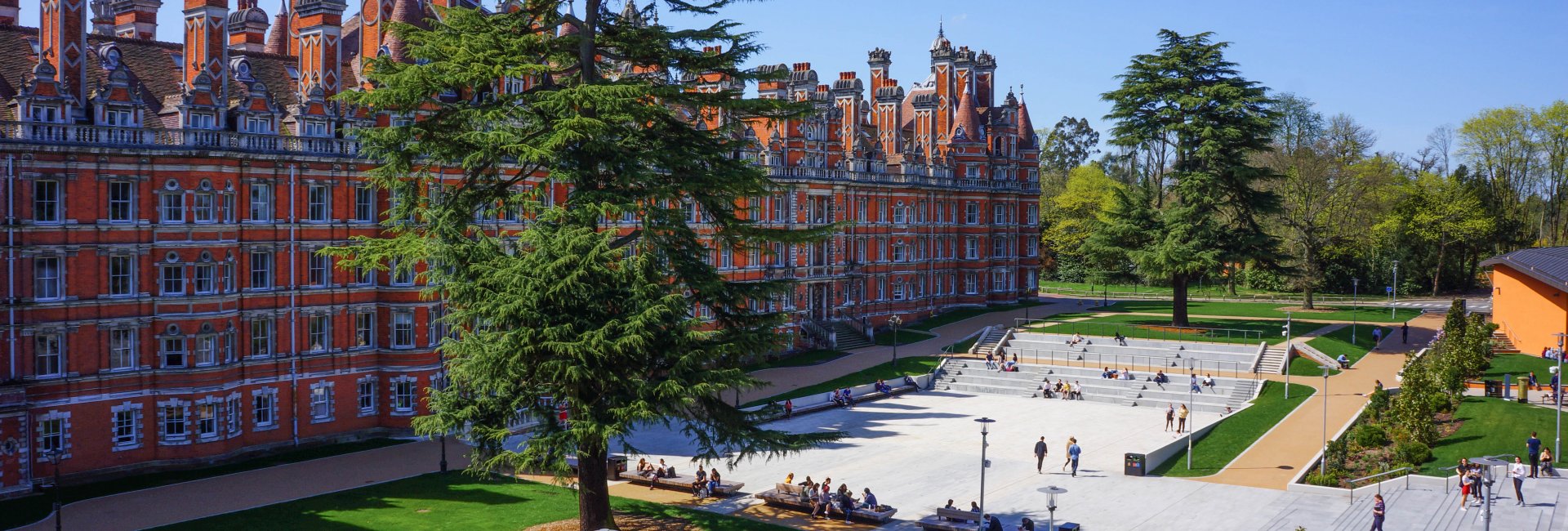
Royal Holloway, University of London
Egham
TW20 0EX
Visit our website Visit our course page
Course contact details
Main Contact
Email:Admissions.Enquiries@RoyalHolloway.ac.uk
Phone:01784 414944

Ecological considerations factor among the key concerns facing our planet today. The decline of bee populations, for example, poses a real threat to agricultural crop yields and the health of flowering plants, and groundbreaking research at Royal Holloway, University of London is helping to uncover the reasons behind this crisis.
Studying Ecology and Conservation at Royal Holloway will teach you the fundamental principles of how plants and animals interact with each other and the wider environment, applying both theoretical and practical tools to understand diverse aspects of ecology including both terrestrial and aquatic ecosystems, behavioural ecology and conservation.
The first year of Ecology and Conservation provides a strong foundation in plant, animal and ecosystem topics, including vertebrate evolution and diversity, plant evolution, form and function, cell biology, genetics and biomes and ecosystems. Acquiring skills in biological data analysis and practical field ecology form a key part of the second year, alongside studies in evolution, invertebrate biology, and insects, plants and fungi. You can also choose to study animal behaviour, microbiology, or to attend the residential field course on marine biology. The final year includes the study of population and community ecology, and marine ecology and biodiversity. There are options to study conservation biology, evolutionary ecology, entomology, extreme animal physiology, circadian biology, as well as to take part in the overseas field course that examines Mediterranean conservation and ecology. This flexible programme allows you to tailor your learning in years 2 and 3, to suit your own interests.
Our biodiverse campus is in easy reach of sites of special scientific interest including Windsor Great Park, Box Hill and Chobham Common, providing the opportunity for rewarding field work and independent study. You will gain practical experience across all three years of the degree, with many laboratory-based or field-based practicals in years 1 and 2, and an individual research project in year 3. The project can involve laboratory, field, or computer-based approaches, but whichever project you choose, you will join our renowned research culture.
Understand how ecological principles can be used to tackle conservation challenges.
Learn the principles of how plants and animals interact with each other and the wider environment.
Take part in an overseas field course that examines Mediterranean conservation and ecology.
Please refer to our website for information:
https://www.royalholloway.ac.uk/courses/undergraduate/biological-sciences/ecology-and-conservation.aspx
Your course will be assessed by a combination of examinations and in-course assignments in the form of essays or presentations.
This is the equal consideration deadline. You can still apply after this date, but your application may not receive guaranteed consideration.

Royal Holloway, University of London has participated in the Teaching Excellence Framework. These ratings were awarded in 2023, for four years.
See why these ratings were awarded
What does this TEF outcome mean?
The following entry points are available for this course:
Combinations of qualifications will be considered on an individual basis, please contact us on study@royalholloway.ac.uk to discuss your situation
At Royal Holloway, we know every student approaches university with different experiences and backgrounds. We look at each application individually, and different factors can affect the exact offer a student receives. For instance, our contextual offer scheme means students from disadvantaged socio-economic background can receive a different offer. For full details please see our website.
Learn more on the Royal Holloway, University of London website
This section shows the range of grades students (with UK A-Levels or Pearson BTEC Level 3 National Extended Diplomas) who received offers were previously accepted with (learn more). It is designed to support your research but does not guarantee whether you will or won't get a place. Admissions teams consider various factors, including interviews, subject requirements, and entrance tests. Check all course entry requirements for eligibility.
We are unable to show previous accepted grades for this course. This could be because the course is new, it's a postgraduate course, there isn't enough historical data, or the provider has opted out of sharing their entry grades data for this course - learn more.
| Location | Fee | Year |
|---|---|---|
| EU | £28900 | Year 1 |
| International | £28900 | Year 1 |
| England | £9535 | Year 1 |
| Northern Ireland | £9535 | Year 1 |
| Scotland | £9535 | Year 1 |
| Wales | £9535 | Year 1 |
| Channel Islands | £9535 | Year 1 |
Tuition fee status depends on a number of criteria and varies according to where in the UK you will study. For further guidance on the criteria for home or overseas tuition fees, please refer to the UKCISA website.
The tuition fee for Home (UK) undergraduates is controlled by Government regulations. The fee for the academic year 2025/26 is £9,535.
This figure is the fee for EU and international students starting a degree in the academic year 2025/26.
Royal Holloway reserves the right to increase tuition fees annually for all students. For further information see fees and funding and the terms and conditions.
These estimated costs relate to studying this particular degree at Royal Holloway during the 2025/26 academic year and are included as a guide. Costs, such as accommodation, food, books and other learning materials and printing, have not been included.
Egham
TW20 0EX
Visit our website Visit our course page
Email:Admissions.Enquiries@RoyalHolloway.ac.uk
Phone:01784 414944
At Royal Holloway, University of London