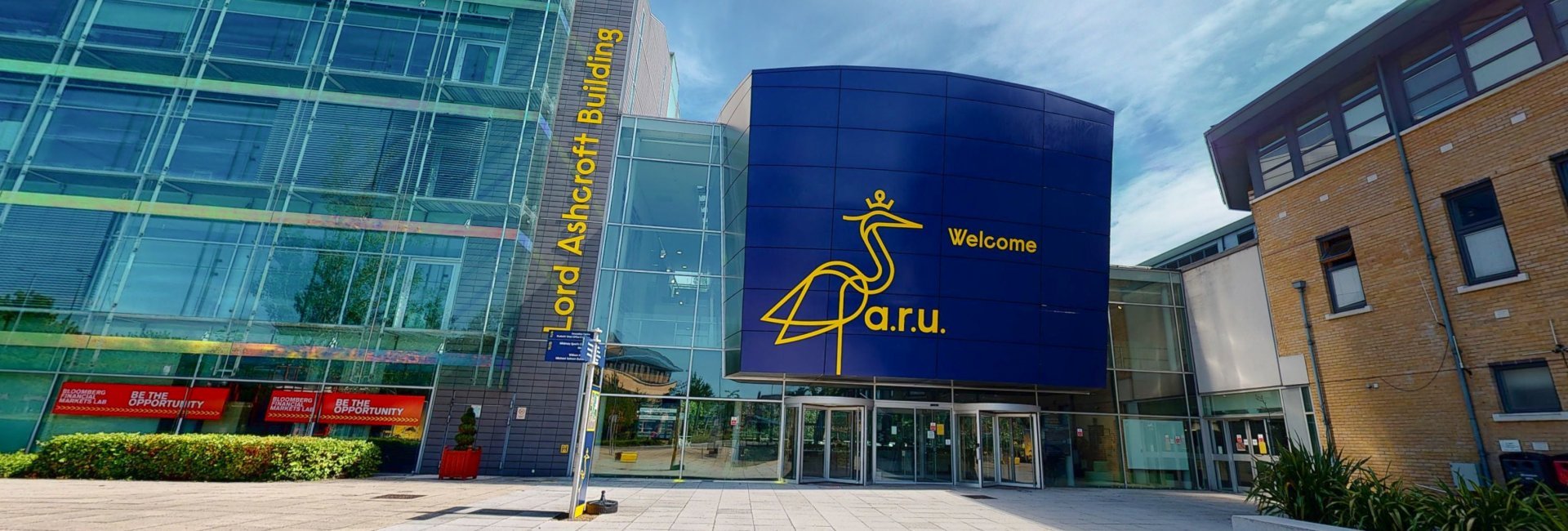
Anglia Ruskin University - Undergraduate Open Day - Cambridge
6 Jun 2026, 09:00
Cambridge

Interior designers work with clients to create attractive, safe and functional rooms and spaces. Study BA (Hons) Interior Design at ARU in Cambridge, and develop your creative vision.
Join a course that scored 95% for Academic Support and 93% for Teaching on my Course in the National Student Survey 2023.
Become a resilient interior designer with a distinctive creative voice.
Benefit from small studio groups, which allow your tutors to really get to know you and your work.
Discover how to embed stories into your designs that help others develop social connections and make your designed spaces important to the community.
Show your talent to the public and industry reps at our final-year Graduate Showcase, and local and national exhibitions like Free Range in London.
Get inspired on our European field trips, or study abroad for a semester with funding available to help cover the cost.
As an interior designer you might work with homeowners, public bodies and businesses. You'll consider the use of furniture, lighting, flooring, artwork and decoration, decor and colour palettes to create residential or commercial spaces that people enjoy using.
To become a professional interior designer you'll typically need a university degree in interior design or a related subject. Practical experience is also valuable and here at ARU, you'll receive ongoing support to find placements and work experience. You can also choose to take an optional placement year in industry as part of your Interior Design degree.
Exciting and intriguing interior spaces offer experiences that make us want to return again and again.
By studying BA (Hons) Interior Design at ARU, you’ll explore the relationships between design, experience and narrative, embedding stories into your designs to help others develop social connections and make your spaces important to and loved by the community.
Based in our dedicated interior design studio in Cambridge, you'll learn to create effective design proposals. Your studio work will include preparing 2D plans and elevations; developing fully realised 3D drawings; creating built models; considering the use of furniture, lighting and materials; looking at small- and large-scale interior design projects.
You'll also learn about project management, professional communication, budgeting, and specification skills.
Throughout the course, you’ll be encouraged to propose design questions, such as: How can public spaces cater for multiple activities and users? How much space do we need to live in? How do major brands reinvent themselves to respond to new markets?
We think your ideas and design skills are important. You’ll develop these by working in small teams at different stages of your degree, sometimes alongside students from other creative courses.
There’s the opportunity to get inspired on European field trips, and to study abroad for a semester – with funding available to help cover the cost.
You can also see your designs become reality in live projects briefs with our partner organisations - our students recently worked with Cambridge Library Services to re-design the café interior at Cambridge Central Library - and foster professional relationships through Design Bench, a series of industry networking meetings.
As well as our dedicated interior design studio, you’ll have use of facilities including:
3D workshops for physical media including wood, plastic, metal and clay
Specialist printmaking workshop including etching, screen-printing and lithography
Dedicated Mac and PC suites with the latest software including Adobe Creative suite
Ruskin Gallery, a professional digital art gallery
Photography and media facilities including darkrooms; studios; film processing; digital printing suite; video editing; and professional equipment loans
Life drawing studio
Year 1 core modules: Design Context and Technology; Studio Culture 1; Visual Communication. Year 2 core modules: Critical Issues and Debates; Digital Media in Application; Studio Culture 2; Ruskin Module. Year 3 core module: Studio Culture 3 (Major Project); Human Behaviour Research Project. Modules are subject to change and availability.
Our studio projects will allow you to focus on your creative development, while you’ll also demonstrate your process and creative decisions through a combination of portfolio, written and practical studio work.
This is the equal consideration deadline. You can still apply after this date, but your application may not receive guaranteed consideration.

Anglia Ruskin University has participated in the Teaching Excellence Framework. These ratings were awarded in 2023, for four years.
See why these ratings were awarded
What does this TEF outcome mean?
The following entry points are available for this course:
Find out more about qualification requirements for this course.
ARU operates a policy of making contextualised offers for this course which may be a reduced conditional offer or an unconditional offer, using data from UCAS to make our assessment. We consider that this approach promotes the equality of educational opportunity for applicants from low participation groups in HE. ARU welcomes students from diverse backgrounds and helping them achieve their full potential. The offer of a place through the contextual offer process is at the discretion of ARU.
This section shows the range of grades students (with UK A-Levels or Pearson BTEC Level 3 National Extended Diplomas) who received offers were previously accepted with (learn more). It is designed to support your research but does not guarantee whether you will or won't get a place. Admissions teams consider various factors, including interviews, subject requirements, and entrance tests. Check all course entry requirements for eligibility.
We are unable to show previous accepted grades for this course. This could be because the course is new, it's a postgraduate course, there isn't enough historical data, or the provider has opted out of sharing their entry grades data for this course - learn more.
| Location | Fee | Year |
|---|---|---|
| England | £9535 | Year 1 |
| Northern Ireland | £9535 | Year 1 |
| Scotland | £9535 | Year 1 |
| Wales | £9535 | Year 1 |
| Channel Islands | £9535 | Year 1 |
| Republic of Ireland | £9535 | Year 1 |
Tuition fee status depends on a number of criteria and varies according to where in the UK you will study. For further guidance on the criteria for home or overseas tuition fees, please refer to the UKCISA website.
https://www.aru.ac.uk/student-life/preparing-for-study/help-with-finances/undergraduate
https://www.aru.ac.uk/study/tuition-fees
East Road
Cambridge
CB1 1PT
Visit our website Visit our course page
Email:answers@aru.ac.uk
Phone:01245 683680
At Anglia Ruskin University