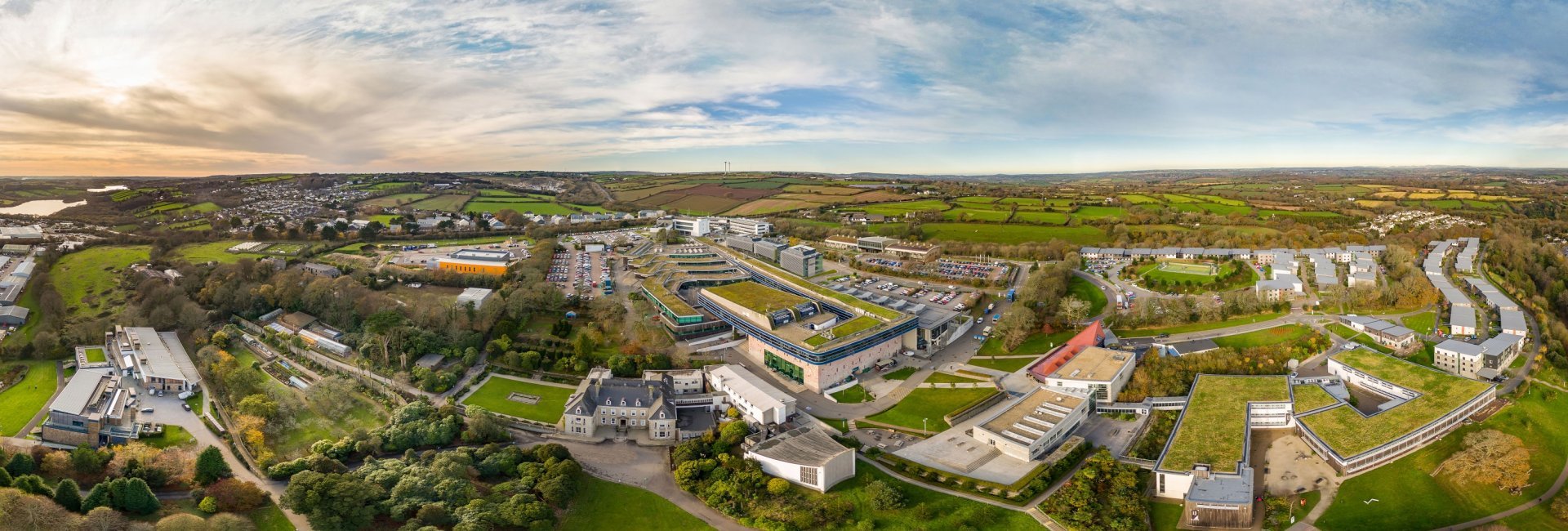
Falmouth University
Woodlane
Falmouth
TR11 4RH
Visit our website Visit our course page
Course contact details
Admissions
Email:applicantservices@falmouth.ac.uk
Phone:01326 213730

Carve out a distinct and sustainable music career.
Develop your creative skills in songwriting, production, performance and promotion while learning how to navigate the legal, ethical and financial aspects of the industry.
Whether it’s DIY or commercial, underground or mainstream, acoustic or electric, you’ll work on your musicianship and craft an artistic identity under the direction of music industry experts and scholars. In collaboration with songwriters, singers, producers, dancers, filmmakers and more, you’ll experiment with approaches and genres to create an innovative audiovisual portfolio and build your audience.
You will:
Become part of a vibrant creative community of songwriters, musicians, producers, DJs, composers and sound artists
Discover how to write and perform original material in relation to a unique artistic identity
Learn to deploy instruments and technology with skill and imagination in live performance and the recording studio
Develop an awareness of music business, including legal, ethical and financial considerations
Gain a framework to explore innovative ways of promoting and disseminating work, independent self-release and building networks
Learn from staff and visiting lecturers with wide-ranging experience and valuable connections across the music industry
Bring your projects to life by tapping into expertise across the university, including dancers, filmmakers, writers and designers
As part of this Popular Music degree, you’ll develop creative skills in musicianship, performance and songwriting as well as technical skills in recording, production and performing technologies. You’ll also gain a critical understanding of the music industry, learning how to represent artistic work and shape a unique identity.
Year one
In your first year, you’ll reinforce and expand your knowledge of music technology, music theory, studio practices, songwriting and performance, while embedding yourself in our creative community through collaborative projects with students and staff. The skills, experiences and self-awareness gained in this first year will help you to confidently progress to the next level of study.
Modules
Playing Live: Songwriting & Performance
Pop Synthesis: Technology, Songwriting & Performance
Expanding Musical Vocabularies
Specialist Music Practice 1
Music and Sound: Context and Cultures
Studiocraft
Year two
In your second year, you’ll be able to tailor your learning to your developing interests and expertise through a range of optional modules covering performance, music business, artistic identity and songwriting. You’ll also have the opportunity to collaborate with students from within and beyond the Music subject area on cross-discipline projects, such as sound and music for film and games, digital arts or multi-modal performance.
Modules
Professional Creative Artist & Songwriter
The Business of Music & Sound
Specialist Music Practice 2
Music & Sound: Resonant Futures
Optional modules
Enterprise: Innovative Music Business Practice
A/V Radical Artistry & New Media Aesthetics
Composing Music for Media
Session Musicianship
Immersive & Interactive Audio
Advanced & Experimental Performance
Resounding: Situated Songwriting & Composition
Voice and Listening: Life, People and Planet
Year three
Your final year is geared towards refining your artistic and professional identity, while deepening your knowledge, skills and networks in line with your chosen specialism. You’ll develop your showcase portfolio, enhance your entrepreneurial practice skills and carry out career design work as you prepare to embark on a successful and creative profession in your chosen field.
Modules
Music & Sound: Dissertation
Professional Development
Your Future
Showcase Portfolio
As part of our process of continuous improvement, we routinely review course content to ensure that all our students benefit from a high-quality and rewarding academic experience. As such, there may be some changes made to your course which are not immediately reflected in the content displayed on our website. Any students affected will be informed of any changes made directly.
All modules involve varying degrees of student choice, allowing you to design projects and tailor assessment tasks to benefit your development and future aspirations. Assessment methods may include:
Portfolio
Studio practice and performance
Journals, case studies, essays and reports
Dissertation
Presentations
Viva (oral assessments)
This is the equal consideration deadline. You can still apply after this date, but your application may not receive guaranteed consideration.

Falmouth University has participated in the Teaching Excellence Framework. These ratings were awarded in 2023, for four years.
See why these ratings were awarded
What does this TEF outcome mean?
The following entry points are available for this course:
If English is not your first language, you will need to demonstrate English language skills that are sufficiently developed for successful completion of your studies. We accept a range of recognised English language qualifications that are equivalent to the International English Language Testing System (IELTS) Academic minimum score of 6.0 overall, with a minimum of 5.5 in Reading, Writing, Speaking and Listening. Through the award of international scholarships, we aim to support academic enrichment by encouraging diversity and excellence at Falmouth. For details of our international scholarships, and how to apply for them, please visit our website at www.falmouth.ac.uk
If you are able to demonstrate relevant, current, equivalent experience instead of formal qualifications, we encourage you to apply. Please contact our Applicant Services team before applying, for advice regarding your individual experience and eligibility.
If you are an international applicant and require a Student visa to study in the UK, you must have a recognised English language test approved and vouched for by the University at the appropriate level. Our Applicant Services team can help you with any general questions you may have about study visas or suitable language tests. For more specific advice, we recommend you also consult UKCISA http://www.ukcisa.org.uk/
| Test | Grade | Additional details |
|---|---|---|
| IELTS (Academic) | 6 | An (IELTS) Academic minimum score of 6.0 overall is required, with a minimum of 5.5 in Reading, Writing, Speaking and Listening |
| Trinity ISE | A minimum of Trinity ISE II with Distinction in all four components is required. | |
| Cambridge English Advanced | Level B2 | A minimum on the Cambridge English scale of 169 is required |
| PTE Academic | 55 | A minimum score in the Pearson Academic Test of English of 55 overall is required, with a minimum of 51 in all four components. |
English language support at Falmouth https://www.falmouth.ac.uk/international/english-language-support
This section shows the range of grades students (with UK A-Levels or Pearson BTEC Level 3 National Extended Diplomas) who received offers were previously accepted with (learn more). It is designed to support your research but does not guarantee whether you will or won't get a place. Admissions teams consider various factors, including interviews, subject requirements, and entrance tests. Check all course entry requirements for eligibility.
We are unable to show previous accepted grades for this course. This could be because the course is new, it's a postgraduate course, there isn't enough historical data, or the provider has opted out of sharing their entry grades data for this course - learn more.
No fee information has been provided for this course
Tuition fee status depends on a number of criteria and varies according to where in the UK you will study. For further guidance on the criteria for home or overseas tuition fees, please refer to the UKCISA website.
No additional fees or cost information has been supplied for this course, please contact the provider directly.
Woodlane
Falmouth
TR11 4RH
Visit our website Visit our course page
Email:applicantservices@falmouth.ac.uk
Phone:01326 213730
At Falmouth University