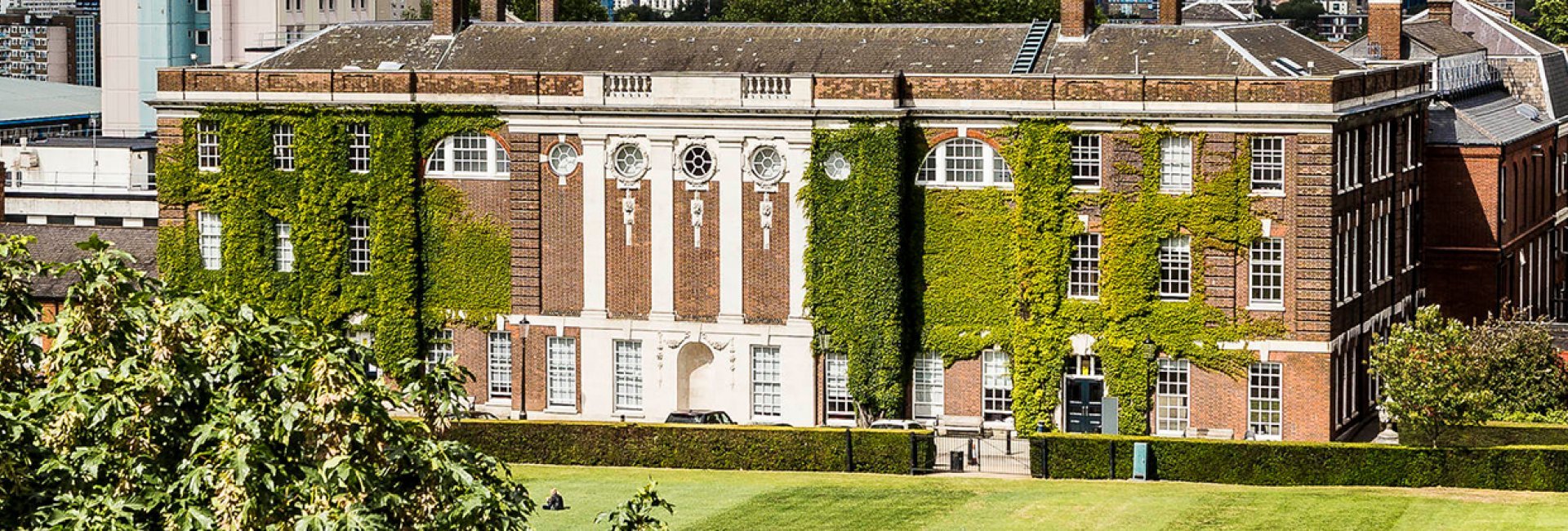
Goldsmiths, University of London - Virtual Campus Tour
25 Nov 2025, 12:00
London

Why study BA Politics and International Relations (with Integrated Foundation Year) at Goldsmiths
This degree offers a distinctive approach that combines the study of politics and international relations, giving you a broad knowledge and experience of both disciplines.
Our BA in Politics and International Relations (with Integrated Foundation Year) offers an alternative entry route for students without the qualifications required for degree-level study
Before progressing onto one of the Department of Politics and International Relations' undergraduate programmes, you will have the chance to develop your academic skills and knowledge of the subject. You are able to select the undergraduate degree you wish to study at the point of application but be able to change as you progress through the foundation pathway if your interests change
You will receive an introduction to the study of politics and gain a better understanding of democracy, political parties, ideologies and movements
Develop an understanding of the political background of contemporary issues such as Brexit, global governance, everyday conflicts around identity and culture, climate change and more
View politics from a range of different perspectives, such as those of feminism, post-colonial thinking, or economics
Learn to write about politics in useful ways, such as essays, political speeches and manifestos
Develop your academic skills including how to present ideas effectively in writing; read, analyse and critically respond to a range of texts; participate effectively in academic discussion; identify how research is conducted in higher education; and compare different research methodologies
You'll be given a grounding in some of the major aspects of politics and international relations. You'll learn about international systems and global governance political theory, UK, European and US politics, international political economy and undertake area-based studies of Asia, Africa and the Middle East
The Department of Politics and International Relations provides a lively interdisciplinary environment, specialising in the study of institutions and conflicts in a way that crosses boundaries between traditional understandings of political phenomena.
Once you progress onto Year 1 of the degree you’ll be able to choose from a wide range of module options that explore the aesthetics of terrorism, critical approaches to security, the politics of development, US politics and foreign policy, the geopolitics of the Middle East, and contemporary movements from the Arab Spring to ISIS. We offer a range of area-based modules covering the Middle East, China and East Asia, Africa and Latin America
We have a lively events programme that attracts renowned speakers, meaning that you'll have the opportunity to hear the latest political arguments, theories and ideas
Our unique Work Placement module gives you the opportunity to gain work experience relevant to the degree and we also give you the opportunity to study abroad
Year 0 Foundation Year
Developing your academic skills
Alongside direct preparation for an undergraduate degree in Politics with International Relations, you will take two modules with our Centre for Academic Language and Literacies (CALL). These modules will help you develop the broader academic and research skills required for undergraduate study.
You will also learn how key social and political movements of the period have influenced the world we live in today through a cross-disciplinary module: Culture and Society in Post-war Britain. This module will cover topics such as 'Windrush and Migration', 'Irish Colonisation', 'Second-wave Feminism', 'Protest and Punk' and 'South-Asian Britain'.
You will take the following compulsory modules:
Reading and Writing Your World
Building Your Research World
Culture and Society in Postwar Britain
Politics in an Age of Crisis
Year 1
You will study the following compulsory modules:
UK and European Comparative Governance and Politics
Colonialism, Power, Resistance
World Politics
Identity, Agency & Environment 1
Identity, Agency & Environment 2
Year 2
You will study the following compulsory modules:
Researching Politics
US Politics and Foreign Policy
or
Global Governance and World Order
Modern Political Theory
or
Modern Britain: Politics from 1979 - today
You'll also take 60 credits worth of optional modules from a list approved annually by the Department of Politics and International Relations and the chance to take the Goldsmiths Elective or an additional 15 credit optional module.
Year 3
In your third year, you write a research dissertation (30 credits) and then choose from a list of optional modules provided annually by the department to a value of 90 credits.
This includes the option of a Work Placement module.
Work Placement module
This optional module gives students experience of working in a range of organisations in the NGO sector such as charities, think-tanks and pressure groups, bodies connected with international organisations, appropriate businesses, and political parties.
There will be a pool of guaranteed places which will be allocated on the basis appropriateness of the placement to the student's interests. However, we also encourage you to take the opportunity to find your own placements and will support you in that process. We would hope that all students will be able to take up the opportunity should an appropriate placement be found.
In fairness to hosts, we will have to be confident that students' levels of attendance and achievement while at Goldsmiths suggest they can benefit from the placement.
Please note that due to staff research commitments not all of these modules may be available every year.
You’ll be assessed by a variety of methods that broaden your academic skillset, depending on your module choices. These include coursework assignments such as essays, case studies, critical commentaries, presentations and personal reflections.
This is the equal consideration deadline. You can still apply after this date, but your application may not receive guaranteed consideration.

Goldsmiths, University of London has participated in the Teaching Excellence Framework. These ratings were awarded in 2023, for four years.
See why these ratings were awarded
What does this TEF outcome mean?
The following entry points are available for this course:
You are also required to have achieved a Level 2 qualification in GCSE English at Grade 4 or above.
For candidates who have not studied any Level 3 qualifications in the last two years, there are no formal qualifications required for admission, but you will need to demonstrate that you can benefit from the programme by undertaking an additional admissions process. This may involve an interview or request for the submission of written information used to assess suitability to study.
We’ll pay particularly careful attention to your personal statement, which is your opportunity to demonstrate your interest in the subject you’ve applied for. Your referees are also welcome to include any relevant contextual comments around your academic achievements. We’ll look at all these things when making a decision on your application, as well as your qualifications and grades.
This section shows the range of grades students (with UK A-Levels or Pearson BTEC Level 3 National Extended Diplomas) who received offers were previously accepted with (learn more). It is designed to support your research but does not guarantee whether you will or won't get a place. Admissions teams consider various factors, including interviews, subject requirements, and entrance tests. Check all course entry requirements for eligibility.
We are unable to show previous accepted grades for this course. This could be because the course is new, it's a postgraduate course, there isn't enough historical data, or the provider has opted out of sharing their entry grades data for this course - learn more.
No fee information has been provided for this course
Tuition fee status depends on a number of criteria and varies according to where in the UK you will study. For further guidance on the criteria for home or overseas tuition fees, please refer to the UKCISA website.
To find out more about fees and funding, please check our undergraduate fees guidance or contact the Fees Office https://www.gold.ac.uk/ug/fees-funding/
New Cross
Lewisham
SE14 6NW
Visit our website Visit our course page
Email:course-info@gold.ac.uk
Phone:020 7078 5300
Email:cshub@gold.ac.uk
Phone:020 8228 5550
At Goldsmiths, University of London