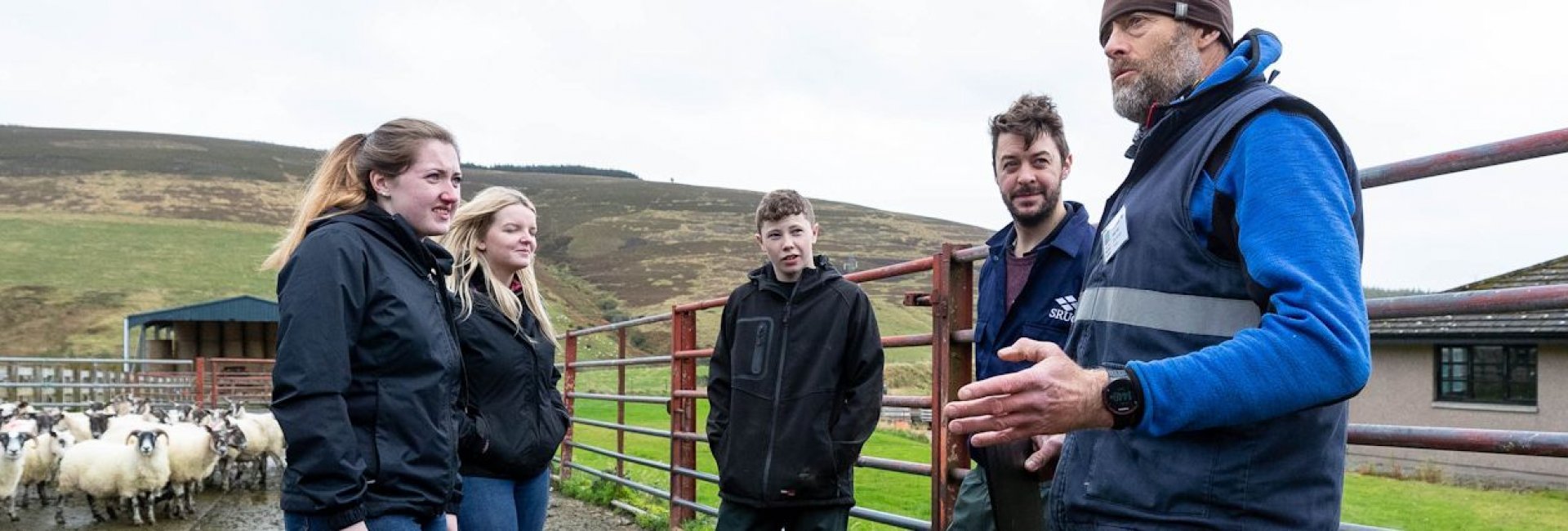
SRUC Edinburgh Open Day
10 Jun 2026, 13:00
Edinbugh

It is an exciting time to be an animal scientist. Animals are at the centre of current global challenges including food security, disease control, climate change and animal welfare. Much of the excitement stems from technological advances that enable us to deliver new insights into the biology of animals and thus address these challenges. To keep up in the vibrant industries surrounding this fast-paced subject you need access to the latest research. SRUC is ranked number 1 for research power in the UK’s Research Excellence Framework (REF) in animal science subjects. There is no better place to study animal science, to be exposed to the latest research and its applications and be taught by researchers leading their field.
Animals contribute to human society in many ways. They provide food and clothing materials, perform duties in the workplace, play key roles in some leisure activities and as pets they provide us with companionship. The Applied Animal Science degree course at SRUC will give you an understanding of animals and how they function, grow, reproduce and behave. You will explore how we can use and interact with animals effectively whether as livestock, research, companion or wild animals without compromising their health and welfare or the health and sustainability of our ecosystems.
SRUC Applied Animal Science graduates go on to pursue a range of careers including research assistant, laboratory technician, animal nutritionist, geneticist, supermarket buyer, animal welfare or rehoming officer, zookeeper, animal care assistant, agriculture or extension officer, technical representative for animal health products.
A number of our graduates also choose to enrol in postgraduate study in a range of fields including animal breeding and genetics, marine biology, conservation biology, animal behaviour and welfare, clinical animal behaviour, and statistics. And some use the degree to help them gain access to competitive undergraduate programmes such as veterinary medicine.
While the full course is offered at the Edinburgh campus, a top up degree (Years 3 and 4 only) is also offered at the Barony campus. Those with a relevant HND or foundation degrees can apply for entry into year 3 at Barony or Edinburgh.
Each academic year is split into two semesters and each semester you will undertake four modules in a range of subject areas including: physiology, health and disease breeding and genetics, behaviour and welfare, nutrition, ethics, and quantitative and research skills.
Year 1
In the first year you will get a broad introduction to biology and different biological systems from the cellular level up to the whole organism. You will also start to build and develop important transferable skills such as laboratory and quantitative skills.
Modules: Diversity of life, Introduction to genetics, Animal behaviour, Comparative physiology, Keeping and managing animals, Data science and computing, Basic animal nutrition, Animal health.
Year 2
In the second year you will build upon and deepen your knowledge and understanding in the core areas of physiology, genetics, animal behaviour, nutrition and health. In addition, important concepts around animal conservation and the ethics of human animal interactions will be introduced as well as the introduction of research skills and critical thinking.
Modules: Animal breeding selection and technologies, Applications of animal behaviour, Nutrient requirements and diet formulation, Host-pathogen interactions, Animal physiology systems, Animal conservation, Animals and society, Research skills and statistics
Year 3
In year 3 you will study to a greater level of detail and are required to undertake more independent study. Modules such as Advanced research methods will further develop your quantitative skills which will be invaluable in an animal science career or post-graduate study. It will also prepare you for your Honours research project in 4th year.
Modules: Advanced research methods, Reproduction, neonatal mammalian nourishment and lactation, Wildlife and agriculture interactions, Animal welfare concepts, Developing a career with animals, Epidemiology, Advanced physiology of growth and development, Strategic animal nutrition
Year 4
In your 4th year you will undertake an extensive piece of individual research, investigating a subject of your own choice. Your honours dissertation gives you the opportunity to work with supervisors from across SRUC, experts in their field actively conducting research or providing consultancy. Conducting your own research project allows you to develop a wealth of skills as well as building specialist knowledge, all of which will be relevant to your future employment or post-graduate study.
Modules: Animal welfare assessment (Elective), Applied animal nutrition (Elective), Animals at the centre of global issues, Disease surveillance and control, Animal breeding and genetics, Animal and climate change.
Modules are assessed using a range of assessment methods to develop your academic skills as well as important transferrable skills for the workplace. Assessments will likely include: laboratory reports, practical investigations, case studies, essays, exams, scientific reports and reviews, oral presentations, posters, groupwork assignments, digital media, data handling, multiple-choice and short answer questions.
The following entry points are available for this course:
Year 2 - Advanced Highers at BB including Biology or Chemistry plus 4 Highers at ABBB to include Biology, Human Biology or Chemistry. Applicants should be able to offer National 5 (A-C) or equivalent (for literacy) and in Maths (for numeracy).
or
3 A-Levels AAB, including Biology or Chemistry, with GCSE passes in Maths and English.
Applicants undertaking relevant HNC and HND qualifications may be considered for advanced entry. Please contact the Admissions Team (admissions@sruc.ac.uk) to discuss further.
SRUC has a long tradition of welcoming students from outside the UK to study with us, and we find they greatly enhance the learning experience of other students and their unique viewpoint and carried life experiences. International student rules and regulations are set by national governments. For the most up to date guidance, please visit our website – www.sruc.ac.uk
To include Biology or Chemistry
To include Biology, Human Biology or Chemistry
To include Biology or Chemistry
Applicants should be able to offer National 5 (A-C)/GCSE (9-4) in Maths and English.
To include Biology, Human Biology or Chemistry.
Applicants should be able to offer National 5 (A-C)/GCSE (9-4) in Maths and English.
Under SRUC’s Contextual Admissions Policy, we will relax our standard entry requirements for some Scottish students depending on their circumstances. More information on our Contextual Admissions Policy can be found on the SRUC website.
Find out more about minimum qualification requirements for this course.
Guidance on English Language requirementshttps://www.sruc.ac.uk/courses-training/student-support/international-students/study-requirements-for-international-students/
This section shows the range of grades that students who received offers were previously accepted on to this course with (learn more).
It is designed to support your research but does not guarantee whether you will or won't get a place.
Admissions teams consider various factors, including interviews, subject requirements, and entrance tests. Check all course entry requirements for eligibility.
We are unable to show previous accepted grades for this course. This could be because the course is new, it's a postgraduate course, there isn't enough historical data, or the provider has opted out of sharing their entry grades data for this course - learn more.
| Location | Fee | Year |
|---|
* This is a provisional fee and subject to change.
Tuition fee status depends on a number of criteria and varies according to where in the UK you will study. For further guidance on the criteria for home or overseas tuition fees, please refer to the UKCISA website.
No additional fees or cost information has been supplied for this course, please contact the provider directly.
Email:study@sruc.ac.uk
Phone:0800 269 453
Email:admissions@sruc.ac.uk
Phone:0131 535 4480
SRUC Edinburgh
West Mains Road
Edinburgh
EH9 3JG
At SRUC Scotland's Rural College