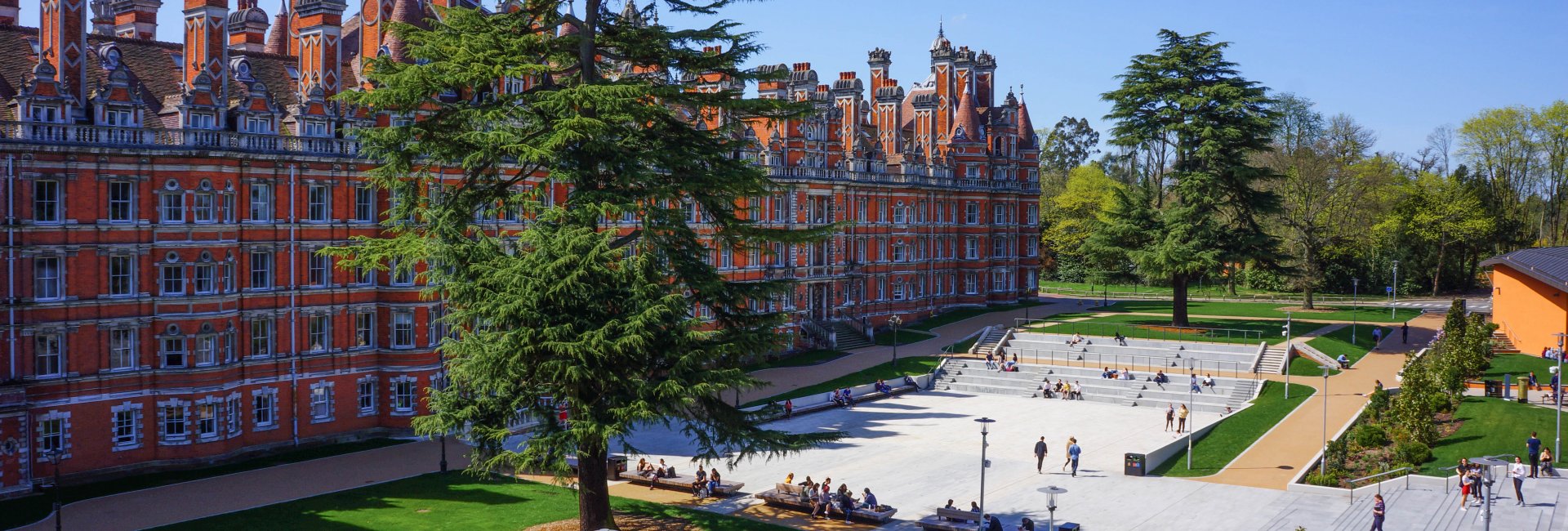
Royal Holloway, University of London
Egham
TW20 0EX
Visit our website Visit our course page
Course contact details
Main Contact
Email:Admissions.Enquiries@RoyalHolloway.ac.uk
Phone:01784 414944

Our Integrated Foundation Year will take you through a carefully-designed programme to help you to progress confidently onto your undergraduate degree.
Engineering, Physical, Computational and Mathematical sciences underpin modern technological society and can help us provide answers to fundamental questions. Graduates with these degrees are highly sought after by employers. The (Physics/Electronic Engineering/Computer Science/Mathematics) Foundation Year provides progressive structures in which you are able to gain knowledge and understanding of approaches to scientific study and your chosen degree subject.
All Foundation Year students take ‘Global Perspectives’, then four subject-based courses provide familiarity with Mathematics and computation – the language of modern science and technology, and key for success in science, technology and engineering.
Once you have completed your Foundation year, you progress onto the full degree programme, BSc Computer Science.
Want to work at the cutting-edge of computing technology and help in shaping the future of our global society? Computers, intelligent devices and the internet are central to so many aspects of 21st century life, from business and industry to governance and our personal lives. Their potential for transforming economies, driving efficiencies and enhancing the well-being of societies is almost limitless. Our progressive curriculum will give you the knowledge and technical skills that employers need, and introduce you to pioneering ideas and technologies to help you to realise your ambitions.
We cover all the essentials of application development, from programming to software engineering, databases to web development, computer graphics to robotics, and information security. You will also explore the fundamentals of computing – what computers do, and how efficiently they do it – and learn about a host of advanced technologies, from computer games, digital sound and music, to concurrent and parallel programming, machine learning, bioinformatics, the internet of things, computational finance and more. From the outset you will be experimenting with programming games, robots, Gadgeteer kits, Subversion, JUnit testing, Scrum-based Agile software and more, in our well-equipped laboratories.
We are a highly respected, research-focused department with a friendly approach and award-winning teaching. We offer a short-term summer work placement programme and a dedicated personal adviser to guide you through your studies. You will also be welcome to join our thriving Computing Society. We are one of only seven departments in the UK to hold the Athena SWAN bronze award for increasing female participation in computer science.
The programme’s modular structure gives you the flexibility to tailor your degree to your interests. We also offer you the opportunity to follow a specialist pathway that matches your career ambitions. At the end of year 1 you will have the option of transferring onto one of these pathways (Artificial Intelligence, Information Security or Distributed & Networked Computing), as well as onto a year-in-industry programme, or onto our longer and more advanced integrated masters programme. Transferring onto our Software Engineering pathway requires previous programming experience and early permission to take the Software Development course in year 1, rather than Object-oriented Programming.
This is the equal consideration deadline. You can still apply after this date, but your application may not receive guaranteed consideration.

Royal Holloway, University of London has participated in the Teaching Excellence Framework. These ratings were awarded in 2023, for four years.
See why these ratings were awarded
What does this TEF outcome mean?
The following entry points are available for this course:
At Royal Holloway, we know every student approaches university with different experiences and backgrounds. We look at each application individually, and different factors can affect the exact offer a student receives. For instance, our contextual offer scheme means students from disadvantaged socio-economic background can receive a different offer. For full details please see our website.
Learn more on the Royal Holloway, University of London website
This section shows the range of grades students (with UK A-Levels or Pearson BTEC Level 3 National Extended Diplomas) who received offers were previously accepted with (learn more). It is designed to support your research but does not guarantee whether you will or won't get a place. Admissions teams consider various factors, including interviews, subject requirements, and entrance tests. Check all course entry requirements for eligibility.
We are unable to show previous accepted grades for this course. This could be because the course is new, it's a postgraduate course, there isn't enough historical data, or the provider has opted out of sharing their entry grades data for this course - learn more.
| Location | Fee | Year |
|---|---|---|
| International | £28900 | Year 1 |
| England | £9535* | Year 1 |
| Northern Ireland | £9535* | Year 1 |
| Scotland | £9535* | Year 1 |
| Wales | £9535* | Year 1 |
| Channel Islands | £9535* | Year 1 |
| Republic of Ireland | £9535* | Year 1 |
| EU | £28900 | Year 1 |
* This is a provisional fee and subject to change.
Tuition fee status depends on a number of criteria and varies according to where in the UK you will study. For further guidance on the criteria for home or overseas tuition fees, please refer to the UKCISA website.
The tuition fee for Home (UK) students taking this Integrated Foundation Year course is controlled by Government regulations.
This figure is the fee for eligible EU and International students for the academic year 2025/26.
Royal Holloway reserves the right to increase tuition fees annually for all students. For further information see fees and funding and the terms and conditions.
These estimated costs relate to studying this particular degree at Royal Holloway during the 2025/26 academic year and are included as a guide. Costs, such as accommodation, food, books and other learning materials and printing, have not been included.
Egham
TW20 0EX
Visit our website Visit our course page
Email:Admissions.Enquiries@RoyalHolloway.ac.uk
Phone:01784 414944
At Royal Holloway, University of London