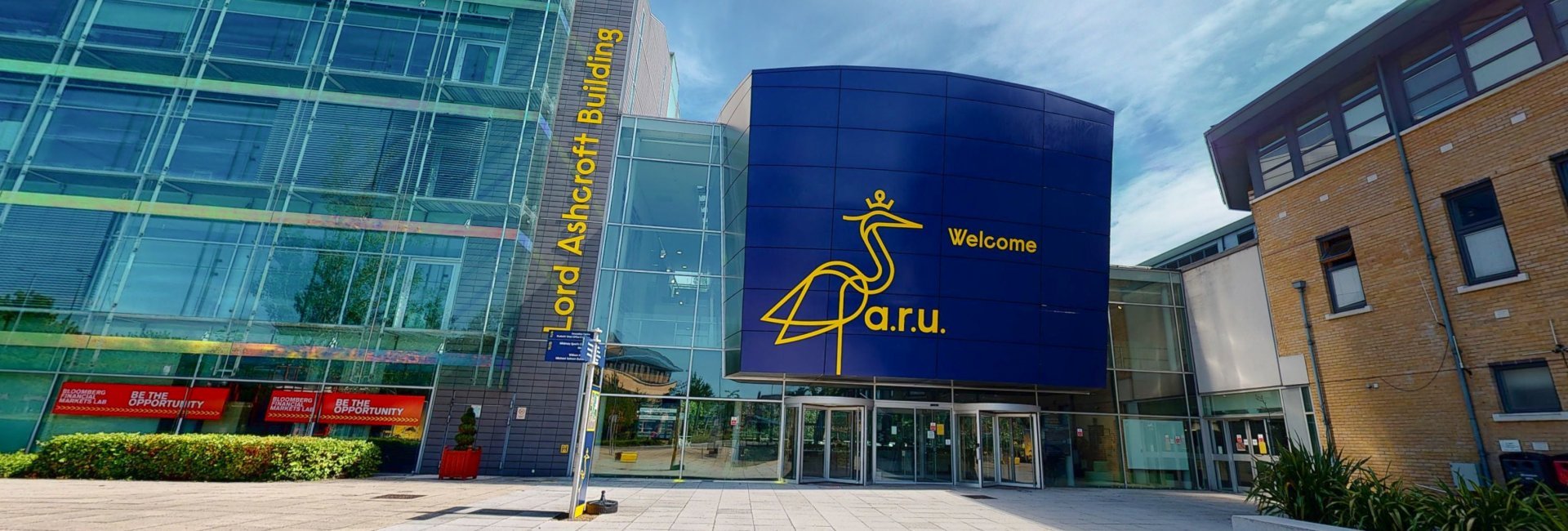
Anglia Ruskin University - Undergraduate Open Day - Cambridge
6 Jun 2026, 09:00
Cambridge

Explore the fascinating realms of psychology and criminology on our joint honours degree, with hands-on experience in our £45m Science Centre.
Our degrees are accredited by the British Psychological Society and delivered in our world class Science Centre with dedicated Psychology labs.
Gain unique experiences at live trials at the Crown Court and the Old Bailey.
Bring the world of work to life through Live Briefs; designed and developed with regional employers to give you exposure to ‘real world’ problem-solving.
Explore world-leading research with 98% of our Psychology research being recognised as internationally significant (REF 2023).
We offer support with the cost of living, and Psychology courses deliver compressed teaching across three days of the week, freeing your time for work experience.
How do our thoughts and feelings dictate our actions? And is there such a thing as the criminal mind?
These are fascinating questions, and psychology and criminology are equally fascinating fields. You might be interested in both, and wondering which area to specialise in. If that’s the case, our British Psychological Society (BPS) accredited Psychology with Criminology degree is made for you.
We start by looking at the main principles of psychology and criminology. Then, in Years 2 and 3, our optional modules give you the freedom to explore your own interests in more depth.
By studying BSc (Hons) Psychology with Criminology at ARU, you’ll learn from expert tutors who are actively engaged in research work. And you can take advantage of our specialist science facilities too, including laboratories for analysing hair and saliva samples, and measuring electrical activity in the brain.
You’ll learn about criminal profiling and how it offers insights into youth offending, gendered violence, genocide, rape, abuse and other types of crime. You’ll look at media representations of crime, and explore social and developmental psychology.
But we don’t just learn in the classroom. There are field trips to places such as the Old Bailey and Auschwitz. You’ll sit in on live trials in Cambridge Crown Court too, and observe the dynamics of the court room.
In the final year of your course, there’s the chance to learn about offending and offender rehabilitation from trainee forensic psychologists. You’ll also complete a major project within psychology – and define your future career path.
Year 1:
Introduction to Contemporary Issues in Criminology (30 credits)
The Psychology of Everyday Life (15 credits)
Becoming a Researcher (30 credits)
Criminal Justice in England and Wales (30 credits)
Clinical and Health Psychology (15 credits)
Year 2 Core Modules:
Research in Action: Statistical Thinking (15 credits)
Research in Action: Qualitative Methods and Psychology in Practice (15 credits)
Social Psychology: Development and Difference (30 credits)
Brain, Body and Mind (30 credits)
Ruskin Module (15 credits)
Year 2 Optional Modules:
Intoxicants and Intoxication (15 credits)
Revolving Doors: Punishment and Rehabilitation (15 credits)
Diagnosis and Formulation in Mental Health (15 credits)
Year 3 Core Modules:
Forensic Psychology (15 credits)
Criminology in Policy and Practice (15 credits)
Psychology Project (30 credits)
Year 3 Optional Modules:
Psychological Assessment (15 credits)
Stress and Stress Management (15 credits)
Exploitation, Trafficking and Sexual Violence (15 credits)
Youth, Crime and Aggression (15 credits)
Investigative Psychology (15 credits)
Clinical Psychology (15 credits)
Cognitive Neuroscience (15 credits)
Lifespan Development (15 credits)
Sex, Sexuality and Gender (15 credits)
Psychology in the Workplace (15 credits)
Emotion (15 credits)
Culture and Health (15 credits)
Concepts of Good and Evil (15 credits)
Comparative and Global Criminal Justice (15 credits)
Organised Crime (15 credits)
The Neuroscience of Self (15 credits)
Atypical Development (15 credits)
Groups in Conflict: Social Psychological Issues (15 credits)
Psychological Therapies (15 credits)
Consumer Psychology (15 credits)
Cyberpsychology (15 credits)
Throughout the course, we’ll use a range of assessment methods to measure your progress. These include written and practical exams, essays, research reports, oral presentations and lab reports. You’ll also write a dissertation (major project) on a subject of your choice.
Professionally accredited courses provide industry-wide recognition of the quality of your qualification.
This is the equal consideration deadline. You can still apply after this date, but your application may not receive guaranteed consideration.

Anglia Ruskin University has participated in the Teaching Excellence Framework. These ratings were awarded in 2023, for four years.
See why these ratings were awarded
What does this TEF outcome mean?
The following entry points are available for this course:
We welcome applications from international and EU students, and accept a range of international qualifications.
Find out more about qualification requirements for this course.
ARU operates a policy of making contextualised offers for this course which may be a reduced conditional offer or an unconditional offer, using data from UCAS to make our assessment. We consider that this approach promotes the equality of educational opportunity for applicants from low participation groups in HE. ARU welcomes students from diverse backgrounds and helping them achieve their full potential. The offer of a place through the contextual offer process is at the discretion of ARU.
This section shows the range of grades students (with UK A-Levels or Pearson BTEC Level 3 National Extended Diplomas) who received offers were previously accepted with (learn more). It is designed to support your research but does not guarantee whether you will or won't get a place. Admissions teams consider various factors, including interviews, subject requirements, and entrance tests. Check all course entry requirements for eligibility.
We are unable to show previous accepted grades for this course. This could be because the course is new, it's a postgraduate course, there isn't enough historical data, or the provider has opted out of sharing their entry grades data for this course - learn more.
| Location | Fee | Year |
|---|---|---|
| England | £9535 | Year 1 |
| Northern Ireland | £9535 | Year 1 |
| Scotland | £9535 | Year 1 |
| Wales | £9535 | Year 1 |
| Channel Islands | £9535 | Year 1 |
| Republic of Ireland | £9535 | Year 1 |
Tuition fee status depends on a number of criteria and varies according to where in the UK you will study. For further guidance on the criteria for home or overseas tuition fees, please refer to the UKCISA website.
https://www.aru.ac.uk/student-life/preparing-for-study/help-with-finances/undergraduate
https://www.aru.ac.uk/study/tuition-fees
East Road
Cambridge
CB1 1PT
Visit our website Visit our course page
Email:answers@aru.ac.uk
Phone:01245 686868
Email:answers@aru.ac.uk
Phone:01245 686868
At Anglia Ruskin University