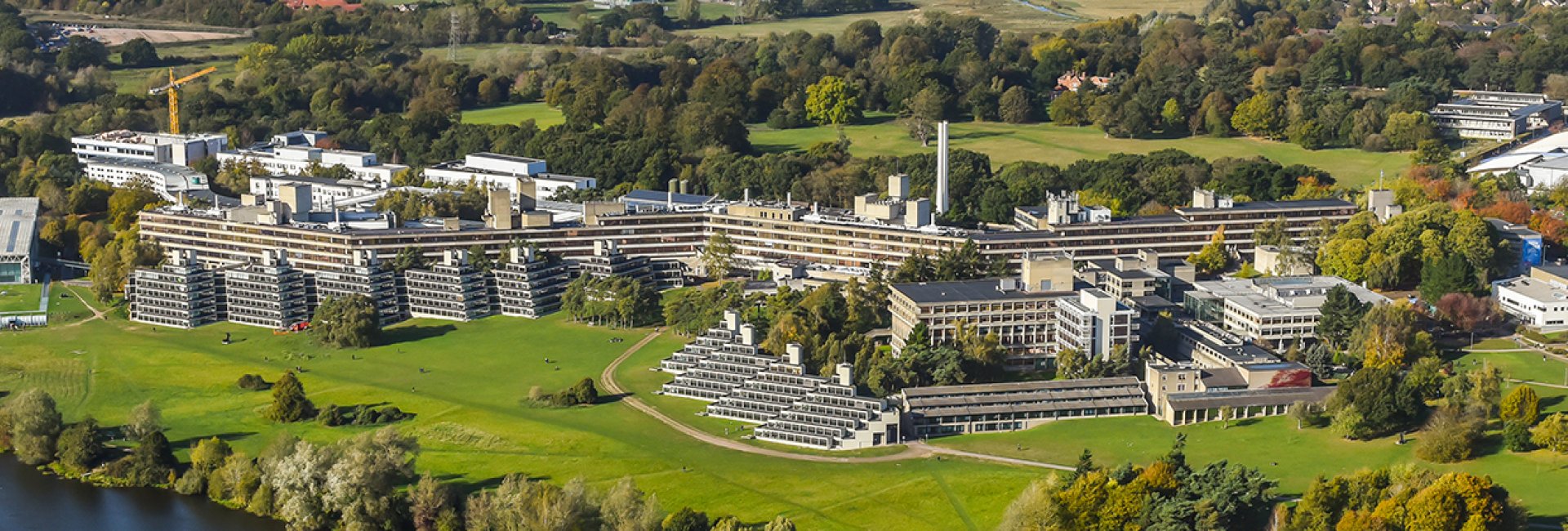
University of East Anglia UEA
Norwich Research Park
Norwich
NR4 7TJ
Visit our website Visit our course page
Course contact details
Admissions Service
Email:admissions@uea.ac.uk
Phone:01603 591515

Overview
Immerse yourself in the wonder of biological organisms and processes at the molecular level. Explore aspects of life from molecules to cells, from tissues to organisms. Learn from leading research scientists who are specialists in their fields of study.
Our Biochemistry degrees at UEA are taught jointly by the Schools of Biological Sciences and Chemistry, with invaluable contributions from scientists from other research institutions located nearby in the Norwich Research Park. This dual approach means that in all elements of the course you benefit from subject-specific experts who inform our teaching. On the Masters in Biochemistry course, you’ll follow the same programme as our BSc students, but you’ll complete a further year of advanced, Masters-level study.
During your time at UEA, you’ll have the chance to study a range of fascinating subjects, progressing from the basics of biochemistry to higher-level research areas such as protein engineering and cancer biology. You’ll not only learn how to perform ground-breaking and highly specialised research, but also how to interpret and communicate these findings to the wider scientific community.
As a Biochemistry student you’ll benefit directly from our enviable position as an integral partner of the Norwich Research Park (NRP), which houses the Norfolk and Norwich University Hospital, as well as leading research institutes such as the John Innes Centre, an international centre of excellence in plant science, genetics and microbiology, the Sainsbury Laboratory for research into plant disease resistance, the Earlham Institute for genomics, bioinformatics and molecular biology research, and the Quadram Institute, where research focuses on human health, food and disease. The Norwich Research Park is one of the largest single-site concentrations of food, genomics and health scientists in Europe. Importantly, as a Biochemistry MSci student you’ll have the opportunity to pursue both of the major research projects of your degree programme in leading laboratories at either the University of East Anglia or these Centres and Institutes across the NRP.
This course will prepare you to work in industry or to progress to a postgraduate degree and a career in research. Having learned on this course about cutting edge methods in synthetic, chemical and structural biology, you’ll have the potential to make an impact on many areas of contemporary science, including health, nutrition, clean energy and tackling pollution. Biochemists are frequent winners of the Nobel Prize for Chemistry and Michael Houghton, an alumnus of the UEA School of Biological Sciences and Biochemistry PhD, won the Nobel prize for Physiology or Medicine in 2020.
Disclaimer
Course details are subject to change. You should always confirm the details on the provider's website: www.uea.ac.uk
This is the equal consideration deadline. You can still apply after this date, but your application may not receive guaranteed consideration.

University of East Anglia UEA has participated in the Teaching Excellence Framework. These ratings were awarded in 2023, for four years.
See why these ratings were awarded
What does this TEF outcome mean?
The following entry points are available for this course:
GCSE Requirements: GCSE English Language grade 4 or C and GCSE Mathematics grade 4 or C.
UEA are committed to ensuring that Higher Education is accessible to all, regardless of their background or experiences. One of the ways we do this is through our contextual admissions schemes – please see our website www.uea.ac.uk/apply/undergraduate/contextual-admissions for further information.
We welcome a wide range of qualifications - for further information please visit our website www.uea.ac.uk
| Test | Grade | Additional details |
|---|---|---|
| IELTS (Academic) | 6 | IELTS: 6.0 overall (minimum 5.5 in each component). |
This course may make contextual offers. This means that we use additional information to understand and recognise your potential to succeed at UEA. Using this insight, we could provide you with an offer with reduced entry requirements to study at UEA. You don’t need to do anything to be considered – if eligible we will process your contextual offer automatically, based on the data we hold in your application. We do not make contextual offers during clearing. Check our website for eligibility.
This section shows the range of grades students (with UK A-Levels or Pearson BTEC Level 3 National Extended Diplomas) who received offers were previously accepted with (learn more). It is designed to support your research but does not guarantee whether you will or won't get a place. Admissions teams consider various factors, including interviews, subject requirements, and entrance tests. Check all course entry requirements for eligibility.
We are unable to show previous accepted grades for this course. This could be because the course is new, it's a postgraduate course, there isn't enough historical data, or the provider has opted out of sharing their entry grades data for this course - learn more.
| Location | Fee | Year |
|---|---|---|
| England | £9535 | Year 1 |
| Northern Ireland | £9535 | Year 1 |
| Scotland | £9535 | Year 1 |
| Wales | £9535 | Year 1 |
| Channel Islands | £9535 | Year 1 |
| International | £27900 | Year 1 |
Tuition fee status depends on a number of criteria and varies according to where in the UK you will study. For further guidance on the criteria for home or overseas tuition fees, please refer to the UKCISA website.
Tuition fees increase annually for all students in subsequent years of study. Any fee increase is based on the fee for the year that you register. Home undergraduate fees, whose rates are regulated by the UK Government, will be amended in line with any alteration advised by the UK Government. Fees not regulated by the UK Government will increase by a maximum of 4% or RPI-X whichever is the higher. RPI-X is the Retail Prices Index excluding mortgage interest.
For further information about additional costs for your course and information on fee status please see our website.
Norwich Research Park
Norwich
NR4 7TJ
Visit our website Visit our course page
Email:admissions@uea.ac.uk
Phone:01603 591515
At University of East Anglia UEA