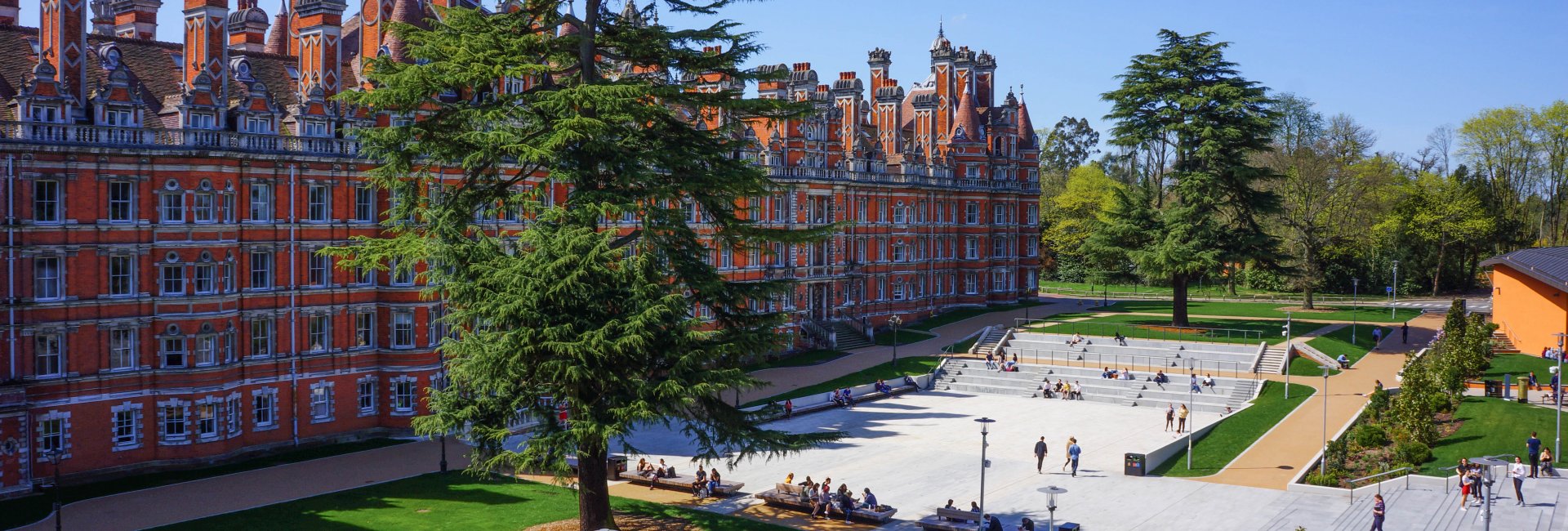
Royal Holloway, University of London
Egham
TW20 0EX
Visit our website Visit our course page
Course contact details
Main Contact
Email:Admissions.Enquiries@RoyalHolloway.ac.uk
Phone:01784 414944

Our Integrated Foundation Year will take you through a carefully-designed programme to help you to progress confidently onto your undergraduate degree.
Engineering, Physical, Computational and Mathematical sciences underpin modern technological society and can help us provide answers to fundamental questions. Graduates with these degrees are highly sought after by employers. The (Physics/Electronic Engineering/Computer Science/Mathematics) Foundation Year provides progressive structures in which you are able to gain knowledge and understanding of approaches to scientific study and your chosen degree subject.
All Foundation Year students take ‘Global Perspectives’, then four subject-based courses provide familiarity with Mathematics and computation – the language of modern science and technology, and key for success in science, technology and engineering.
Once you have completed your Foundation year, you progress onto the full degree programme, MSci Physics.
Our students often say their enthusiasm to study Physics stems from wanting to learn more about the Higgs particle, dark matter, nanotechnology or just a wide-ranging curiosity about how things really work. Whatever your reasons, our Physics department aims to inform and excite you in the study of Physics, the most fundamental of the sciences.
As one of the most respected centres for Physics teaching and research in the UK, you will join a vibrant environment, where you can pursue your studies and plan your future career.
On our four-year MSci course, we’ll cover the core material that a graduate physicist would be expected to know, including quantum mechanics, electromagnetism, statistical physics and thermodynamics, Einstein’s relativistic physics and the study of the fundamental structure of matter and the universe. You’ll also develop the mathematical, experimental and conceptual knowledge and skills to a more advanced level.
Your fourth year is intercollegiate, which means you can pick choices from other University of London colleges – modules can include Quantum Computation, Nanoscale Physics and others. You’ll also develop experimental, conceptual and observational skills from your final year Major Project, which will make you an attractive candidate in a range of sectors, including management and finance, as well as scientific, technical, engineering and teaching careers.
We’re based at the heart of the campus, where you’ll have access to laboratories, technical help, academic staff and, on the roof of the department, our astronomical dome. In Egham Surrey, we’re well away from the light pollution of the big city so our telescopes can give you the best observational astronomy in the University of London. Beyond the specialist equipment, we also have video-conferencing facilities that allow people to take part in seminars and lectures at other institutions.
Research is expanding in new and exciting directions, plus strategic partnerships such as CERN and the National Physical Laboratory (NPL), SNOLAB and with industry, and there are impressive research facilities in the Physics labs with dedicated technical help.
We put a real emphasis on small group teaching – a close-knit, friendly and supportive environment with high staff-student ratio and an open door policy.
We enjoy a strong track record of high student satisfaction in the annual National Student Survey.
We’ve been awarded IOP Juno Champion and Athena SWAN silver awards for best practice in equality, promoting women in science and welcoming large cohorts of female students
This course is fully accredited by the Institute of Physics (IOP)
This is the equal consideration deadline. You can still apply after this date, but your application may not receive guaranteed consideration.

Royal Holloway, University of London has participated in the Teaching Excellence Framework. These ratings were awarded in 2023, for four years.
See why these ratings were awarded
What does this TEF outcome mean?
The following entry points are available for this course:
At Royal Holloway, we know every student approaches university with different experiences and backgrounds. We look at each application individually, and different factors can affect the exact offer a student receives. For instance, our contextual offer scheme means students from disadvantaged socio-economic background can receive a different offer. For full details please see our website.
Learn more on the Royal Holloway, University of London website
This section shows the range of grades students (with UK A-Levels or Pearson BTEC Level 3 National Extended Diplomas) who received offers were previously accepted with (learn more). It is designed to support your research but does not guarantee whether you will or won't get a place. Admissions teams consider various factors, including interviews, subject requirements, and entrance tests. Check all course entry requirements for eligibility.
We are unable to show previous accepted grades for this course. This could be because the course is new, it's a postgraduate course, there isn't enough historical data, or the provider has opted out of sharing their entry grades data for this course - learn more.
| Location | Fee | Year |
|---|---|---|
| International | £28900 | Year 1 |
| England | £9535* | Year 1 |
| Northern Ireland | £9535* | Year 1 |
| Scotland | £9535* | Year 1 |
| Wales | £9535* | Year 1 |
| Channel Islands | £9535* | Year 1 |
| Republic of Ireland | £9535* | Year 1 |
| EU | £28900 | Year 1 |
* This is a provisional fee and subject to change.
Tuition fee status depends on a number of criteria and varies according to where in the UK you will study. For further guidance on the criteria for home or overseas tuition fees, please refer to the UKCISA website.
The tuition fee for Home (UK) students taking this Integrated Foundation Year course is controlled by Government regulations.
This figure is the fee for eligible EU and International students for the academic year 2025/26.
Royal Holloway reserves the right to increase tuition fees annually for all students. For further information see fees and funding and the terms and conditions.
These estimated costs relate to studying this particular degree at Royal Holloway during the 2025/26 academic year and are included as a guide. Costs, such as accommodation, food, books and other learning materials and printing, have not been included.
Egham
TW20 0EX
Visit our website Visit our course page
Email:Admissions.Enquiries@RoyalHolloway.ac.uk
Phone:01784 414944
At Royal Holloway, University of London