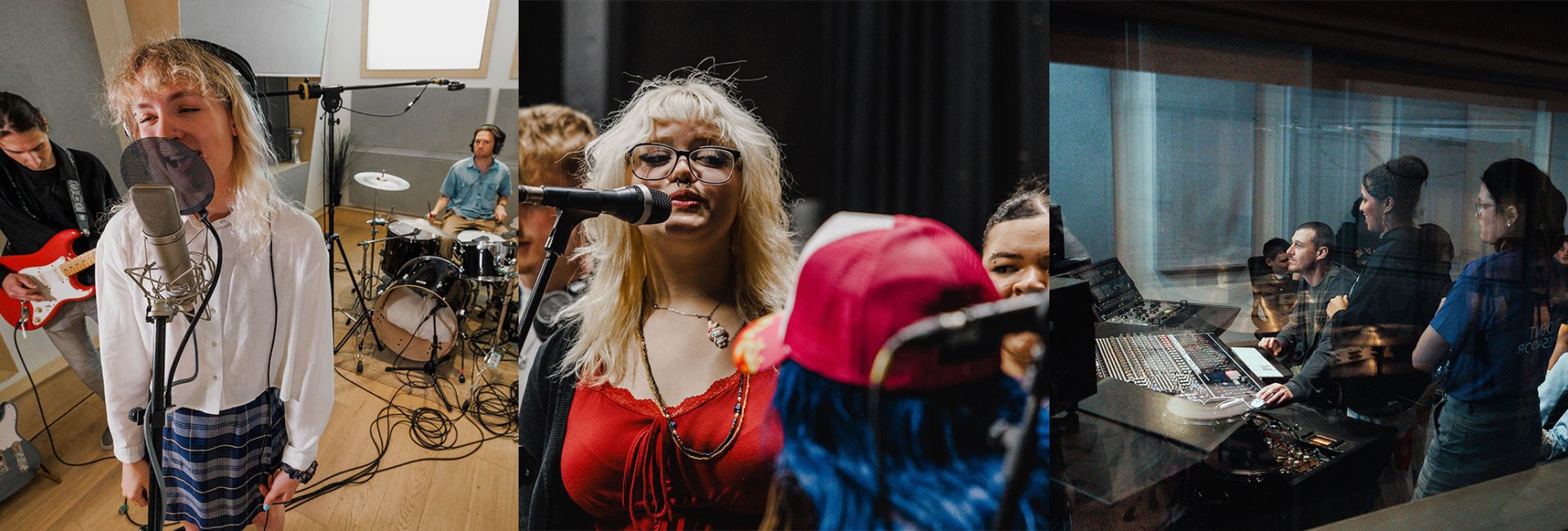
dBs Institute Manchester Open Day
20 Jun 2026, 10:00
Manchester

Our Music Production & Sound Engineering degree is designed to give you the creative, technical, and professional skills needed to excel in today's dynamic music industry. This comprehensive degree course offers you immersive, hands-on experiences from the outset, designed to transform you into a highly skilled music producer and sound engineer equipped with the expertise and confidence to record and produce music at the highest level.
The perfect blend of creativity and technical expertise, you’ll cover recording techniques, composition, modern production methods, and sound engineering principles while being encouraged to push the boundaries of your creative and technical abilities.
Stay ahead of the curve with cutting-edge modules that delve into immersive audio and innovation in sound. Explore the latest in multichannel and spatial audio techniques, including surround sound, object-based audio, and Dolby Atmos, gaining skills that are increasingly in demand within not only the music industry but the games, film, and wider media sectors too.
Our Music Production degree places a strong emphasis on employability, equipping you with the skills to navigate and succeed in the competitive music industry. You'll gain insights into current trends, emerging technologies, and innovative revenue streams, ensuring you're well-prepared for a wide range of career opportunities in music production and sound engineering.
Why Choose This Course?
Professional Studio Experience: Gain extensive hands-on experience in our top-tier studios, equipped with the latest technology at your chosen campus—Bristol, Manchester, or Plymouth.
Industry Connections: Benefit from our strong ties with the music industry, including guest lectures, workshops, and networking opportunities with top professionals and successful alumni.
Skill Development: Our course is designed to develop not just your technical abilities, but also your creativity, critical thinking, and problem-solving skills, making you a well-rounded music production and sound engineering professional.
Throughout your studies you’ll also have access to a substantial guest lecture programme with topics ranging from demonstration and instruction in new technology to personal viewpoints and techniques from experienced professional practitioners.
This course is taught by dBs Institute and awarded by Falmouth University.
Modules
Year 1
Studio Practice
Music Production
Production Analysis
Mixing
Industry Foundations
Creative Recording Techniques
Year 2
Immersive Audio
Industry Practice
Advanced Music Production
Advanced Mixing & Mastering
Research Practice
Applied Acoustics
Year 3
Innovation: Exploration
Investigation
Professional Portfolio Development
Innovation: Realisation
Professional Portfolio Delivery
Research Project
Full course details and module information can be found on our website. Programme structures and modules can change as part of our curriculum enhancement and review processes.
You’ll spend a significant amount of time in state-of-the-art recording studios honing your skills as a music producer and sound engineer, using industry-standard equipment such as mixing consoles, digital audio workstations, high-quality hardware, and microphones. In addition to studio sessions, your learning will be supported by practical workshops, lectures, seminars, group and individual tutorials, and tutor and peer feedback on your work.
Assessment Methods
The following entry points are available for this course:
We welcome applications from students wishing to transfer from their current course or to top up an FdA, HND or similar qualification.
Year 2 Entry: 120 Credits
Year 3 Entry: 240 Credits
We regret that this course is not available to international applicants who would require a Student Visa. If English is not your first language, you will need to demonstrate English language skills that are sufficiently developed for successful completion of your studies. We accept a range of recognised English language qualifications that are equivalent to the International English Language Testing System (IELTS) Academic minimum score of 6.0 overall, with a minimum of 5.5 in Reading, Writing, Speaking and Listening.
A typical offer is between 104 and 120 UCAS points, primarily from Level 3 equivalent qualifications, such as A levels, a BTEC Extended Diploma or a Foundation Diploma, or current, relevant experience. Grade 4 (or C) or above in GCSE English Language, or equivalent, is a minimum language requirement for all applicants. Due to the creative nature of our courses, you will be considered on your own individual merit and potential to succeed on your chosen course. Please contact the dBs Admissions Team for advice if you are predicted UCAS points below this range, or if you have questions about the qualifications or experience you have.
We welcome A Levels in a wide range of subjects, especially in those relevant to the course for which you apply. A typical offer is between 104 and 120 UCAS points.
We welcome BTECs in wide range of subjects, especially in those relevant to the course. A typical offer is between 104 and 120 UCAS points
60 credits (with a minimum of 45 credits achieved at level 3) in a relevant subject.
A typical offer is between 104 and 120 UCAS points
Find out more about qualification requirements for this course.
You can find full information of accepted qualification on our validating partner's website. https://www.falmouth.ac.uk/study/international/english-language-requirements
We consider all applications on their own individual merit and potential. If you are able to demonstrate relevant, current, equivalent experience instead of formal qualifications, we encourage you to apply, you will be considered on an individual basis. Applicants who do not meet our typical offer guidelines may be invited to interview, where you will have the opportunity to discuss your experience and suitability for the course. Please contact us for further details.
This section shows the range of grades that students who received offers were previously accepted on to this course with (learn more).
It is designed to support your research but does not guarantee whether you will or won't get a place.
Admissions teams consider various factors, including interviews, subject requirements, and entrance tests. Check all course entry requirements for eligibility.
We are unable to show previous accepted grades for this course. This could be because the course is new, it's a postgraduate course, there isn't enough historical data, or the provider has opted out of sharing their entry grades data for this course - learn more.
| Location | Fee | Year |
|---|
Tuition fee status depends on a number of criteria and varies according to where in the UK you will study. For further guidance on the criteria for home or overseas tuition fees, please refer to the UKCISA website.
No additional fees or cost information has been supplied for this course, please contact the provider directly.
Email:admissions@dbsinstitute.ac.uk
Phone:01615526467
2 Mitchell Lane
Bristol
BS1 6BU
At dBs Institute