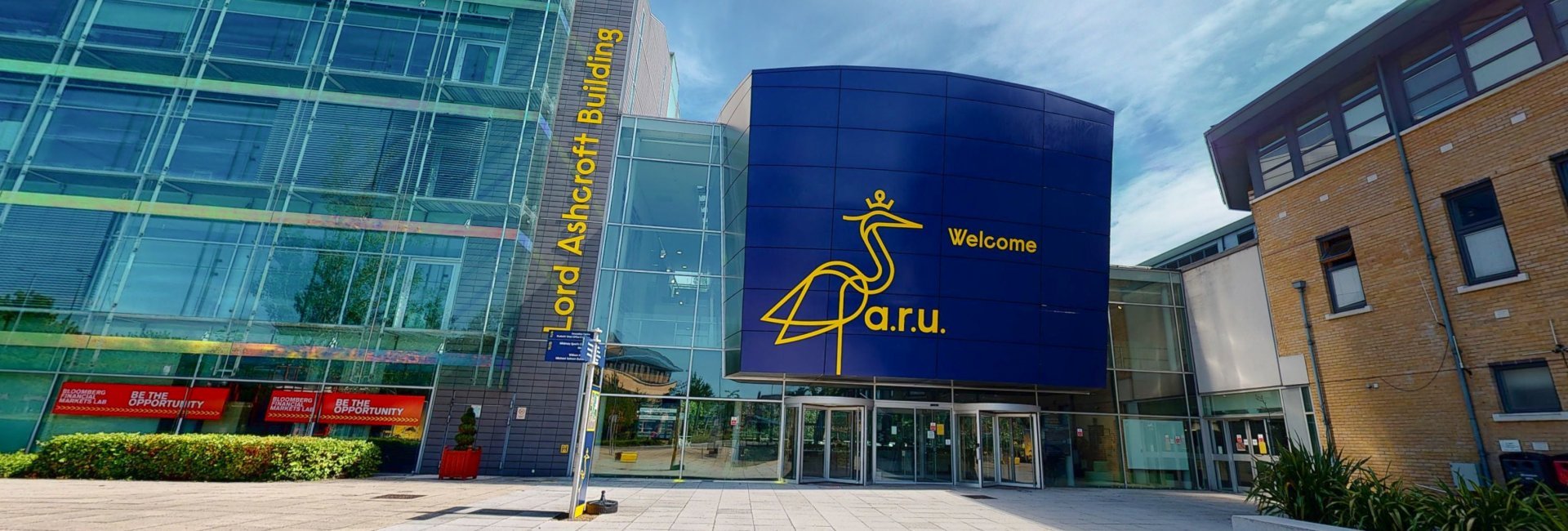
Anglia Ruskin University - Undergraduate Open Day - Cambridge
6 Jun 2026, 09:00
Cambridge

Turn a passion for filmmaking into a career by joining our acclaimed BA (Hons) Film and Television Production degree course at ARU.
Study on a course industry-recognised by ScreenSkills, the industry-led skills body for the UK's screen-based industries, with the ScreenSkills Select quality-mark for courses best suited to prepare you for a career in the screen industries.
Develop your skills in script, cinematography, editing, producing, and directing, in studio and on location.
Benefit from support from award-winning lecturers whose work has been screened on all the major UK television networks, as well as at multiple international film festivals.
Join a course whose students' films have won awards in the regional and National Royal Television Society Student Awards over many years.
Get hands-on in our specialist film facilities, with full training from our technical team.
Take advantage of our links with local and national organisations, which will help you make contacts, find work placements, take part in "live briefs", and even give you the opportunity to show your films publicly at Cambridge Arts Picturehouse.
Join our organised trips to Sheffield Documentary Festival, Camerimage in Poland and Aesthetica Short Film Festival in York.
Join the award-winning students on our BA (Hons) Film and Television Production degree and develop your skills in script, cinematography, editing, producing and directing in studio and on location. If you don't want to just watch film and television, but make it, this is the course for you.
As a production course, this is all about the filmmaking. Your modules will be around 80% practice-based to 20% context and research.
Over the three years you'll gain key skills, from ideas development and scripting to pre-production planning and shooting, through to post-production skills in editing and colour grading. You can choose to keep a broad skillset or start to specialise in particular craft areas like producing, camera or editing.
You'll shoot on digital formats from HD to 4K and analogue 16mm film. By the final year, you and your crew will be working with feature film industry level equipment like our new Arri Alexa Mini cameras.
You'll learn from highly experienced filmmakers, television producers and technical officers in our specialist facilities. With an emphasis on collaborations, you'll have opportunities to work with students from all the year groups as well as your lecturers on this small, focused and friendly course.
Whether your career aspirations are to crew on high-end TV drama or film, work in post-production, set up your own company as a videographer, create stunning cinematography or innovative online content, reinvent what television is, or use film to make change in the world, the skills you learn on this course will set you up to start that journey.
As a BA (Hons) Film and Television Production student at ARU, you'll be supported by award-winning, lecturers whose work has been screened on all the major UK television networks, as well as at multiple international film festivals. They have won Emmys, HUGOs and BAFTAs and continue to make films and programmes.
You'll produce a range of programmes and films that may be as prize and film festival-worthy as our other recent student work.
Our students’ films have been very successful in the regional Royal Television Society Student Awards. In 2024, the film Eternity’s Grace won both the Drama and Camerawork categories, while Therapy won first place in the Entertainment and Comedy Drama category in 2023. In 2021, Lidia Bieniarz won the Best Short Form Film category as well as the top prize – The Sir Lenny Henry Award, while Agata Kazmierczak won best editing.
You’ll also have the chance to join our organised trips and take part in live briefs with partner organisations.
Year 1 Core modules: Screen Skills; Film Language; Film Drama: Production and Practices; Screen Skills Intermediate; Television Production and Practice. Year 2 Core modules: Documentary Making; Advanced Screen Skills 1; Fiction Filmmaking; Advanced Screen Skills 2; Ruskin Module.Year 2 Optional modules: Independent Cinema: US and Beyond; Filmmakers on Film; Theorising Spectatorship. Year 3 Core modules: Film and Television Production Major Project; Graduation Films.Year 3 Optional modules: Commissions and Collaborations; Working in the Creative Industries. Modules are subject to change and availability.
You will be given verbal and written feedback at key stages of each module, for example, on project proposals, scripts, works in progress. You’ll be assessed via assessment on group projects; contribution and engagement; presentations; reports; written critical reflections and contextual analysis; essays – written and visual; scripts, proposals and written pitches; portfolios, including final programs and films; individual research workbooks or research files and material; production documentation; marketing materials; and showreels.
This is the equal consideration deadline. You can still apply after this date, but your application may not receive guaranteed consideration.

Anglia Ruskin University has participated in the Teaching Excellence Framework. These ratings were awarded in 2023, for four years.
See why these ratings were awarded
What does this TEF outcome mean?
The following entry points are available for this course:
Find out more about qualification requirements for this course.
ARU operates a policy of making contextualised offers for this course which may be a reduced conditional offer or an unconditional offer, using data from UCAS to make our assessment. We consider that this approach promotes the equality of educational opportunity for applicants from low participation groups in HE. ARU welcomes students from diverse backgrounds and helping them achieve their full potential. The offer of a place through the contextual offer process is at the discretion of ARU.
This section shows the range of grades students (with UK A-Levels or Pearson BTEC Level 3 National Extended Diplomas) who received offers were previously accepted with (learn more). It is designed to support your research but does not guarantee whether you will or won't get a place. Admissions teams consider various factors, including interviews, subject requirements, and entrance tests. Check all course entry requirements for eligibility.
We are unable to show previous accepted grades for this course. This could be because the course is new, it's a postgraduate course, there isn't enough historical data, or the provider has opted out of sharing their entry grades data for this course - learn more.
| Location | Fee | Year |
|---|---|---|
| England | £9535 | Year 1 |
| Northern Ireland | £9535 | Year 1 |
| Scotland | £9535 | Year 1 |
| Wales | £9535 | Year 1 |
| Channel Islands | £9535 | Year 1 |
| Republic of Ireland | £9535 | Year 1 |
Tuition fee status depends on a number of criteria and varies according to where in the UK you will study. For further guidance on the criteria for home or overseas tuition fees, please refer to the UKCISA website.
https://www.aru.ac.uk/student-life/preparing-for-study/help-with-finances/undergraduate
https://www.aru.ac.uk/study/tuition-fees
East Road
Cambridge
CB1 1PT
Visit our website Visit our course page
Email:answers@aru.ac.uk
Phone:01245 68 68 68
At Anglia Ruskin University