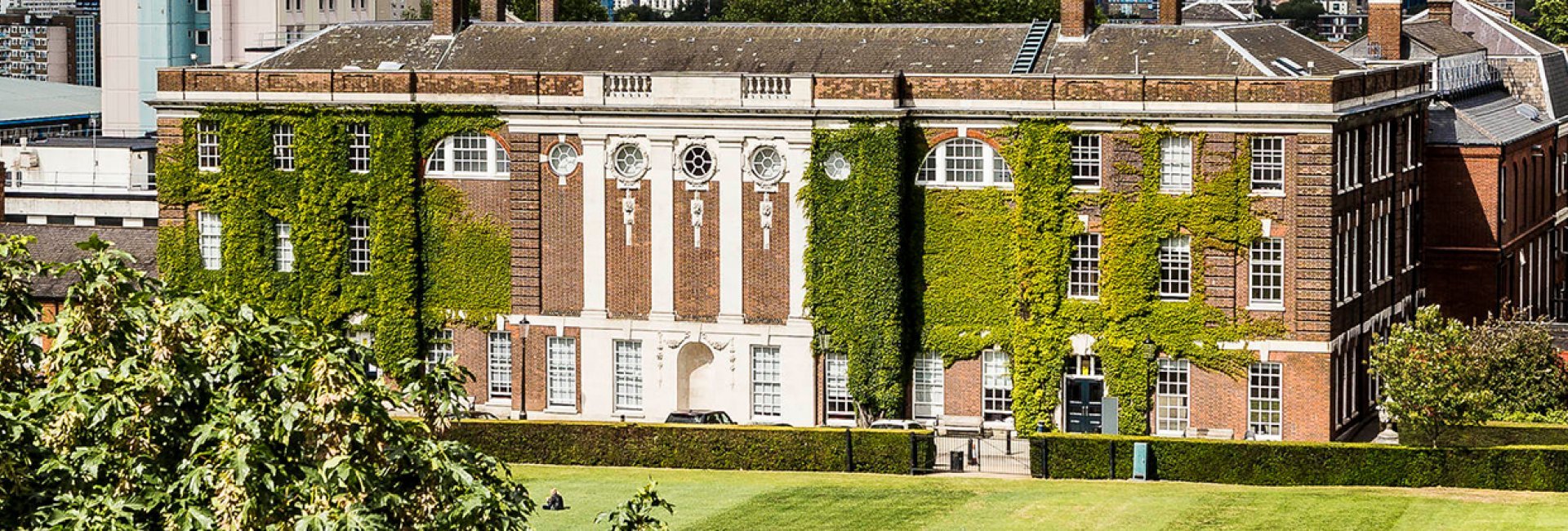
Goldsmiths, University of London - Virtual Campus Tour
25 Nov 2025, 12:00
London

Why study BA International Relations (with Integrated Foundation Year) at Goldsmiths
Discover the key institutions and ideas that are shaping the political world around you in these turbulent times.
Our BA in International Relations (with Integrated Foundation Year) offers an alternative entry route for students without the qualifications required for degree-level study
Before progressing onto one of the Department of Politics and International Relations' undergraduate programmes, you will have the chance to develop your academic skills and knowledge of the subject. You are able to select the undergraduate degree you wish to study at the point of application but be able to change as you progress through the foundation pathway if your interests change
You will receive an introduction to the study of politics and gain a better understanding of democracy, political parties, ideologies and movements
Develop an understanding of the political background of contemporary issues such as Brexit, global governance, everyday conflicts around identity and culture, climate change and more
View politics from a range of different perspectives, such as those of feminism, post-colonial thinking, or economics
Learn to write about politics in useful ways, such as essays, political speeches and manifestos
Develop your academic skills including how to present ideas effectively in writing; read, analyse and critically respond to a range of texts; participate effectively in academic discussion; identify how research is conducted in higher education; and compare different research methodologies
A degree in international relations will provide you with an in-depth understanding of the processes and outcomes of world politics, including the relations between states, security and conflict, and global cooperation and governance.
At Goldsmiths you will study these themes in a way that reflects the College’s reputation as an institution at the forefront of critical thinking in the arts, humanities and cultural studies.
Our programme provides you with a contemporary perspective on international relations, one that prioritises Non-Western and Global South actors, institutions and ideas that challenge the post-Cold War liberal international order.
Not only will you study the ‘high politics’ of international relations – war, multilateral cooperation and international trade and finance – but international politics 'from below', focused on climate change, migration, human rights, human security and indigenous demands for global justice.
In line with the interdisciplinary approach to politics of the department, you will encounter ‘the international’ in diverse sites of cultural practices, including the politics of vision, non-Western political thought and music.
Studying international relations at Goldsmiths you will acquire a wide range of transferable academic and research skills suitable for the workplace or postgraduate study.
You can put your knowledge into practice with our work placement module. Work with organisations in the international relations sector, such as policy think-tanks, development agencies and NGOs and get real experience before you graduate.
Studying an international relations degree in London means that Westminster, global business, and diverse diasporas are all in easy reach.
When you join Goldsmiths you will become part of a global academic family, with students from more than 130 countries and alumni around the globe.
Year 0 (Foundation Year)
Developing your academic skills
Alongside direct preparation for an undergraduate degree in International Relations, you will take two modules with our Centre for Academic Language and Literacies (CALL). These modules will help you develop the broader academic and research skills required for undergraduate study.
You will also learn how key social and political movements of the period have influenced the world we live in today through a cross-disciplinary module: Culture and Society in Post-war Britain. This module will cover topics such as 'Windrush and Migration', 'Irish Colonisation', 'Second-wave Feminism', 'Protest and Punk' and 'South-Asian Britain'.
Reading and Writing Your World
Building Your Research World
Culture and Society in Postwar Britain
Politics in an Age of Crisis
Year 1
You will study the following compulsory modules:
World Politics
Colonialism, Power, Resistance
Everything is a Text
Researching our Lives and Worlds
Political Theory and Ideologies
Year 2
You will study the following compulsory modules:
Researching Politics
Global Governance and World Order
Rough Politics
The Goldsmiths Elective
Optional modules
You will also choose optional modules to the value of 60 credits from a list approved by the Department of Politics and International Relations.
Year 3
You will study the following compulsory modules:
Dissertation
Security Studies
Optional modules
You will also choose 75 credits of optional modules.
Current examples include:
Colonialism and Non-Western Political Thought
Migration, Technology, and Humanitarianism
The Politics of Memory
Ethics and Economics of Environmental Protection
Fascisms, Old and New
The Politics of Popular Music
Work Placement (Politics)
Work Placement module
This optional module gives students experience of working in a range of organisations in the NGO sector such as charities, think-tanks and pressure groups, bodies connected with international organisations, appropriate businesses, and political parties.
There will be a pool of guaranteed places which will be allocated on the basis of appropriateness of the placement to the student's interests. However, we also encourage you to take the opportunity to find your own placements and will support you in that process. We would hope that all students will be able to take up the opportunity should an appropriate placement be found.
Please note that due to staff research commitments not all of these modules may be available every year.
You’ll be assessed by a variety of methods that broaden your academic skillset, depending on your module choices. These include coursework assignments such as essays, case studies, critical commentaries, presentations and personal reflections.
This is the equal consideration deadline. You can still apply after this date, but your application may not receive guaranteed consideration.

Goldsmiths, University of London has participated in the Teaching Excellence Framework. These ratings were awarded in 2023, for four years.
See why these ratings were awarded
What does this TEF outcome mean?
The following entry points are available for this course:
You are also required to have achieved a Level 2 qualification in GCSE English at Grade 4 or above.
For candidates who have not studied any Level 3 qualifications in the last two years, there are no formal qualifications required for admission, but you will need to demonstrate that you can benefit from the programme by undertaking an additional admissions process. This may involve an interview or request for the submission of written information used to assess suitability to study.
We’ll pay particularly careful attention to your personal statement, which is your opportunity to demonstrate your interest in the subject you’ve applied for. Your referees are also welcome to include any relevant contextual comments around your academic achievements. We’ll look at all these things when making a decision on your application, as well as your qualifications and grades.
This section shows the range of grades that students who received offers were previously accepted on to this course with (learn more).
It is designed to support your research but does not guarantee whether you will or won't get a place.
Admissions teams consider various factors, including interviews, subject requirements, and entrance tests. Check all course entry requirements for eligibility.
We are unable to show previous accepted grades for this course. This could be because the course is new, it's a postgraduate course, there isn't enough historical data, or the provider has opted out of sharing their entry grades data for this course - learn more.
No fee information has been provided for this course
Tuition fee status depends on a number of criteria and varies according to where in the UK you will study. For further guidance on the criteria for home or overseas tuition fees, please refer to the UKCISA website.
To find out more about fees and funding, please check our undergraduate fees guidance or contact the Fees Office https://www.gold.ac.uk/ug/fees-funding/
Email:course-info@gold.ac.uk
Phone:020 7078 5300
Email:cshub@gold.ac.uk
Phone:020 8228 5550
New Cross
Lewisham
SE14 6NW
At Goldsmiths, University of London