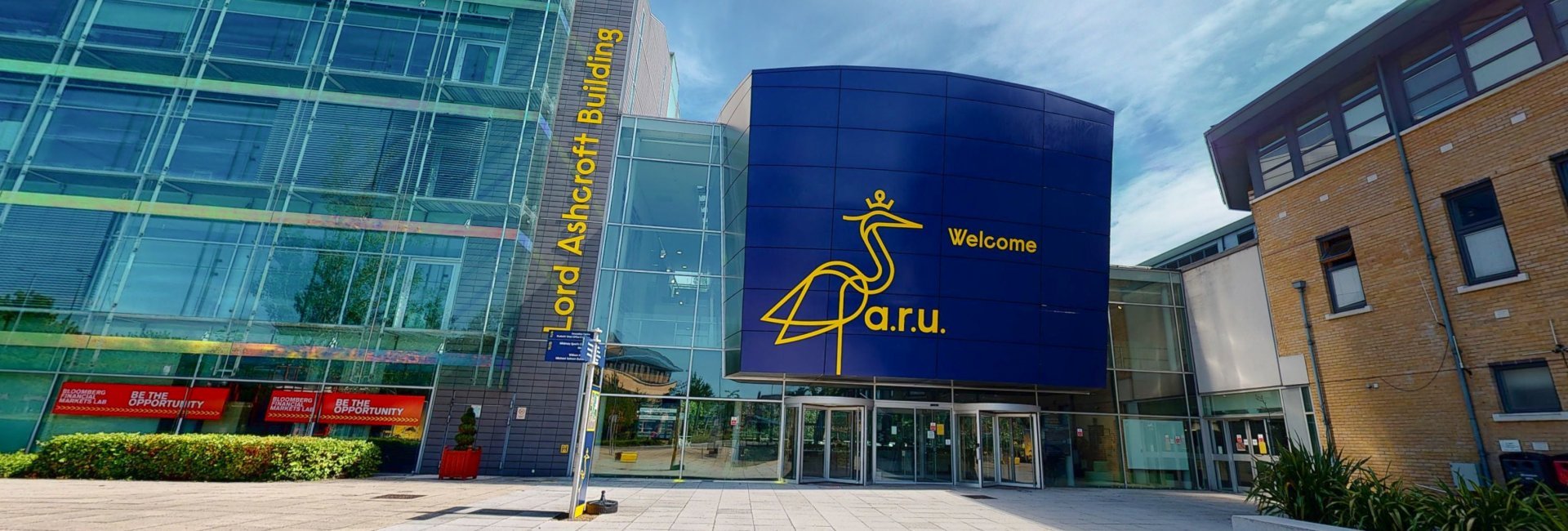
Anglia Ruskin University - Undergraduate Open Day - Cambridge
6 Jun 2026, 09:00
Cambridge

Specialise in the design and analysis of built environment projects, focusing on infrastructure.
You'll be immersed in an integrated learning environment designed to foster environmentally sustainable approaches.
We intertwine in-class engineering theory, in-lab hands-on experience, and on-site practical construction activities throughout our course.
Bring the world of work to life through Live Briefs; designed and developed with regional employers to give you exposure to ‘real world’ problem-solving.
Our course is developed by a dynamic collaboration of staff, students, and leading regional companies, meaning students on this course have maximum opportunity to gain critical skills for employment.
With challenges such as climate change and resource scarcity, engineers have an important part to play in designing, planning and future-proofing our built environment.
By studying BEng (Hons) Civil Engineering at ARU, you’ll focus on the design and analysis of infrastructure.
From day one of this civil engineering degree, you will be working on real built environment projects. Our course is project-based, meaning you’ll be getting hands-on experience – and learning to think and work like an engineer.
Designing and building structures like bridges, roads, airports and flood defences demands a high degree of technical skill. Our Civil Engineering BEng course will teach you to approach projects competently, ethically and safely.
It’s a practical course where you’ll learn to carry out site investigations and land surveys, select materials, analyse and design infrastructure and engineering systems, and plan the construction process. There’s a strong focus on sustainability and understanding the environmental impact of your work. You’ll also become skilled at using computer-aided design and specialist software.
You’ll learn from expert tutors in specialist facilities, including labs for geotechnics, hydraulics, concrete testing and more.
Outside of the lab, there’s the chance to join lectures given by guest speakers and take an optional placement year in industry. You'll also take part in three week-long construction projects during your course.
This degree is accredited by the Joint Board of Moderators, comprising the Institution of Civil Engineers (ICE), Institution of Structural Engineers, Institute of Highway Engineers, the Chartered Institution of Highways and Transportation (CIHT) and the Permanent Way Institution on behalf of the Engineering Council, for the purposes of partially meeting the academic requirement for registration as a Chartered Engineer (CEng).
Going to university can offer you a series of once-in-a-lifetime opportunities. As part of your course, you could study abroad with one of our short-term Global Experience programmes. Opportunities include summer schools and placements, lasting from one to four weeks and funded by ARU’s UK Turing Scheme grants.
Year 1
Feasibility and Flood Hydrology Project (30 credits)
Introduction to Engineering (15 credits)
Applied Engineering Mathematics (15 credits)
Structural Mechanics (15 credits)
Building Information Modelling for Civil Engineering (15 credits)
Materials, Design and Construction Project (30 credits)
Year 2
Structure and Construction Project (30 credits)
Sustainable Conceptual Design for Civil Engineering (30 credits)
Ruskin Module (15 credits)
Hydraulics (15 credits)
Advanced Engineering Mathematics (15 credits)
Structural Analysis (15 credits)
Year 3
Civil Engineering Design Project (30 credits)
Geotechnics and Nature-based Solutions Project (30 credits)
Research Methods and Individual Project (30 credits)
Structural Dynamics (15 credits)
Civil Engineering Materials and Manufacture (15 credits)
Throughout the course, we’ll use a range of assessment methods to help you and your tutors measure your progress. Besides exams, you’ll demonstrate your learning though a mix of assignments, group work, presentations, drawings, lab work and projects.
Professionally accredited courses provide industry-wide recognition of the quality of your qualification.
This is the equal consideration deadline. You can still apply after this date, but your application may not receive guaranteed consideration.

Anglia Ruskin University has participated in the Teaching Excellence Framework. These ratings were awarded in 2023, for four years.
See why these ratings were awarded
What does this TEF outcome mean?
The following entry points are available for this course:
We welcome applications from international and EU students, and accept a range of international qualifications.
Find out more about qualification requirements for this course.
ARU operates a policy of making contextualised offers for this course which may be a reduced conditional offer or an unconditional offer, using data from UCAS to make our assessment. We consider that this approach promotes the equality of educational opportunity for applicants from low participation groups in HE. ARU welcomes students from diverse backgrounds and helping them achieve their full potential. The offer of a place through the contextual offer process is at the discretion of ARU.
This section shows the range of grades students (with UK A-Levels or Pearson BTEC Level 3 National Extended Diplomas) who received offers were previously accepted with (learn more). It is designed to support your research but does not guarantee whether you will or won't get a place. Admissions teams consider various factors, including interviews, subject requirements, and entrance tests. Check all course entry requirements for eligibility.
We are unable to show previous accepted grades for this course. This could be because the course is new, it's a postgraduate course, there isn't enough historical data, or the provider has opted out of sharing their entry grades data for this course - learn more.
| Location | Fee | Year |
|---|---|---|
| England | £9535 | Year 1 |
| Northern Ireland | £9535 | Year 1 |
| Scotland | £9535 | Year 1 |
| Wales | £9535 | Year 1 |
| Channel Islands | £9535 | Year 1 |
| Republic of Ireland | £9535 | Year 1 |
Tuition fee status depends on a number of criteria and varies according to where in the UK you will study. For further guidance on the criteria for home or overseas tuition fees, please refer to the UKCISA website.
https://www.aru.ac.uk/student-life/preparing-for-study/help-with-finances/undergraduate
https://www.aru.ac.uk/study/tuition-fees
East Road
Cambridge
CB1 1PT
Visit our website Visit our course page
Email:answers@aru.ac.uk
Phone:01245 686868
Email:answers@aru.ac.uk
Phone:01245 686868
At Anglia Ruskin University