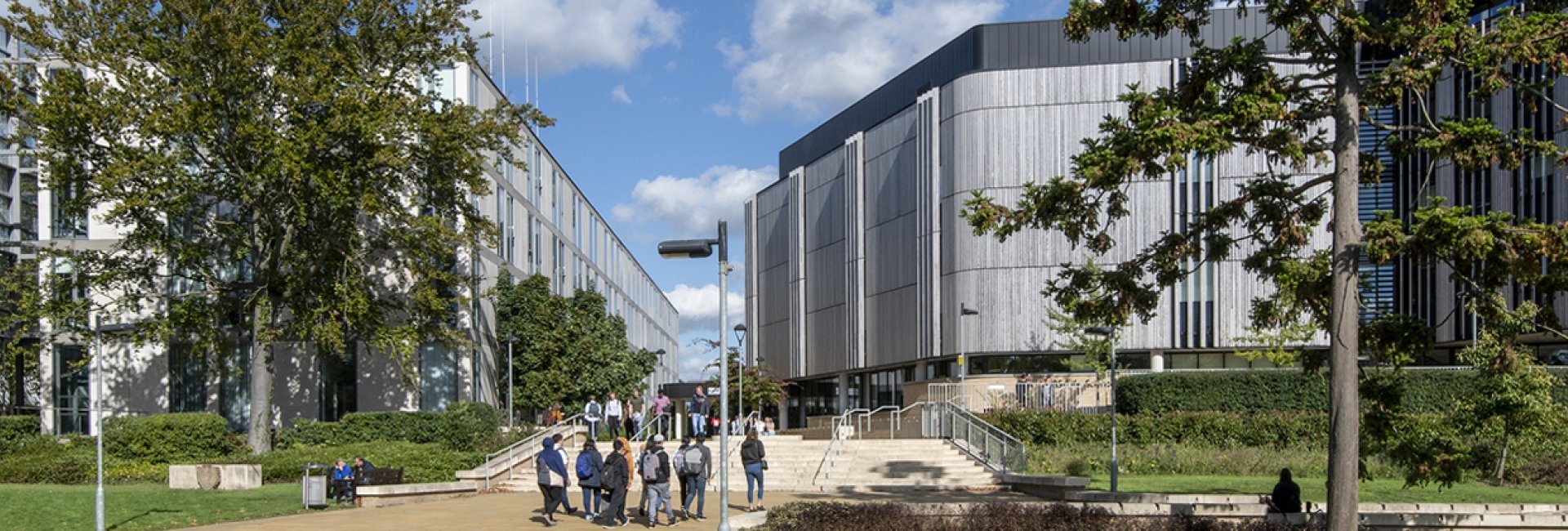
Winchester School of Art - Open Day
6 Jun 2026, 09:00
Winchester

Acoustical engineering is the application of acoustics – the science of sound and vibration – in technology, with broad applications from the design of cars, 3D-audio systems and concert halls, to reducing aircraft noise and using ultrasound to fight antimicrobial resistance.
As an acoustical engineering student, you will develop specialist knowledge of sound, vibration and their human effects, in addition to a solid foundation in a wide range of engineering fundamentals. You will learn by studying the theoretical principles of acoustical engineering alongside practical design modules and projects.
During your first two years, you will study specialist modules in acoustics and audio signal processing, alongside the core principles of mechanical engineering, including mechatronics and electronics. In your third year, advanced modules and an individual project will deepen your understanding of acoustics and human responses to sound and vibration.
You'll have access to our extensive facilities, including dedicated student design studios and workshops, anechoic and reverberation chambers, a listening room, aeroacoustic wind tunnel, loudspeaker audio lab and a virtual acoustics laboratory.
Your Industrial Placement Year will enhance your employability, with an additional year-long paid placement in an engineering organisation. You will be able to apply the knowledge and skills that you developed during the early years of your degree, developing vital professional knowledge and skills to prepare you to become a professional engineer after graduation.
Our acoustical engineering courses are accredited by the Institution of Mechanical Engineers, and offer a route to chartered status. They also meet the educational requirements for the Institute of Acoustics.
Typical modules include:
Year one: Acoustics; Engineering Design; Electrical and Electronic Systems; Mathematics; Mechanics, Structures and Materials; Thermofluids
Year two: Acoustics; Audio and Signal Processing; Electronics, Drives and Control; Engineering Management and Law; Fluid Mechanics; Mathematics; Mechanics, Machines and Vibration; Systems Design and Computing
Year three: Individual Project; Acoustical Engineering Design; Human Response to Sound and Vibration; Noise Control Engineering; plus additional module options.
Testing is conducted through a combination of unseen written examinations and assessed coursework in the form of problem-solving exercises, laboratory reports, design exercises, essays, and individual and group projects. Experimental, research and design skills are assessed through laboratory reports, coursework exercises and oral presentations.
The Industrial Placement Year is assessed via an individual reflective report.
Professionally accredited courses provide industry-wide recognition of the quality of your qualification.
This is the equal consideration deadline. You can still apply after this date, but your application may not receive guaranteed consideration.

University of Southampton has participated in the Teaching Excellence Framework. These ratings were awarded in 2023, for four years.
See why these ratings were awarded
What does this TEF outcome mean?
The following entry points are available for this course:
Find out about equivalent entry requirements and qualifications for your country: https://www.southampton.ac.uk/uni-life/international/your-country.page
AAB including mathematics (minimum grade A) and either chemistry, electronics, further mathematics or physics (minimum grade A).
A pass in the science Practical is required where it is separately endorsed. Offers typically exclude General Studies and Critical Thinking.
If you are taking an EPQ in addition to 3 A levels, you will receive the following offer in addition to the standard A level offer: ABB including mathematics (minimum grade A) and either chemistry, electronics, further mathematics or physics, plus grade A in the EPQ.
We are committed to ensuring that all applicants with the potential to succeed, regardless of their background, are encouraged to apply to study with us. The additional information gained through contextual data allows us to recognise an applicant's potential to succeed in the context of their background and experience. Applicants who are highlighted in this way will be made an offer which is lower than the typical offer for that programme.
Applicants who have not studied the required subjects at A-level can apply for the Engineering/Physics/Mathematics Foundation Year.
We normally consider applicants who offer at least 1 Advanced Higher. Applicants presenting with only Highers will be considered on a case by case basis. Where Highers are taken over two years it might be expected that higher grades are achieved, particularly in any specific subjects required. For example, S5 – S6 (2 years): AABBB (A in specific subject) or S6 (1 year): ABBBB (A in specific subject).
Unless a more advanced level (Higher or Advanced Higher) is specified in the stated entry requirements, all applicants will be required to have achieved a pass in Mathematics and English at Standard Grade, Grade 3 or National 5, Grade C, the equivalent of GCSE Grade C/ Grade 4"
We are committed to ensuring that all learners with the potential to succeed, regardless of their background, are encouraged to apply to study with us. The additional information gained through contextual data allows us to recognise a learner's potential to succeed in the context of their background and experience. Applicants who are highlighted in this way will be made an offer which is lower than the typical offer for that programme.
D in the BTEC National Extended Certificate plus grades AA from two A-levels including mathematics and either chemistry, electronics, further mathematics or physics.
A pass in the science Practical is required where it is separately endorsed. Offers typically exclude General Studies and Critical Thinking.
We are committed to ensuring that all learners with the potential to succeed, regardless of their background, are encouraged to apply to study with us. The additional information gained through contextual data allows us to recognise a learner’s potential to succeed in the context of their background and experience. Applicants who are highlighted in this way will be made an offer which is lower than the typical offer for that programme.
D in the BTEC Subsidiary Diploma plus grades AA from two A-levels including mathematics and either chemistry, electronics, further mathematics or physics.
A pass in the science Practical is required where it is separately endorsed. Offers typically exclude General Studies and Critical Thinking.
We are committed to ensuring that all learners with the potential to succeed, regardless of their background, are encouraged to apply to study with us. The additional information gained through contextual data allows us to recognise a learner’s potential to succeed in the context of their background and experience. Applicants who are highlighted in this way will be made an offer which is lower than the typical offer for that programme.
Offers will be based on exams being taken at the end of S6. Subjects taken and qualifications achieved in S5 will be reviewed. Careful consideration will be given to an individual’s academic achievement, taking in to account the context and circumstances of their pre-university education. Please see the University of Southampton’s Curriculum for Excellence Scotland Statement for further information. Applicants are advised to contact their Faculty Admissions Office for more information.
Pass, with 34 points overall with 17 points at Higher Level, including 6 at Higher Level in Mathematics: Analysis and Approaches or 7 at Higher Level in Mathematics: Applications and Interpretation, and 6 at Higher Level in Chemistry or Physics
We are committed to ensuring that all learners with the potential to succeed, regardless of their background, are encouraged to apply to study with us. The additional information gained through contextual data allows us to recognise a learner’s potential to succeed in the context of their background and experience. Applicants who are highlighted in this way will be made an offer which is lower than the typical offer for that programme.
International Baccalaureate Career Programme (IBCP) offer
Offers will be made on the individual Diploma Course subject(s) and the career-related study qualification. The CP core will not form part of the offer. Where there is a subject pre-requisite(s), applicants will be required to study the subject(s) at Higher Level in the Diploma course subject and/or take a specified unit in the career-related study qualification. Applicants may also be asked to achieve a specific grade in those elements.
Please see the University of Southampton International Baccalaureate Career-Related Programme (IBCP) Statement for further information. Applicants are advised to contact their Faculty Admissions Office for more information.
AAB from 3 A levels including mathematics (minimum grade A) and either chemistry, electronics, further mathematics or physics
or
AA from two A levels including mathematics and either chemistry, electronics, further mathematics or physics and B from the Advanced Skills Baccalaureate Wales.
A pass in the science Practical is required where it is separately endorsed. Offers typically exclude General Studies and Critical Thinking. Applicants who have not studied the required subjects can apply for the Engineering/Physics/Mathematics Foundation Year.
AAB from 3 A levels including mathematics (minimum grade A) and either physics, further mathematics, electronics or chemistry (minimum grade A) or AA from two A levels including mathematics (minimum grade A) and either physics, further mathematics, electronics or chemistry (minimum grade A) and B from the Advanced Welsh Baccalaureate Skills Challenge Certificate.
A pass in the science Practical is required where it is separately endorsed. Offers typically exclude General Studies and Critical Thinking
We are committed to ensuring that all learners with the potential to succeed, regardless of their background, are encouraged to apply to study with us. The additional information gained through contextual data allows us to recognise a learner’s potential to succeed in the context of their background and experience. Applicants who are highlighted in this way will be made an offer which is lower than the typical offer for that programme.
AAB from 3 A levels including mathematics (minimum grade A) and either chemistry, electronics, further mathematics or physics (minimum grade A) or AA from two A levels including mathematics (minimum grade A) and either chemistry, electronics, further mathematics or physics (minimum grade A) and B from the Advanced Welsh Baccalaureate Skills Challenge Certificate
A pass in the science Practical is required where it is separately endorsed. Offers typically exclude General Studies and Critical Thinking. Applicants who have not studied the required subjects at A-level can apply for the Engineering/Physics/Mathematics Foundation Year.
H1 H2 H2 H2 H2 H2 including mathematics, applied mathematics and either chemistry, physics or physics-chemistry
D3 D3 M2 in three Principal subjects including mathematics (minimum grade D3) and either chemistry, further mathematics or physics (minimum grade D3)
We are committed to ensuring that all learners with the potential to succeed, regardless of their background, are encouraged to apply to study with us. The additional information gained through contextual data allows us to recognise a learner’s potential to succeed in the context of their background and experience. Applicants who are highlighted in this way will be made an offer which is lower than the typical offer for that programme.
Cambridge Pre-U's can be used in combination with other qualifications such as A levels to achieve the equivalent of the typical offer, where D2 can be used in lieu of A-level grade A* or grade D3 can be used in lieu of A-level grade A.
Applicants must hold GCSE English language (or GCSE English) (minimum grade 4/C) and mathematics (minimum grade 4/C)
Find out more about qualification requirements for this course.
| Test | Grade | Additional details |
|---|---|---|
| IELTS (Academic) | 6.5 | with no component below 6.0 |
Find out more about the University’s English Language requirements https://www.southampton.ac.uk/studentadmin/admissions/admissions-policies/language.page
Most of the students who enrolled on this course in previous years met their offer conditions at our published entry criteria, securing their place on their chosen course.
We encourage all applicants with the potential to succeed, regardless of their background, to apply to study with us. Applicants who qualify for contextual admissions will be made an offer which is lower than the typical offer for that programme.
This section shows the range of grades that students who received offers were previously accepted on to this course with (learn more).
It is designed to support your research but does not guarantee whether you will or won't get a place.
Admissions teams consider various factors, including interviews, subject requirements, and entrance tests. Check all course entry requirements for eligibility.
We are unable to show previous accepted grades for this course. This could be because the course is new, it's a postgraduate course, there isn't enough historical data, or the provider has opted out of sharing their entry grades data for this course - learn more.
| Location | Fee | Year |
|---|
Tuition fee status depends on a number of criteria and varies according to where in the UK you will study. For further guidance on the criteria for home or overseas tuition fees, please refer to the UKCISA website.
Please see our website for further details and updates: www.southampton.ac.uk/uni-life/fees-funding.page
At University of Southampton