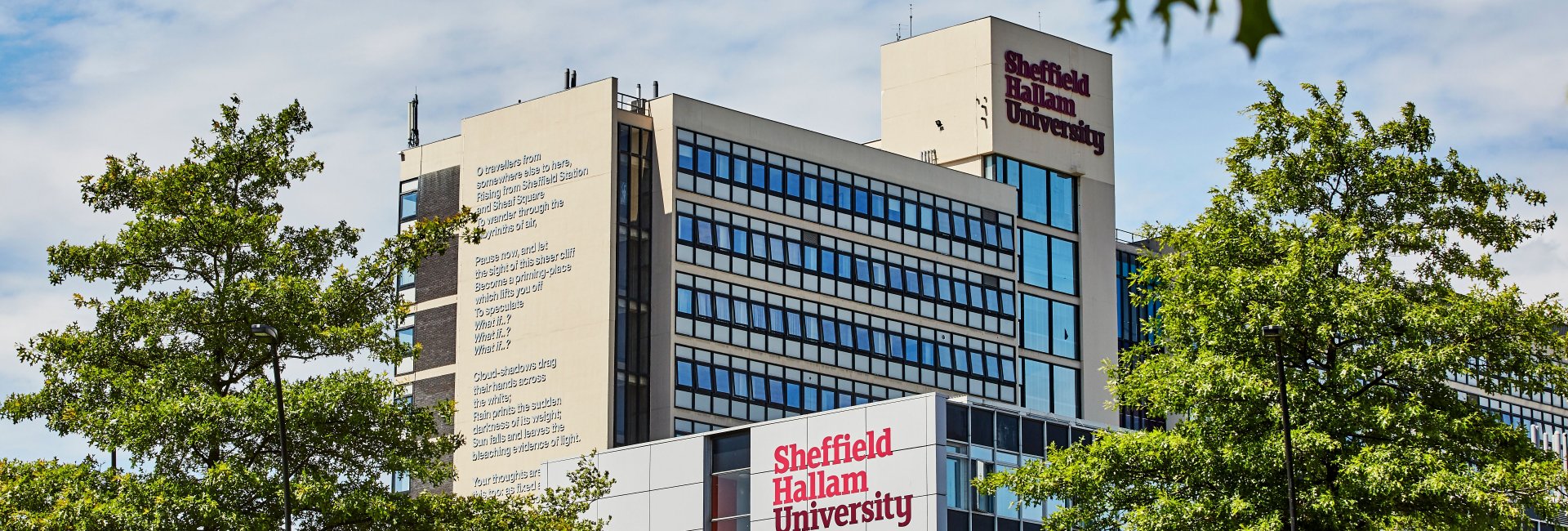
Course contact details
Student Recruitment Operations Team
Phone:(+44) 0114 225 5533
Sheffield Hallam University
City Campus
Howard Street
Sheffield
S1 1WB

Please check the Sheffield Hallam University website for the latest information
Course summary
Study the drivers and impacts of the climate emergency, combining multidisciplinary approaches to explore solutions for a sustainable future
Gain anti-colonial, global perspectives of the varied dimensions of sustainability challenges, from environmental science, ecology, policy and social science
Combine work placements and innovative classroom learning to develop applied analytical skills for sustainable environmental management
Build your network with ethical business leaders, international partners and voluntary organisations
Prepare for the degree with an extra foundation year at the start
This applied course will prepare you to tackle critical global challenges, with specialist knowledge in topics of critical importance. You’ll become a catalyst of change, harnessing practical skills relevant to business, the public sector, research and non-governmental organisations.
This course is professionally accredited by the Institution of Environmental Sciences.
How you learn
On this course you’re able to specialise in critical areas for green careers, building your education around your ambitions. Crucially, the course is centred on applied, real-world experience, developed through employers, international partnerships, and civic activities within the local community.
Learning and assessment is focused on hands-on, skills-based learning – taking a positive, solutions-based approach to the existential challenges posed by complex connections between the natural world and society. You’ll benefit from both classroom and real-world training – preparing yourself to face a future that demands urgent action.
High-quality teaching will be delivered by academics who conduct cutting-edge research – many of whom have professional experience in the environmental sector. Their specialisms include social patterns of resource consumption, rewilding and ecology, and environmental geoscience.
Key themes
This course is designed to ignite your passion for change. With inclusion at its core, the course takes an anti-colonial, international approach to climate, sustainability and environment teaching and learning. By bringing together natural and social sciences, you’ll explore a range of interconnected themes crucial to understanding and addressing the climate and biodiversity emergencies.
Pathway themes include:
Energy, resources and consumption
Environmental change
Sustainable societies
Nature’s recovery
Within these themes, topics include the energy transition, conservation and habitat management, adaptation and mitigation for a low-carbon future, sustainable waste and resource management, social and environmental justice, and disaster risk reduction.
You’ll also have the opportunity to study and work abroad, with the possibility of funding through the Turing Scheme.
Applied learning
Your course has been designed to embrace real-world challenges and provide you with the practical skills and knowledge to be successful.
Work placement and study abroad
You’ll have the opportunity to arrange a year-long work placement in between your second and final years. This gives you valuable work experience to prepare you for your future career and allows you to graduate with an Applied Professional Diploma to add to your CV.
A sandwich placement is recognised as the ‘gold standard’ opportunity to apply your knowledge within an industry of your choice, which we expect all our students to aspire to. Your course is designed to give you the knowledge, confidence and readiness to secure and succeed in your placement.

Sheffield Hallam University has participated in the Teaching Excellence Framework. These ratings were awarded in 2023, for four years.
See why these ratings were awarded
What does this TEF outcome mean?
This course may be available at alternative locations, please check if other course options are available.
Course optionsThere are no specific entry requirements for this course.
This section shows the range of grades that students who received offers were previously accepted on to this course with (learn more).
It is designed to support your research but does not guarantee whether you will or won't get a place.
Admissions teams consider various factors, including interviews, subject requirements, and entrance tests. Check all course entry requirements for eligibility.
We are unable to show previous accepted grades for this course. This could be because the course is new, it's a postgraduate course, there isn't enough historical data, or the provider has opted out of sharing their entry grades data for this course - learn more.
Choose a specific option to see funding information.
Course optionsScholarships, discounts and bursaries may be available to students who study this course.
Phone:(+44) 0114 225 5533
City Campus
Howard Street
Sheffield
S1 1WB
At Sheffield Hallam University