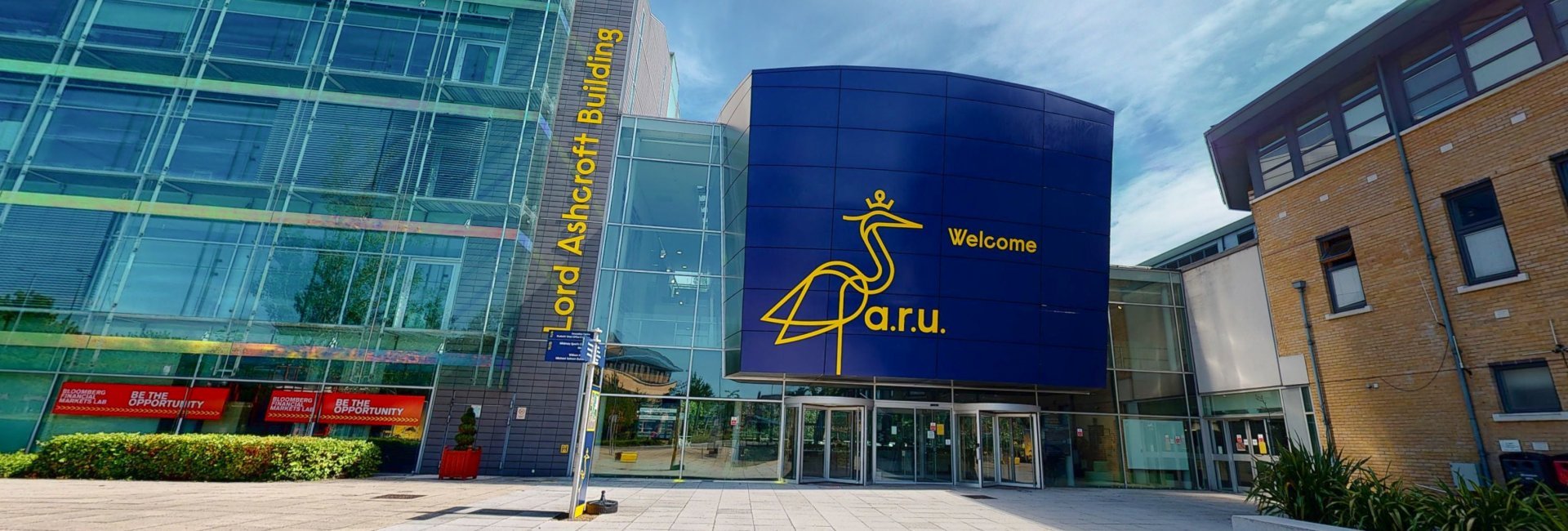
Anglia Ruskin University - Undergraduate Open Day - Cambridge
6 Jun 2026, 09:00
Cambridge

Explore how literature has reflected and influenced different societies over the centuries and prepare for many careers – some you might not even have thought about yet – on our BA (Hons) English Literature degree in Cambridge.
You’ll study a range of texts, including classic literary forms such as the novel, poetry, and plays, but also theatrical performances, films, essays, pamphlets, reviews and works of critical and cultural theory, developing your ability to read and respond critically.
Studying literature - by its nature a multi-disciplinary subject - will develop your understanding of history, politics, philosophy, religion, psychology and many other subjects, as well as your understanding of the written works that have shaped our world.
Throughout the degree, you’ll have opportunities to explore topics from other creative subjects too, including writing, film and media.
Our wide range of optional modules will give you the chance to narrow your studies to interests of your choice. You might decide to learn more about a particular genre, such as crime fiction or children’s books, explore digital publishing or online journalism, or develop your own creative writing skills. You could also further improve your CV by applying for the work placement year option, studying abroad for a trimester, or learning a new language with our Anglia Language Programme.
We’ll also support you to find placements and work experience throughout the course. You can also choose to take an optional placement year or seek a placement during the course, with live briefs embedded into some modules - our students recently took part in a live brief with Metal Culture, producing critical responses and reviews for their publication In Other Words. We also run exciting projects with the National Centre for Writing, where our students work with lecturers, NCW staff and the wider community.
You’ll have many opportunities to attend co-curricular events that include interactions with writers, publishers and other professionals related to the field, which will allow you to expand your network as well as your knowledge base. Your studies will be supported by our team of expert lecturers, including several published authors, such as Course Leader Dr Cassie Gorman (The Atom in Seventeenth-Century Poetry); Dr Tory Young (Studying English Literature, a text used on many other university courses as well as our own); and Professor Eugene Giddens (Lewis Carroll’s Alice’s Adventures in Wonderland and Through the Looking-Glass: A Publishing History).
You can also attend events organised by our Cambridge Writing Centre, including guest talks and live lit jams, where you can showcase your own creative writing and make new contacts in the industry, and get feedback and support for your writing projects from our Royal Literary Fund Fellowship Scheme mentors.
Careers
Our BA (Hons) English Literature will equip you with many skills that are transferrable to a wide range of graduate occupations. These include research and communication, which lend themselves to careers close to the study of literature and writing such as journalism and teaching, while the course’s emphasis on critical thinking and independent learning will transfer to professions including (but not limited to) business, law, consultancy, administration, librarianship, publishing and arts management.
You’ll develop a range of intellectual, research-based and practical skills that will give you the vital combination of flexible thinking and transferable expertise required for the 21st century workplace.
Throughout the course, you’ll receive reflexive peer and tutor support with our Personal Development Tutoring (PDT) programme, while your core modules at every level will include built-in Employability sessions. Live Briefs will give you opportunities to devise solutions for real-world industry professionals, giving you both work experience and potential connections for your career.
Year 1 core modules: Introduction to the Study of Literature and Writing; Myth, Miracle and Magic; Reading Critically, Old English to Enlightenment; The History of the Novel; How Texts Work. Year 2 core modules: Ruskin Module; Nineteenth Century Literature and the Environment; Crocodiles, Pirates and Moon-men: Renaissance Encounters; From Modernism to the Millenium. Year 2 optional modules: Nineteenth Century Afterlives and Adaptations; Professional Placement; Online Journalism; Science Fiction; Performing Shakespeare; Film Criticism and Reviewing; Digital Stylistics; Writing Creative Non-Fiction; Cult Media; Anglia Language Programme. Year 3: Placement. Year 4 core modules: Spectacle and Representation in Renaissance Drama; Writing and the Present; Undergraduate Major Project in English. Year 4 optional modules: New Media Discourse; Literature and Exile: Displacement, Identity, Self; Crime and Detective Fiction; Renaissance Magic; Writing Poetry; Research Communication; Communication, Flesh, Philosophy; The Making of Modern Media; Forbidden Stories: Banned Children's Books; Life Writing; Film Journalism; Gender and Sexuality in Britain: 1880-2000; Anglia Language Programme. Modules are subject to change and availability.
We’ll assess your progress using a combination of critical reflection, essays, portfolios, reviews, oral presentations, exams and discussion boards, as well as your final-year Major Project.
This is the equal consideration deadline. You can still apply after this date, but your application may not receive guaranteed consideration.

Anglia Ruskin University has participated in the Teaching Excellence Framework. These ratings were awarded in 2023, for four years.
See why these ratings were awarded
What does this TEF outcome mean?
The following entry points are available for this course:
We accept A Levels, T Levels, BTECs, OCR, Access to HE and most other qualifications within the UCAS Tariff.
3 GCSEs at grade C, or grade 4, or above.
Find out more about qualification requirements for this course.
ARU operates a policy of making contextualised offers for this course which may be a reduced conditional offer or an unconditional offer, using data from UCAS to make our assessment. We consider that this approach promotes the equality of educational opportunity for applicants from low participation groups in HE. ARU welcomes students from diverse backgrounds and helping them achieve their full potential. The offer of a place through the contextual offer process is at the discretion of ARU.
This section shows the range of grades that students who received offers were previously accepted on to this course with (learn more).
It is designed to support your research but does not guarantee whether you will or won't get a place.
Admissions teams consider various factors, including interviews, subject requirements, and entrance tests. Check all course entry requirements for eligibility.
We are unable to show previous accepted grades for this course. This could be because the course is new, it's a postgraduate course, there isn't enough historical data, or the provider has opted out of sharing their entry grades data for this course - learn more.
| Location | Fee | Year |
|---|
Tuition fee status depends on a number of criteria and varies according to where in the UK you will study. For further guidance on the criteria for home or overseas tuition fees, please refer to the UKCISA website.
In the 2025/26 academic year, the placement year fee will be £1,500.
https://www.aru.ac.uk/student-life/support-and-facilities/careers-and-employability/placements
https://www.aru.ac.uk/study/tuition-fees
https://www.aru.ac.uk/student-life/preparing-for-study/help-with-finances
Email:answers@aru.ac.uk
Phone:01245 68 68 68
East Road
Cambridge
CB1 1PT
At Anglia Ruskin University