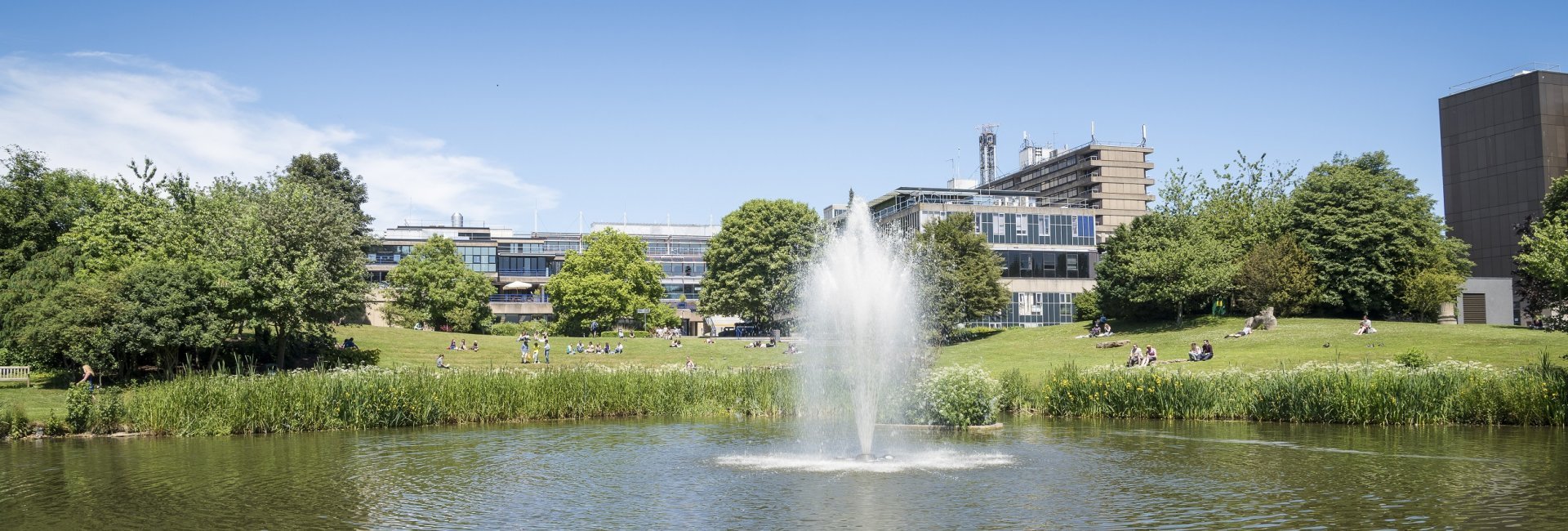
University of Bath - open day event
12 Jun 2026, 08:30
Bath

Develop your biomechanics, physiology and psychology knowledge. Explore and understand how humans function in sport, physical activity and health environments.
This degree has three core strands:
Biomechanics: explore how humans create and control movement including athletes’ technique
Physiology: learn about the structure, function, regulation and performance of bodily systems
Psychology: examine the role of thoughts, feelings and behaviours in sport and exercise settings
Through these core strands, you'll apply your knowledge to sports performance and exercise participation. This will develop your understanding of the relevance of sport and exercise science to current practice.
Along with the core study of biomechanics, physiology and psychology, examples of other topics you will cover include:
-biochemistry
-motor control
-nutrition and metabolism
-research methods
-sports medicine
-strength and conditioning
In Year 1, you'll develop your functional anatomy knowledge and link it to basic concepts of biomechanics. You’ll build on your understanding of human physiology and psychology, and their application to sport and exercise. You will also develop your skills in research design and statistics.
Through Year 2, you'll advance your knowledge of biomechanics and psychology, and explore the impact of nutrition on sport, exercise and health. You’ll apply your biomechanics, physiology and psychology knowledge in the context of sport and exercise medicine, and develop practical skills that relate to sport and exercise science data collection and interpretation.
BSc route
In your final year, you'll design and carry out a year-long research project and study in-depth issues in sport and exercise science. You’ll also be able to tailor your profile towards specific disciplines and choose an area of interdisciplinary study.
MSci route
In your final two years, you will design and carry out an extended, independent research project and study advanced units covering key topics in sport and exercise science at master’s level. You’ll also be able to tailor your profile towards specific disciplines and choose an area of interdisciplinary study.
This is the equal consideration deadline. You can still apply after this date, but your application may not receive guaranteed consideration.

University of Bath has participated in the Teaching Excellence Framework. These ratings were awarded in 2023, for four years.
See why these ratings were awarded
What does this TEF outcome mean?
The following entry points are available for this course:
Typical offer:
AAA or A*AB in three A levels including A in one of: Biology, Chemistry, Further Mathematics, Mathematics, Physics, Psychology or Statistics.
Contextual offer:
ABB in three A levels including B in one of: Biology, Chemistry, Further Mathematics, Mathematics, Physics, Psychology or Statistics.
Alternative offers with additional study:
AAB in three A levels including A in one of: Biology, Chemistry, Further Mathematics, Mathematics, Physics, Psychology or Statistics plus additional study - please see the course pages on our website
We are able to consider the following BTEC Level 3 National Extended Diplomas (RQF):
DDD in the BTEC Level 3 National Extended Diploma (RQF) in Sport and Exercise Science. You must be studying and achieve a Distinction in at least two of the following units: 1, 2, 3, 5 or 7.
DDD in the BTEC Level 3 National Extended Diploma (RQF) in Applied Science.
DDD in the BTEC Level 3 National Extended Diploma (RQF) in Health and Social Care (Health Studies). You must be studying and achieve a Distinction in least two of the following units: 3, 11, 13 or 24.
If you are studying towards a BTEC qualification in Sport or another subject-area, we are only able to consider an application from you if you are also studying an A level in Biology, Chemistry, Further Mathematics, Mathematics, Physics, Psychology or Statistics. You may also wish to consider our Sport Management and Coaching or Health and Exercise Science courses.
We prefer you to have achieved grade 6 or B in GCSE English, Maths and science qualifications.
36 credits at Distinction
A pass in the Access to HE Diploma with at least 36 credits achieved at Distinction and 3 credits achieved at Merit or above. This must include at least 12 credits achieved at Distinction in a science subject.
We are able to consider the Access to HE Diploma for entry. You should be studying at least 12 credits (preferably more) in at least one science subject (Biology, Chemistry, Further Mathematics, Mathematics, Physics, Psychology or Statistics).
AA in two Advanced Highers including one science or mathematics subject.
Psychology is accepted as a science subject for this course.
We make offers based on Advanced Highers. You will typically be expected to have completed five Scottish Highers and your grades in these will be considered as part of your application. We prefer applicants who have achieved at least AAAAB in their Highers.
Typical offer:
36 points overall and 6, 6, 6 or 7, 6, 5 in three Higher Level subjects including 6 in one science or mathematics subject.
We accept the following Higher Level science or mathematics subjects for this course:
Biology
Chemistry
Mathematics: Analysis & Approaches or Applications & Interpretations
Physics
Psychology
Sports, Exercise and Health Science
If you are not studying one of these subjects at Higher Level we may be able to consider a Standard Level subject in its place. In this case the typical offer is 36 points with 6, 6, 5 in three Higher Level subjects plus 7 in one Standard Level science or mathematics subject. We cannot consider Standard Level Mathematics: Applications & Interpretations in place of a Higher Level science subject.
Contextual offer:
36 points overall and 6, 5, 5 in three Higher Level subjects including 5 in one science or mathematics subject.
We accept the following Higher Level science or mathematics subjects for this course:
Biology
Chemistry
Mathematics: Analysis & Approaches or Applications & Interpretations
Physics
Psychology
Sports, Exercise and Health Science
GCSE requirements
GCSE Mathematics grade 4 or C
GCSE in one of Combined Science, Biology, Chemistry or Physics grade 4 or C
GCSE English Language or Literature grade 4 or C
You do not need the required grade in Mathematics or a science GCSE if you study a higher level qualification in that subject (such as an A level, AS level or a Core Mathematics qualification).
This section shows the range of grades that students who received offers were previously accepted on to this course with (learn more).
It is designed to support your research but does not guarantee whether you will or won't get a place.
Admissions teams consider various factors, including interviews, subject requirements, and entrance tests. Check all course entry requirements for eligibility.
We are unable to show previous accepted grades for this course. This could be because the course is new, it's a postgraduate course, there isn't enough historical data, or the provider has opted out of sharing their entry grades data for this course - learn more.
No fee information has been provided for this course
Tuition fee status depends on a number of criteria and varies according to where in the UK you will study. For further guidance on the criteria for home or overseas tuition fees, please refer to the UKCISA website.
Home (UK) fees for 2026/27 have not yet been confirmed and are subject to parliamentary approval.
For information on tuition fees visit our web pages: https://www.bath.ac.uk/topics/tuition-fees/
For information about our scholarships and bursaries visit: https://www.bath.ac.uk/topics/undergraduate-scholarships-bursaries-and-other-funding/
Email:admissions@bath.ac.uk
Phone:01225 383019
Claverton Down
Bath
BA2 7AY
At University of Bath