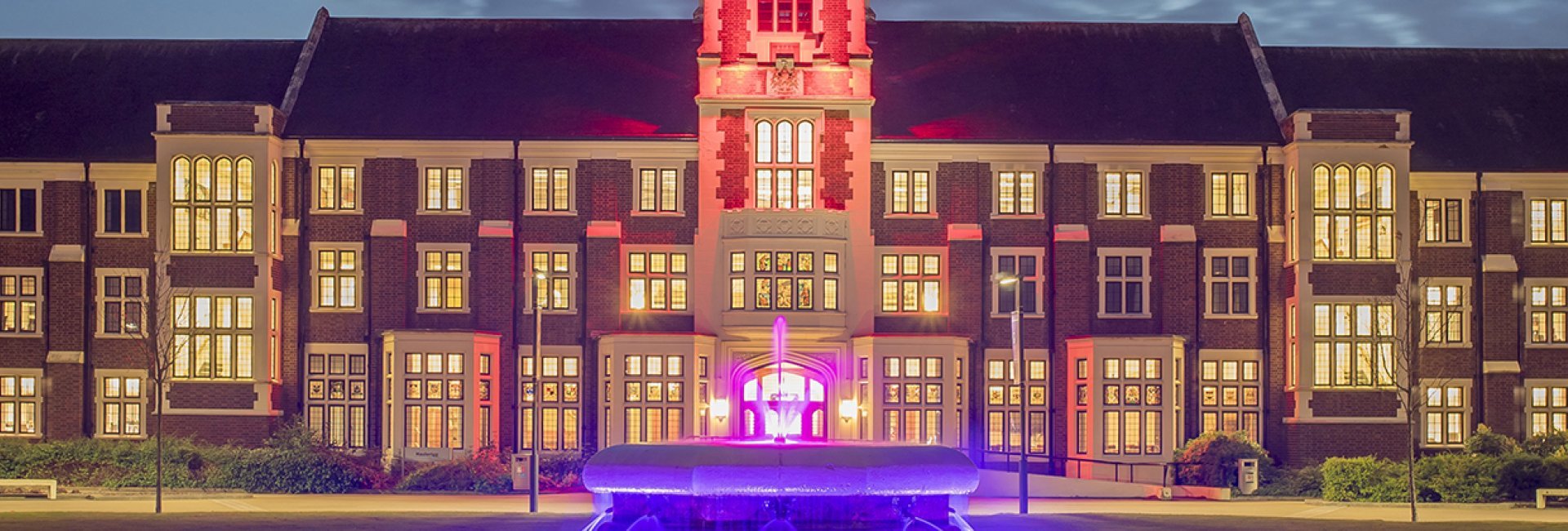
Loughborough University
Loughborough
LE11 3TU
Visit our website Visit our course page
Course contact details
Undergraduate Admissions Office
Email:admissions@lboro.ac.uk
Phone:01509 274 403

This BSc degree course in pure chemistry opens up the fascinating world of chemistry, providing you with plenty of hands-on practical experience and flexible module choice - taught in our outstanding state-of-the-art laboratory facilities.
Chemistry powers many aspects of our lives, from the clean water we drink to the air we breathe. The materials we use in our everyday lives, much of the food we eat, and the energy that runs our homes, schools and workplaces we owe to the work of chemists. Chemistry is a vibrant, fascinating subject that enhances our understanding of the natural and physical world and often provides the key to solving global challenges. This is why chemistry students can go on to make a real difference in the world, tackling issues like climate change, hunger and disease.
At Loughborough, our BSc (Hons) degree in Chemistry provides a comprehensive study of the subject with the opportunity to tailor the course in your final year through a range of optional modules. Throughout your undergraduate studies you will gain practical hands-on experience in our state-of-the-art STEMLab facilities - gaining highly developed lab skills in the process.
As your knowledge of chemistry grows, you will also develop analytical and problem-solving skills that have value in a wide variety of employment contexts. Our placement scheme gives you the opportunity to gain highly sought-after workplace experience and apply what you have learnt in a real job with real responsibilities, often working with major companies and organisations (for example, GlaxoSmithKline, RB, Lubrizol, and Pirelli). You could also broaden your horizons with a year studying abroad.
Our Department of Chemistry prides itself on offering our students high levels of pastoral support, a peer-mentoring scheme, and the compelling insights of our renowned academic staff, many of whom are active in research with far-reaching impact.
In Years 1 and 2 the main areas of inorganic, organic and physical chemistry form the backbone of the BSc Chemistry degree, with additional modules in spectroscopy, analytical chemistry, and mathematics. Laboratory classes, workshops and seminars support these lectures. After Year 2, the development of core chemistry continues along with optional topics which include drug synthesis and action, advanced analytical research methodologies, energy and equilibria, and inorganic chemistry.
In the final year of your Chemistry degree you will study research techniques and methods that are complemented with further advanced modules in chemistry. Two investigative projects, often working in teams, are undertaken - building your research skills and team working abilities.
What's the difference between MChem and BSc?
Both the Chemistry BSc (Hons) degree and the Chemistry MChem (Hons) degree are orientated towards the practice of chemistry in the world outside the University. Our 3 (or 4 year sandwich) BSc equips you for employment in chemistry, scientific and other sectors. The 4 (or 5 year sandwich) MChem is suited for students who may wish to pursue a PhD or a career in industrial research.
For a full list of areas studied, see the 'What You'll Study' section of the course page on our website.
You are assessed by examination and coursework. Depending on the module, coursework may include written laboratory reports, oral presentations, poster presentations, research papers, peer review and dissertations.
Your BSc degree classification will be determined by the weighted average of marks obtained in Years 2 and 3 in the ratio 40:60.
Professionally accredited courses provide industry-wide recognition of the quality of your qualification.
This is the equal consideration deadline. You can still apply after this date, but your application may not receive guaranteed consideration.

Loughborough University has participated in the Teaching Excellence Framework. These ratings were awarded in 2023, for four years.
See why these ratings were awarded
What does this TEF outcome mean?
The following entry points are available for this course:
Loughborough accepts a wide range of qualifications for entry as outlined on our website www.lboro.ac.uk/study/undergraduate/getting-started/applying/entrance-requirements/
This information details the general requirements and should be read in conjunction with the information given for each course.
Loughborough also accepts a wide range of international qualifications for entry as outlined on our website www.lboro.ac.uk/international/applicants/country/
Loughborough uses contextual data in the admissions process to provide insights into the context in which your academic qualifications have been achieved. This may influence the typical offers outlined in the information given for each course. www.lboro.ac.uk/study/undergraduate/getting-started/applying/contextual-data/
Find out more about qualification requirements for this course.
All applicants are required to demonstrate that they have an appropriate level of English language. For full details of the acceptable English language requirements see our website. http://www.lboro.ac.uk/international/applicants/english/
We consider contextual information as part of the assessment of an application to provide us with further insight into your achievements. This may lead to reduced offers, up to two grades lower than the typical offer requirements, as well as additional consideration when your results are received. For further information about Contextual Admissions at Loughborough including our Access Loughborough Contextual Offer please visit our website.
This section shows the range of grades students (with UK A-Levels or Pearson BTEC Level 3 National Extended Diplomas) who received offers were previously accepted with (learn more). It is designed to support your research but does not guarantee whether you will or won't get a place. Admissions teams consider various factors, including interviews, subject requirements, and entrance tests. Check all course entry requirements for eligibility.
We are unable to show previous accepted grades for this course. This could be because the course is new, it's a postgraduate course, there isn't enough historical data, or the provider has opted out of sharing their entry grades data for this course - learn more.
| Location | Fee | Year |
|---|
Tuition fee status depends on a number of criteria and varies according to where in the UK you will study. For further guidance on the criteria for home or overseas tuition fees, please refer to the UKCISA website.
The fees stated above are for the 2025/26 academic year; fees for 2026/27 have not yet been confirmed by the UK government. We will update this information as soon as it is available. Fees are reviewed annually and are likely to increase to take into account inflationary pressures.
Costs that are not included in tuition fees include textbooks and stationary. Protective clothing (including a lab coat and safety glasses) are provided.
UK tuition fees align with the applicable fee caps set by the UK government, and as such they are subject to changes made to the agreed cap in a specific year.
Loughborough
LE11 3TU
Visit our website Visit our course page
Email:admissions@lboro.ac.uk
Phone:01509 274 403
At Loughborough University