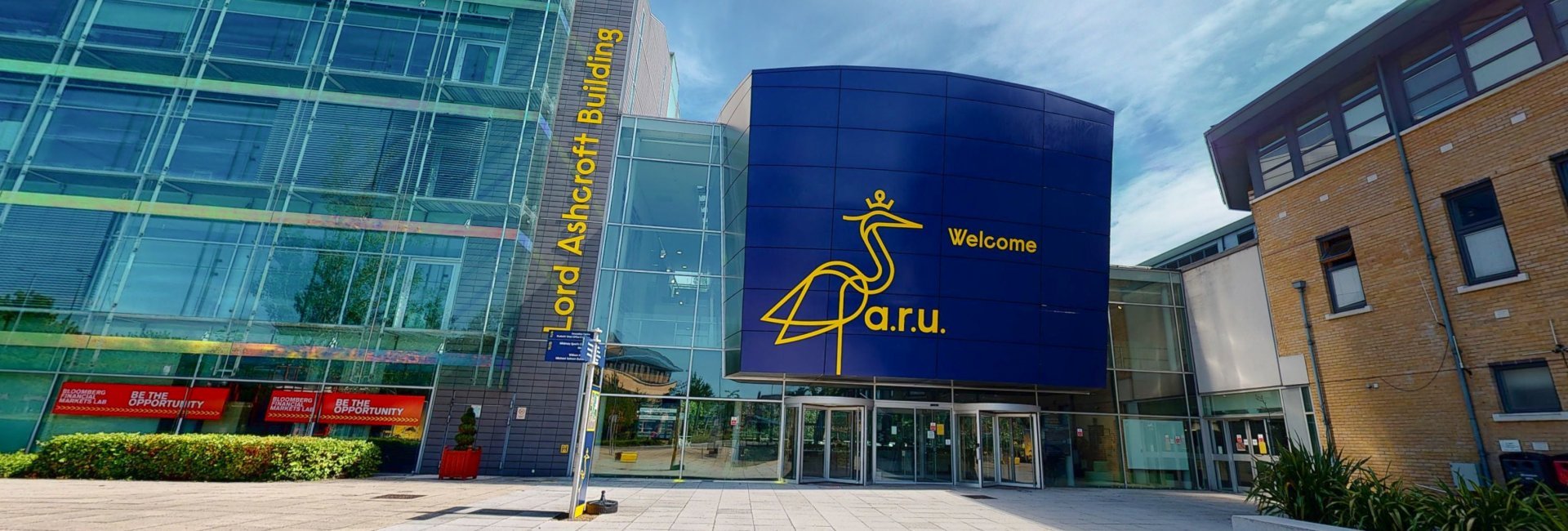
Anglia Ruskin University - Undergraduate Open Day - Cambridge
6 Jun 2026, 09:00
Cambridge

Whether you want to use your communication skills in the media or in the boardroom, our degree course will give you a thorough understanding of how the English language works and how it reflects the most important issues of our times.
Join a course ranked 11th in the UK in the Guardian University Guide 2024, and 7th in the UK for student satisfaction in the Complete University Guide 2023.
Explore the power of the English language in communication, and how it expresses and reflects crucial global issues such as ideologies, culture wars, conflict, social justice, equality, diversity, inclusion, and sustainability.
Our core modules will give you a broad, interdisciplinary introduction to language and communication, including its psychology and social and cultural impact, and giving you the skills to deconstruct, critically analyse and research texts from many different fields, including media, politics, advertising, and even laboratory experiments.
You can then use and further develop these skills while exploring your own areas of interest on our optional modules, including digital media, online journalism, youth culture and podcasting, preparing you for many possible careers in the modern digital world.
The modern world is ever-changing, thanks to continual technological and cultural developments, and the English language is changing with it, becoming even more globally-used and more relevant to many new areas of work. Our course recognises this, giving you the skills and understanding that you’ll need in the English language and its use in communication across many emerging areas of work as well as more traditional ones.
By learning to systematically identify, describe and analyse spoken and written language phenomena, and critically evaluate the role it plays in shaping sociocultural norms, identities and realities in a range of public and private domains, as well as in relation to globalisation, mobility, sustainability and social justice, you’ll be ready to take on work in the world of politics, business and the media - or even as a social media influencer.
You’ll also pick up the all-important transferable skills that will further your opportunities in whichever field you choose to work, including problem solving, researching, creative thinking, persuasive writing techniques, rigorous examination of evidence, computer and digital skills, teamwork, and communication (including discussion and delivery of presentations to a range of academic, public and professional audiences).
Cambridge has a range of vibrant business and industry sectors, ranging from major publishing houses to technology companies, all of which require graduates with strong communication and analytic skills. With over 30 English language schools, Cambridge is the perfect place to study English. Our business and industry partners provide opportunities for live briefs, placements and volunteering positions, they also give you a vital network for your future employment and projects. If you’re interested in teaching English, you might also be able to take up part-time work with them, and further develop your skills at the same time.
Our team of expert lecturers will support you throughout your time at ARU, including Dr Vahid Parvaresh (co-author, Elastic Language in Persuasion and Comforting: A Cross-Cultural Perspective), Dr Bettina Beinhoff (Perceiving Identity through Accent – Attitudes towards Non-Native Speakers and their Accents in English), and Dr Sebastian Rasinger (co-author, The Cambridge Introduction to Intercultural Communication).
Year 1 Core modules: Foundation in Humanities, English, Media, Social Sciences and Education. Year 2 Core modules: Psychology of Communication; Deconstructing Communication; How Texts Work; Language, Communication and Society; Psychology of Language; Into ARU. Year 3 Core modules: Bridging Cultures; Digital Stylistics; The Research Toolkit: Design and Delivery; Ruskin Module. Year 3 Optional modules: Key Paradigms 2: Sociology and Politics; Woke Wars; Digital Media Theory: Social Media, AI, and the Cultures of the Internet; Online Journalism; Professional Placement; Sounds and Communication; Cult Media; Anglia Language Programme. Year 4 Core modules: Undergraduate Major Project in English Language, Linguistics; New Media Discourse; Research Communication. Year 4 Optional modules: Communication Disorders; Prejudice and Ideologies; Cultural Politics of Celebrity; Hitler to the Hashtag: Political Communication in Peace and War; Race, Racism and Ethnic Identity; Key Paradigms 3: International and Global Perspectives in Education; Language and the Law; Communication, Flesh, Philosophy; The Making of Modern Media; Film Journalism; Digital Methods; Anglia Language Programme. Modules are subject to change and availability.
We’ll assess you using a range of methods, including essays, exams, oral presentations, portfolios, practical work, and your third-year Major Project.
This is the equal consideration deadline. You can still apply after this date, but your application may not receive guaranteed consideration.

Anglia Ruskin University has participated in the Teaching Excellence Framework. These ratings were awarded in 2023, for four years.
See why these ratings were awarded
What does this TEF outcome mean?
The following entry points are available for this course:
Find out more about qualification requirements for this course.
| Test | Grade | Additional details |
|---|---|---|
| IELTS (Academic) | 5.5 | With minimum 5.5 in each component |
This section shows the range of grades that students who received offers were previously accepted on to this course with (learn more).
It is designed to support your research but does not guarantee whether you will or won't get a place.
Admissions teams consider various factors, including interviews, subject requirements, and entrance tests. Check all course entry requirements for eligibility.
We are unable to show previous accepted grades for this course. This could be because the course is new, it's a postgraduate course, there isn't enough historical data, or the provider has opted out of sharing their entry grades data for this course - learn more.
| Location | Fee | Year |
|---|
Tuition fee status depends on a number of criteria and varies according to where in the UK you will study. For further guidance on the criteria for home or overseas tuition fees, please refer to the UKCISA website.
https://aru.ac.uk/student-life/preparing-for-university/help-with-finances/undergraduate
Email:answers@aru.ac.uk
Phone:01245 68 68 68
East Road
Cambridge
CB1 1PT
At Anglia Ruskin University